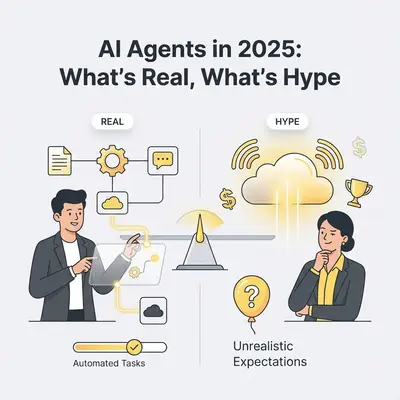
Plenty of AI agent pilots never reach production, and that gap is where hype and production reality part ways. As a decision-maker evaluating investments, you need facts: what delivers ROI today, what breaks in the wild, and how to plan without overcommitting.
This deep dive draws from industry surveys, expert analyses, and real deployments to separate signal from noise. We'll cover proven capabilities, experimental edges, failure modes, required skills/tooling, and SMB-specific strategies. If you're weighing agents for automation, this framework helps you decide where they fit—and where they don't.
Quick Win: Focus agents on "narrow autonomy"—tasks with defined tools and goals, like lead triage—where the tool boundary is clear and a wrong step is cheap to catch.
What Actually Works Today in AI Agents
By late 2025, AI agents moved beyond pilots in structured domains, delivering measurable value when scoped tightly. Agents aren't yet "digital employees," but they handle multi-step processes reliably in controlled environments.
Key working capabilities:
-
Data Analysis and Insights: Agents like Uber's financial tools parse datasets, run queries, and generate reports. In SMBs, this means automating weekly sales forecasts: an agent pulls CRM data, applies basic models, and emails summaries—saving 5-10 hours weekly for a 10-person team.
-
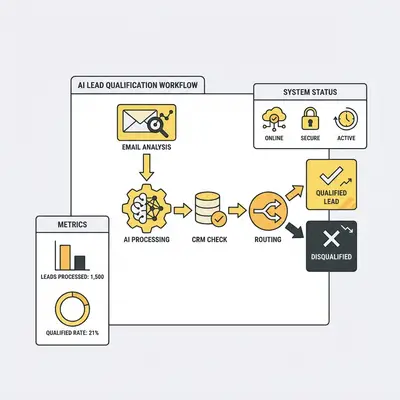
Lead Qualification and Routing: Platforms like Salesforce integrate agents to score inbound leads via email analysis and CRM checks. For example, an agent classifies intent (hot/cold), assigns reps, and schedules calls if thresholds met, so a hot lead gets a response while it is still hot. For a practical guide on getting started, see our introduction to AI agents.
-
Routine Customer Support: Delivery Hero's agents build knowledge bases on-the-fly, answering queries with inventory pulls. In practice, agents resolve 40-60% of tier-1 tickets autonomously, escalating complex ones—reducing response times from hours to minutes.
-
Inventory and Supply Chain Optimization: Ecommerce agents monitor stock via APIs, predict shortages based on sales trends, and trigger reorders. For more on automation workflows, see our guide on automation workflow optimization.
These successes share traits: clear objectives, reliable tools (APIs/databases), and human oversight gates. Industry analysts note agents reaching maturity in 2025 for enterprise use, with 45% of large firms deploying them in ops.
Reality Check: Agents work best as "co-pilots" in workflows, not standalone. Overpromising full autonomy leads to the 93% failure rate seen in pilots.
What’s Still Experimental or Brittle in 2025
Despite progress, many hyped features remain lab curiosities—prone to brittleness in real-world variability. Industry analysis suggests "full autonomy" is 3-5 years away, with current agents struggling beyond narrow scopes. For technical details, see IBM's overview on AI agents.
Brittle areas include:
-
Long-Term Planning and Adaptation: Agents falter in dynamic scenarios, like multi-week project management. One missed piece of context derails the whole chain: an agent misreads a market shift in supply planning, and every step after it inherits the error.
-
Ethical and Nuanced Decisions: Handling ambiguity, like privacy compliance or bias mitigation, is unreliable. Without explicit safeguards, an agent will carry the biases in its training data straight into the decision instead of flagging the ambiguity.
-
Unstructured Environments: Web scraping or ad-hoc data sources lead to hallucinations, causing agents to stall when inputs are inconsistent.
-
Scalability in High-Volume Ops: At scale, latency spikes—Deep Think modes take 10-15 seconds per step, per Google benchmarks, making them impractical for real-time apps.
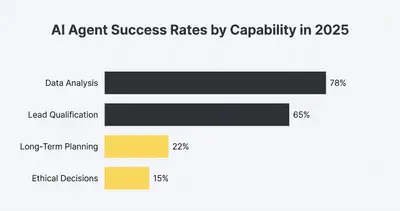
Experimental pilots, like Microsoft's Azure AI agents for open web tasks, show promise but high error rates (15-25%). Industry research advises treating these as R&D, not core bets—only 22% of surveyed firms saw ROI from advanced agents. For business impact analysis, see BCG's report on AI agents' business impact.
Pro Tip: Test brittleness with "adversarial scenarios"—inject noise like incomplete data—and measure recovery rates before production.
To visualize adoption gaps:
Common Failure Patterns in Production Deployments
2025 saw widespread agent trials, and most of them never made it out of pre-production. These aren't LLM flaws but systemic issues in design and integration.
Top patterns:
-
Integration Gaps: Agents lack an "OS"—failing at tool handoffs, like mismatched schemas causing silent errors.
-
Error Handling Deficiencies: Cascading failures amplify: a failed tool call loops indefinitely without schema-driven prompts and retries in place.
-
Context Dilution Over Time: In long threads, agents forget rules—diluting instructions by turn 20+.
-
Over-Scoping Ambition: Hyped as "autonomous," agents break on variability. Overpromising at the pilot stage is what gets a project quietly shelved afterwards.
-
Bias and Hallucination Propagation: Without audits, agents compound errors—e.g., biased lead scoring.
Mitigation? Start with allowlists and human-in-loop for 20% of decisions.
Key Insight: Failures cluster in "uncharted territory"—novel inputs. Route 10-15% of cases to humans via confidence scores to hit 80% reliability.
For a breakdown:
| Failure Pattern | Prevalence (2025 Surveys) | Primary Cause | Mitigation Strategy |
|---|---|---|---|
| Integration Gaps | 40% | API/Schema Mismatches | Tool Contracts & Testing |
| Error Cascades | 35% | Poor Handling | Retries & Fallbacks |
| Context Dilution | 25% | Long Interactions | State Management |
| Over-Scoping | 60% (Post-Pilot) | Hype-Driven Design | Narrow Pilots |
| Bias Propagation | 30% | Unaudited Outputs | Regular Audits |
If you're hitting these walls, a structured audit can identify fixes—book a free AI agent review to map your stack.
Essential Skills and Tooling for Building Reliable Agents
Building agents in 2025 demands a mix of technical and strategic skills—far beyond "prompt hacking." Industry experts outline key competencies for managing the "AI workforce," while tools evolve to simplify deployment.
Core Skills:
-
Prompt Engineering and Tool Design: Craft schemas for reliable interactions. Anthropic emphasizes "prompt engineering your tools"—defining inputs/outputs tightly.
-
Data Management and Integration: Handle retrieval, databases, and APIs. Skills in RAG (Retrieval-Augmented Generation) are what let an agent answer from your data rather than from its training set.
-
Ethical AI and Governance: Audit for biases, ensure compliance. Decide before launch who reviews an agent's decisions and how often.
-
System Architecture: Design for modularity—e.g., multi-agent teams for specialization. BCG recommends categorizing skills: search, planning, execution.
-
Monitoring and Iteration: Use analytics to track failures. Skills in A/B testing agents are key, as stacks churn quickly.
Tooling Landscape:
-
Frameworks: LangChain for orchestration, UiPath for enterprise workflows—supporting schema-driven builds.
-
Platforms: Microsoft Azure AI Foundry for customization, Anthropic for effective agents with built-in safeguards.
-
Specialized Tools: Composio for integrations, Retool for SMB-friendly agents—focusing on security and governance.
Best practices stress starting with use cases, then tools—e.g., database queries for data agents. For SMBs, no-code options lower barriers, but custom needs require dev skills. For workflow automation basics, see our step-by-step automation guide.
Pro Tip: Budget 30-50% of project time for testing—use adversarial datasets to simulate production failures.
If scaling agents sounds daunting, our team can help prototype—schedule a demo for tailored tooling advice.
Realistic Planning for SMBs: Where to Start and What to Expect
For small businesses, 2025's agent landscape offers accessible entry points—but success hinges on realism.
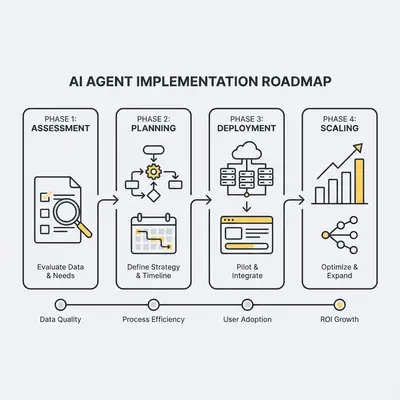
Step-by-Step Plan:
-
Assess Readiness (Week 1-2): Audit data quality and integrations, and ensure CRM/email APIs are stable before piloting.
-
Pilot Narrow Use Cases (Month 1): Start with one agent, like support ticket triage, using an established platform (e.g., Salesforce AI) suited to SMBs.
-
Set KPIs and Guardrails (Month 2): Track ROI via time savings/conversion lifts. Include human escalation for 20% of cases. Salesforce reports that 78% of growing SMBs plan to increase their AI investment.
-
Iterate and Scale (Months 3-6): Add agents for leads/inventory. Budget $5k-20k initial—industry projections show the global agent market growing significantly through 2030.
-
Monitor Risks: Plan for biases/hallucinations with audits. McKinsey advises "superagency"—empowering humans with agents, not replacing.
Expectations: 2-4 months to ROI for pilots, with 20-40% efficiency. Avoid hype: Agents augment, not automate fully - adapt use cases to your niche.
Key Insight: SMB winners treat agents as tools in existing stacks—integrate with Google Workspace or QuickBooks for quick wins.
Ready to plan your agent rollout? Book a strategy session to align with your ops.
Key Takeaways and Your Next Step
In 2025, AI agents delivered on structured automation but fell short of full autonomy—success rates climb with narrow scopes, robust tooling, and realistic plans. Connect back to the opening: While hype promised revolution, reality rewards pragmatism—focusing on data/lead agents yields 20-40% gains without the pitfalls.
Next steps: Audit your ops for agent-fit tasks, pilot one use case, and measure against baselines.
For hands-on help building reliable agents tailored to SMB constraints, book a demo with Evalics—we'll map a low-risk path to production value.
By Kevin Michael Schindler, AI Automation Expert at Evalics.