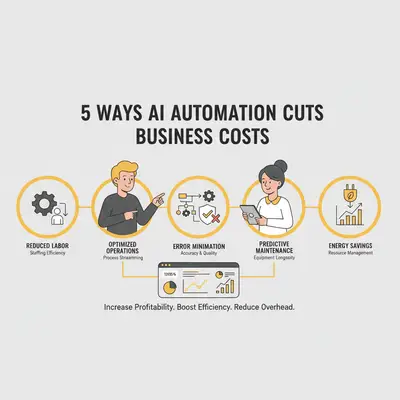
AI automation is transforming how businesses save money by streamlining tasks, reducing errors, and optimizing resources. Here's how companies are cutting expenses while increasing efficiency:
- Eliminating Manual Tasks: Automating repetitive work like data entry and invoice processing reduces labor costs and speeds up operations.
- Reducing Errors: AI minimizes costly mistakes in tasks like financial reporting and quality control, saving time and money.
- Improving Resource Allocation: Smarter forecasting ensures businesses avoid overstaffing, stock shortages, or excess inventory.
- Speeding Up Processes: AI accelerates workflows, reducing delays and improving productivity without increasing labor costs.
- Simplifying Compliance: Automated systems handle regulatory updates and reporting, cutting the risk of fines and lowering oversight expenses.
With solutions like Evalics, businesses are achieving faster returns on investment by automating key areas, reducing operating costs, and staying competitive in a challenging market.
AI Agency Owner Rates Every AI Automation He's Ever Made
1. Eliminating Labor-Intensive Manual Tasks
Manual tasks eat up valuable time and resources that could be better spent on strategic priorities. AI automation steps in to take over these repetitive processes, traditionally handled by human workers. The result? Lower costs and a foundation for greater efficiency.
Cost Savings Potential (USD)
Automating tasks like data entry can lead to substantial savings in salaries, benefits, and overhead. For example, companies that automate data entry processes can save a significant amount per employee each year. Similarly, manual invoice processing, which often involves time-consuming tasks like error correction and approvals, racks up high operational costs. AI-powered systems streamline these workflows, cutting down expenses for businesses managing large invoice volumes.
Customer service is another area ripe for automation. AI chatbots and virtual assistants handle routine inquiries, reducing the workload on human agents. This not only lowers support costs but also boosts efficiency by resolving common issues more quickly.
Efficiency Improvements
AI automation doesn’t just save money - it also speeds things up. Take document processing, for instance. Tasks like extracting key details from contracts or purchase orders are completed far faster with AI than through manual reviews. Similarly, scheduling and appointment management benefit from AI systems that efficiently juggle time zones, availability conflicts, and rescheduling requests without the delays of human coordination.
Routine tasks like generating reports can also be automated. Whether it’s creating financial reports, performance dashboards, or compliance documentation, AI enables quicker output, freeing up capacity for higher-value work.
Practical Business Applications
The efficiency gains from automation have a direct impact on day-to-day business operations:
- Accounts Payable: AI systems can scan invoices, extract critical data, and route them for approval, reducing the need for manual data entry and speeding up processing times.
- Human Resources: Automation tools can screen resumes and conduct initial candidate assessments, allowing recruiters to manage more applications while maintaining consistent evaluations.
- Inventory Management: AI monitors stock levels, calculates reorder points, and communicates with suppliers, improving accuracy and reducing the risk of stockouts or overstock situations.
Alignment with US Market Needs
In the US, where low unemployment and rising wages make hiring for repetitive roles more challenging, automation provides a scalable solution. By minimizing the need for additional staffing, businesses can adapt to labor market constraints more effectively.
AI also simplifies compliance with US regulatory requirements. Industries often face demands for extensive documentation and reporting, whether it’s for SOX compliance, OSHA standards, or tax filings. AI systems streamline the creation of these reports, easing the workload on compliance teams and ensuring businesses meet their obligations efficiently.
2. Reducing Errors and Rework Costs
Mistakes can be expensive. They lead to delays, extra work, and reduced productivity. AI automation steps in to minimize these errors, offering consistent accuracy in areas where human efforts might fall short.
Cost Savings Potential (USD)
Errors in high-volume tasks can quickly add up to substantial costs. Take invoice processing, for example: even a small error rate can snowball into significant expenses over time. In industries like financial services, a single data entry mistake might trigger regulatory reviews, additional customer communications, or even legal fees. AI-powered tools for data validation can drastically cut down these error rates, saving money and time. Similarly, in manufacturing, mistakes in quality control can lead to costly product recalls or warranty claims - issues that AI can help prevent by ensuring greater accuracy from the start.
Efficiency Improvements
AI systems don’t tire or lose focus, which makes them ideal for repetitive tasks prone to human error. They consistently deliver precise results, whether it’s validating data, cross-referencing information, or flagging potential issues in real time. This kind of accuracy prevents errors from snowballing into larger problems, saving time that would otherwise be spent fixing mistakes. The benefits extend across departments: accounts payable teams can reconcile invoices faster, and customer support can resolve issues more efficiently, all thanks to AI’s reliability.
Practical Business Applications
AI is making a difference across industries. In healthcare, it improves coding accuracy, reducing the likelihood of claim denials. Automated inventory tracking systems in retail and supply chain management ensure stock levels are accurate, minimizing misplaced items. Even payroll systems benefit from AI, as they handle complex calculations with precision, reducing errors and ensuring compliance with regulations.
Alignment with US Market Needs
In the United States, businesses face strict regulatory requirements where errors can have serious consequences. For example, compliance with the Sarbanes-Oxley Act demands accurate financial reporting; mistakes here could lead to fines, audits, or even legal trouble. Similarly, errors in contracts, billing, or customer communications can result in costly lawsuits. By automating error-prone tasks, companies not only avoid these risks but also free up employees to focus on strategic priorities. This shift toward automation supports smoother business operations while keeping costs in check, aligning perfectly with the needs of the US market.
3. Improving Resource Allocation and Forecasting
Poor resource planning can be a financial drain. When businesses miscalculate staffing needs, inventory levels, or budget distributions, they risk overspending or missing out on growth opportunities. AI automation steps in as a game-changer, leveraging historical data to make more accurate predictions about future needs.
Cost Savings Potential (USD)
AI-powered resource allocation can significantly trim costs by reducing excess inventory and improving operational efficiency. For instance, AI-driven demand forecasting helps businesses maintain the right inventory levels - minimizing storage costs while reducing the risk of stockouts that could lead to lost sales.
Workforce planning also benefits from AI insights. Overhiring during slow periods or scrambling to recruit during busy seasons can hurt profitability. By analyzing historical data, seasonal trends, and market conditions, AI tools can predict staffing needs well ahead of time, enabling businesses to plan shifts and hiring cycles more effectively.
Budget forecasting is another area where AI excels. When financial plans are based on data-driven predictions instead of rough guesses, finance teams can allocate resources more effectively and avoid unpleasant surprises.
These cost-saving measures create a foundation for smoother, more efficient operations.
Efficiency Improvements
AI takes resource planning from being reactive to proactive. Traditional methods, like spreadsheets, often fail to capture subtle shifts in demand. AI systems, on the other hand, analyze vast datasets - sales history, market trends, economic indicators, and seasonal patterns - to produce highly detailed forecasts.
Real-time adjustments also become possible. When actual performance deviates from predictions, AI tools alert managers, allowing them to quickly update plans and avoid waste caused by outdated strategies.
AI also helps unify resource allocation across departments. By factoring in the interconnected nature of business operations, it identifies opportunities to reassign resources more effectively across the organization.
Practical Business Applications
The practical benefits of AI forecasting are clear and measurable. For example, in supply chain management, AI analyzes supplier reliability, transportation costs, and demand trends to recommend cost-effective sourcing and distribution strategies. This might involve setting optimal order quantities, timing purchases to capitalize on better pricing, or selecting suppliers based on both cost and performance.
Energy management in commercial spaces and manufacturing facilities also sees improvements. AI tools predict energy usage patterns, optimizing schedules based on factors like building occupancy, weather conditions, and energy pricing. This helps businesses cut utility costs while maintaining operational efficiency.
Marketing budgets benefit as well. AI pinpoints which channels and campaigns deliver the best return on investment, allowing businesses to focus their spending on high-performing initiatives and reduce waste on those that fall short.
Alignment with US Market Needs
Precise forecasting is especially critical for American businesses, which often face unique challenges. Seasonal demand swings, whether in retail or construction, require careful preparation. AI tools help companies anticipate these cycles and spot emerging trends that could disrupt traditional patterns.
The US labor market also presents its own set of complexities, with varying state regulations and a competitive hiring landscape. AI helps businesses fine-tune staffing strategies while ensuring they remain compliant with local labor laws.
Lastly, supply chain resilience is a growing priority for many US companies. By using AI to build more reliable and cost-efficient supply chains, businesses can achieve better financial stability and more predictable earnings - key factors in maintaining a competitive edge in today's market. This reinforces AI's critical role in reducing costs, a core focus of this discussion.
4. Speeding Up Process Execution and Workflow Efficiency
Time is money, and sluggish workflows can drain resources faster than you might think. When processes drag, labor costs rise, deadlines are missed, and valuable opportunities slip away. AI automation tackles these issues head-on by removing bottlenecks and simplifying operations that once relied heavily on manual effort. The result? Faster workflows and lower operating costs.
Cost Savings Potential (USD)
Speeding up processes doesn’t just save time - it cuts costs too. Take document processing, for example. Automating tasks like data extraction and routing eliminates the need for manual handling, saving hours of work. In customer service, AI can pre-process inquiries and route them to the right agents, ensuring faster responses and fewer delays. Over time, these efficiencies translate into measurable reductions in operating expenses.
Efficiency Improvements
AI brings speed and consistency to workflows. Traditional processes often get bogged down by delays during handoffs between departments. AI systems manage these transitions automatically, ensuring tasks move smoothly without unnecessary pauses.
Another advantage? AI works around the clock. This 24/7 capability means no need for overtime, night shifts, or costly rework due to human error. Tasks are completed quickly and accurately the first time, saving both time and money.
Practical Business Applications
AI automation isn’t just theoretical - it’s already transforming industries. In manufacturing, AI-powered assembly lines use real-time data to adjust machine settings, maximizing output. Financial services leverage AI for tasks like compliance checks and document verification, enabling faster responses to regulatory demands and market shifts. In sales, automated lead qualification ensures potential customers are quickly identified and routed to the right representatives, so no opportunity is left on the table.
Alignment with US Market Needs
In the fast-paced US market, speed and agility are non-negotiable. Businesses face rising labor costs and increasing pressure to boost productivity. AI automation helps companies meet these demands by streamlining workflows and cutting down response times. In industries like healthcare and finance, where tight deadlines and strict regulations are the norm, automated processes ensure compliance while maintaining efficiency.
AI automation isn’t just a convenience - it’s a game-changer for businesses striving to stay competitive in today’s demanding market. By improving efficiency and reducing costs, it offers a clear path to success.
5. Improving Compliance and Reducing Regulatory Costs
Navigating the maze of evolving regulations and intricate documentation can be a costly challenge for US businesses. AI-powered automation steps in to simplify these processes, helping companies manage compliance efficiently while cutting costs. This not only reduces the risk of expensive violations but also frees up resources, allowing businesses to focus on growth.
Cost Savings Potential (USD)
AI transforms compliance by automating tasks like tracking regulatory updates, monitoring transactions, and flagging issues in real time. This minimizes penalty risks and lowers labor costs. For instance, industries like finance and healthcare face hefty fines for compliance failures. By automating these processes, businesses can shift resources from manual oversight to more strategic initiatives.
Efficiency Improvements
AI ensures compliance with unmatched precision and consistency. Instead of relying on periodic audits and manual checks, AI tools continuously scan regulatory databases, adjust internal workflows, and maintain detailed audit trails. This streamlines documentation and reporting, enabling compliance officers to focus on higher-level decision-making while ensuring regulations are implemented promptly and accurately.
Practical Business Applications
AI is already making a difference across various industries:
- Banking: Automated transaction monitoring analyzes vast amounts of data to detect suspicious activities, reducing the need for large compliance teams.
- Healthcare: AI helps maintain HIPAA compliance by automating data encryption and tracking access to sensitive patient information.
- Tax Compliance: AI simplifies tax preparation by categorizing expenses, tracking deductible items, and ensuring documentation aligns with IRS standards, reducing the risk of audits.
- Manufacturing: AI analyzes sensor data from equipment and monitors environmental conditions to identify potential OSHA violations before they escalate into costly incidents.
Alignment with US Market Needs
The US regulatory environment is notoriously complex, with overlapping federal, state, and local requirements. AI provides tailored compliance solutions, applying the right protocols based on a company's location and industry. As regulations around data privacy, environmental policies, and financial transparency become stricter, AI's ability to quickly adapt to new rules becomes invaluable. For growing businesses, AI offers a scalable way to meet increasing regulatory demands without proportionally increasing staff or overhead costs.
Cost Comparison Table
The table below highlights the differences between traditional manual methods and AI automation, focusing on their impact on reducing costs and improving efficiency.
| Business Area | Traditional Approach Cost Impact | AI Automation Cost Impact | Evalics Features | ROI Timeline |
|---|---|---|---|---|
| Manual Task Elimination | High labor costs from manual processes | Lower costs through automated workflows | Sales automation, operational process automation | Fast ROI |
| Error Reduction | Significant rework and correction expenses | Reduced costs with advanced monitoring tools | Advanced analytics automation, quality control | Quick ROI |
| Resource Allocation | High costs from inefficient staffing and resource use | Optimized allocation with predictive modeling | AI-driven analytics, predictive modeling | Moderate ROI |
| Process Speed | Costly delays due to slow workflows | Faster processes with streamlined management | Operational process automation, workflow optimization | Quick ROI |
| Compliance Management | Expensive manual oversight and penalty risks | Lower costs with real-time monitoring | Compliance automation, real-time monitoring | Timely ROI |
This comparison focuses on mid-sized businesses (50–200 employees), where traditional methods often result in higher labor and operational costs. In contrast, AI automation shifts expenses toward software licensing, implementation, and maintenance - offering a more sustainable solution.
The financial benefits of AI automation vary by company size. Smaller businesses may see moderate savings, while larger enterprises typically benefit from more substantial cost reductions as efficiency improvements scale across operations.
Evalics simplifies the transition to automation, ensuring quick implementation and measurable financial returns. The platform helps businesses achieve a shorter payback period while continuing to deliver cost and efficiency advantages over time.
Conclusion: Financial Impact of AI Automation
AI automation brings a clear advantage to businesses by reducing costs in multiple ways - eliminating manual tasks, minimizing errors, using resources more efficiently, speeding up processes, and simplifying compliance efforts. Together, these changes create a powerful strategy for cutting expenses and boosting efficiency.
By automating repetitive tasks, businesses can redirect their workforce toward more strategic goals, lowering operational costs. Fewer errors mean less time and money wasted on fixing mistakes, while smarter resource allocation ensures staffing levels match actual demand. Faster processes not only reduce bottlenecks but also accelerate revenue generation. Automated compliance systems help avoid costly penalties and reduce the risk of human oversight. Additionally, replacing high labor costs with predictable software expenses leads to a more manageable and consistent cost structure. This combination of strategies not only delivers immediate savings but also lays the groundwork for ongoing financial improvements.
The return on investment (ROI) from AI automation depends on how it’s implemented. Processes like task automation and error reduction often deliver quick results, while resource optimization and compliance management build value over time. Evalics simplifies this transition by combining these automation strategies into a single, cohesive solution. This allows businesses to adopt multiple cost-saving measures at once, speeding up financial benefits while maintaining smooth operations.
Beyond the immediate savings, long-term adoption of AI automation amplifies these benefits. As systems grow more advanced, cost reductions continue to scale, giving businesses a lasting competitive edge. The initial investment in automation technology pays off through lower operational costs, increased accuracy, and greater efficiency that supports business growth. These strategies enable American businesses to achieve measurable financial success that lasts well into the future.
FAQs
How does AI automation help reduce errors in financial reporting and quality control?
AI-powered automation is transforming financial reporting and quality control by delivering precision and consistency that manual processes often struggle to achieve. These advanced systems use algorithms to process data, spot discrepancies, flag anomalies, and automatically ensure compliance with regulations - all while reducing the likelihood of human error.
In the realm of financial reporting, AI simplifies tasks such as data reconciliation, invoice management, and audit preparation. This not only minimizes costly errors but also speeds up the entire process. On the quality control side, AI can monitor production data in real time, detect defects as they occur, and even predict potential problems before they escalate. The result? Improved accuracy and consistently better product standards.
By automating these essential operations, businesses can save valuable time, lower risks, and deliver more dependable results.
What are the first steps a mid-sized business should take to successfully adopt AI automation?
To make the most of AI automation, mid-sized businesses should begin by pinpointing areas where automation can have the greatest impact. Focus on tasks that are repetitive, time-consuming, or prone to mistakes. These are often the best candidates for automation, as they can free up valuable time and reduce errors.
After identifying these areas, assess your current tools and infrastructure to ensure they can support AI-powered solutions. This might mean upgrading existing software, integrating new platforms, or providing training for employees to adapt to these tools. Starting with a small pilot project is a smart move - it allows you to test the technology, measure its performance, and gather useful insights before committing to a larger rollout.
Lastly, it’s crucial to establish clear goals and metrics to measure success. Whether it’s cutting costs, boosting productivity, or reducing errors, having specific, measurable outcomes will help you track progress and stay focused on achieving real results. This structured approach can help you maximize the benefits of AI automation while keeping risks to a minimum.
How does AI automation help US businesses stay compliant with complex regulations?
AI automation helps businesses in the US tackle the challenges of complex regulations by simplifying compliance processes. It keeps a close eye on data processing, financial transactions, and customer interactions in real time, ensuring that companies meet legal requirements without missing a beat.
By taking over tasks like creating audit trails, generating reports, and validating data, AI not only minimizes the chances of human error but also saves valuable time. This means businesses can maintain compliance more effectively while dedicating their energy to what they do best.