With 58% of businesses now integrating AI into their core operations, the primary challenge for 2025 has shifted from simple adoption to achieving rigorous model explainability. The gap between a stalled pilot and a high-ROI workflow is usually the ability to audit the 'why' behind every automated decision. By moving beyond black-box systems to implement transparent logic paths, organizations can transform AI from a risky experiment into a reliable, scalable engine for operational efficiency.
Recent data from McKinsey confirms that while 25% of business processes now rely on AI, organizations that prioritize explainability see a 30% higher rate of successful scaling. Building verification layers directly into the agent’s decision-making framework is what makes that auditability real rather than aspirational. By ensuring every automated output is traceable and compliant, we mitigate the risks of hallucination and bias, allowing your team to trust the system while capturing the full value of your automation investment.
How Can Small Business Owners Successfully Adopt AI Automation in 2025?
What Are the Primary Benefits of AI Automation for Business Workflows?
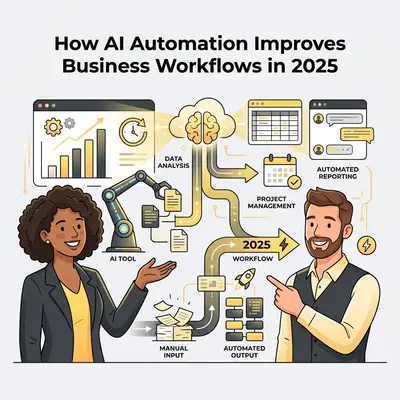
As businesses continue to address inefficiencies, AI automation has become a game-changer in 2025, offering smarter ways to handle operations and execute strategies. It brings three standout advantages to the table: eliminating manual tasks, improving decision-making with data, and intelligently managing workflows. Together, these benefits highlight how AI can streamline processes, provide actionable insights, and optimize operations.
Reducing Manual Work and Boosting Efficiency
One of the most noticeable perks of AI automation is its ability to handle repetitive tasks that often drain time and energy. Tasks like data entry, scheduling, approvals, and even routine customer service inquiries - once handled manually - are now completed faster and more accurately by AI systems [5][6][9].
For example, 58% of businesses report that IT teams spend between 5 and 20 hours each week on tasks like password resets and software provisioning. HR departments, on the other hand, dedicate nearly 57% of their time to addressing repetitive employee inquiries. According to a TeamDynamix InformationWeek report, 90% of respondents noted that such tasks negatively impact morale [9].
By integrating AI automation, companies can save significant resources. In fact, case studies reveal that businesses can save up to $1 million annually by redirecting focus from routine tasks to strategic priorities [7]. Unlike older rule-based automation systems, AI-powered workflows adapt and improve over time, reducing errors and delivering smarter, more streamlined processes. Among businesses using generative AI, 74% report measurable returns on investment, and 86% see annual revenue growth exceeding 6% [9].
Enhancing Decision-Making with Data
AI doesn’t just handle tasks - it transforms how decisions are made. By analyzing massive amounts of real-time data, AI uncovers insights that might otherwise go unnoticed. Teams no longer have to rely on weekly reports or quarterly reviews; instead, they gain instant access to predictive analytics, KPI dashboards, and real-time updates [11][12].
AI goes beyond basic analysis by enhancing cognitive functions like planning and reasoning. It helps teams develop detailed, step-by-step strategies to meet business goals [10]. AI-powered analytics tools can identify customer behavior patterns, predict trends, and monitor performance across various areas, enabling businesses to act quickly and with precision [11][3].
Streamlining Workflows with AI Agents
While data-driven insights improve strategic planning, AI agents take it a step further by operationalizing these insights across workflows. These advanced systems go beyond simple bots, managing complex processes, optimizing task assignments, and eliminating bottlenecks [3][12]. By learning from past data, processing unstructured information, and making real-time decisions without constant human input, AI agents significantly enhance operational efficiency [1].
The adoption of AI agents is accelerating. Currently, 62% of organizations are experimenting with them, and 23% have already scaled these systems within their operations [2]. By 2027, 86% of executives believe AI agents will play a major role in automating processes and rethinking workflows, while 90% expect these tools to empower teams with real-time, actionable analytics [8].
AI workflow platforms also centralize automation processes, making them repeatable, auditable, and easy to adjust. They act as a bridge between insight and action, enabling teams to collaborate more effectively with shared workflows, real-time task tracking, and continuous updates [3][12]. This seamless coordination ensures that businesses can adapt quickly and stay ahead in a competitive landscape.
Which Key Business Functions Benefit Most From AI Automation?
AI automation is reshaping how businesses operate, delivering faster and measurable outcomes. By 2025, AI is expected to redefine essential areas like sales, back-office operations, and analytics.
Sales and Revenue Operations
AI is revolutionizing sales by streamlining processes that were once manual and time-consuming. Sales teams now use AI to improve lead scoring, create outreach sequences, and forecast pipelines with precision [13][14]. AI-powered sales assistants provide real-time insights during customer interactions, offering personalized recommendations based on past data and suggesting proactive strategies to boost performance [14]. This allows sales teams to shift their focus to building relationships and pursuing high-value opportunities. These advancements in front-end operations pave the way for equally impactful changes in back-office automation.
Operations and Back-Office Tasks
Back-office workflows have become smarter and more efficient, thanks to AI. Retailers, for instance, are leveraging Intelligent Process Automation (IPA) to predict inventory needs and automate reordering when stock levels drop, reducing both shortages and overstock [4]. In financial services, firms like Morgan Stanley use AI assistants to provide advisors with instant insights, automate document creation, and prioritize tasks effectively [4]. Advanced AI systems now understand user intent and context, enabling workflows to adapt dynamically and operate without constant human oversight [4].
Advanced Analytics and Reporting
AI has dramatically reduced the lag between gathering data and taking action. Companies now use AI to automate data consolidation, enrichment, and reporting in real time [3][15]. Features like natural language summaries, anomaly detection, and predictive analytics are becoming standard [3][4][15]. For example, if customer sentiment in a specific region drops suddenly, AI can immediately alert the relevant team, provide an analysis, and even recommend corrective steps - all within minutes.
The market for Intelligent Process Automation is projected to grow from $16.03 billion in 2024 to $18.09 billion in 2025, reflecting a growth rate of 12.9% [4]. By the end of 2025, the share of AI-enabled workflows in enterprise processes is expected to jump from 3% to 25%, marking an eightfold increase [3]. These advancements ensure that businesses can respond faster and integrate actions seamlessly into their broader automation strategies.
How Can You Implement AI Automation in Your Business in 5 Steps?
Implementing AI automation requires a thoughtful and strategic approach. While 84% of organizations investing in AI report seeing a return on investment [17], nearly two-thirds have yet to scale AI across their entire enterprise [2]. The difference between success and stagnation often lies in how businesses choose, build, and refine their automated workflows. This guide offers practical steps to align strategy with action.
Finding the Right Workflows to Automate
Start by identifying repetitive, high-volume tasks that consume resources. Tasks like data entry, status updates, approvals, task assignments, and scheduling are ideal candidates [12][4][16][1]. Workflows dealing with unstructured data, such as handwritten documents or printed forms, can also benefit significantly from AI's ability to extract and structure information at scale [1].
Focus on processes that involve frequent handoffs and clicks across systems. AI can connect logic and context across platforms, creating more autonomous, end-to-end workflows [3]. Additionally, prioritize tasks requiring real-time decision-making, such as routing support tickets based on urgency or flagging anomalies in invoices [3][1]. According to Gartner, 20% of organizations will use AI to automate management tasks by 2026 [1], making this an opportune time to audit your operations.
Evalics, for example, offers business audits to identify automation opportunities within organizations. These audits can pinpoint areas where AI can deliver rapid returns, whether it’s eliminating repetitive sales tasks or streamlining back-office approvals. However, keep in mind that tasks requiring creativity, intuition, or emotional intelligence still benefit from human oversight [4][16].
Once you've identified the right tasks, the next step is designing workflows that scale effectively.
Building Scalable AI Workflows
After identifying automation opportunities, the focus shifts to creating workflows that are scalable and efficient. Leading organizations don’t just add AI to existing processes - they redesign workflows to maximize efficiency [2]. Use modular components that can be applied across departments. This approach ensures workflows are repeatable, easy to audit, and adaptable while maintaining clear oversight [3].
Incorporate error management into your workflows from the beginning. Not every situation will follow a predefined path, so your system needs the flexibility to escalate unusual cases to human reviewers. Include human oversight at critical decision points, particularly for customer-facing actions or financial transactions. The goal isn’t to eliminate humans but to free them from repetitive tasks so they can focus on more complex decisions.
Your workflows must also be scalable and flexible. Choose an automation platform that can handle more users, larger data volumes, and customizable workflows without needing constant developer intervention [12]. With AI-enabled workflows projected to grow from 3% to 25% of enterprise processes by 2025 [3], your system must be ready to handle rapid growth.
Measuring ROI and Improving Over Time
Every AI initiative should be tied to clear KPIs, such as cost reduction, speed, customer satisfaction, or revenue growth [18]. Key metrics to track include cycle time (how long processes take), cost savings (labor hours eliminated), and revenue impact (faster deal closures or improved customer retention). AI can help reduce acquisition costs by 20-40% through smarter segmentation and automated bidding, while AI-driven systems can lower operating costs by up to 25% [18].
Leadership alignment is critical. Agreeing on shared value metrics is often the biggest factor in achieving success with digital initiatives [17]. However, only 24% of employees regularly use AI tools integrated into workflows [18], which underscores the importance of ongoing training and engagement. Consider implementing a shared value scorecard that tracks technical ROI, KPI improvements, and EBITDA impact to ensure all stakeholders see the benefits [17].
Continuous improvement is key. A study by MIT revealed that only 5% of generative AI pilots deliver sustained value at scale [17]. The difference lies in adopting adaptive systems that improve over time. Reevaluate workflows quarterly, making adjustments based on performance data and shifting business needs. This ongoing optimization ensures AI continues to deliver value as your business evolves [18].
What Are the Future Trends in AI Automation Beyond 2025?
As we look beyond 2025, the advancements in AI automation are set to redefine how businesses operate. The shift from rule-based systems to more intelligent, adaptive technologies is already reshaping industries. Agentic AI, for instance, has transitioned from experimental phases to widespread deployment, where it now autonomously handles complex, multi-step workflows [2][19][21]. Unlike traditional automation, which depends on rigid, predefined rules, these advanced systems interpret intent, learn from context, and act independently without constant human oversight [4]. They can dynamically adjust processes to align with changing strategies [3], setting the stage for further groundbreaking innovations in automation.
New Technologies Shaping AI Automation
The rise of multimodal AI is a game-changer. By integrating text, images, video, 3D modeling, and real-time simulations, these systems can process diverse data types and generate more nuanced, context-aware solutions [20]. This capability opens the door to smarter, more versatile AI-driven applications.
Meanwhile, hyperautomation is gaining momentum. By combining robotic process automation (RPA), AI, machine learning, and process orchestration, hyperautomation creates unified systems that go far beyond automating isolated tasks. Instead, it reimagines entire operational ecosystems. Companies embedding AI deeply into their workflows are seeing transformative benefits [2]. This shift moves automation from incremental task improvements to a complete overhaul of how organizations function, paving the way for workflows that can operate with minimal human intervention.
Preparing for Autonomous Workflows
The emergence of fully autonomous workflows marks a significant turning point. These systems can plan, execute, and adapt in real time, fundamentally altering how businesses approach operations [2]. However, this transition requires a rethinking of team roles, ensuring human input is reserved for areas where judgment and creativity are irreplaceable.
Forward-thinking organizations are taking steps to integrate AI into their core processes rather than treating it as a standalone tool. This deeper integration highlights the importance of security-by-design, clear explainability, and strong governance. Transparent AI systems are essential, especially for customer-facing decisions or regulatory compliance. Companies like Evalics, through their AI Accelerator Partnership, are helping businesses prepare for this future by offering tailored roadmaps, continuous optimization, and team training. The ultimate goal isn’t to replace human decision-making but to let AI handle routine complexities, freeing people to focus on strategic initiatives and creative problem-solving.
How Does AI Automation Drive Long-Term Business Efficiency?
By 2025, AI automation has evolved from being an experimental tool to becoming a core component of modern business operations. A staggering 88% of organizations now incorporate AI into at least one business function, up from 78% just a year ago [2]. And the results? They're hard to ignore - companies report up to 30% in cost savings through automation and over 60% reductions in HR processing time, particularly with automated onboarding [24]. These aren't minor tweaks; they're game-changing shifts in how businesses operate. The numbers highlight the pressing need to integrate AI strategically.
Moving forward demands decisive action, not hesitation. Start by pinpointing repetitive, high-friction processes, analyzing workflow bottlenecks, and designing optimized systems using tools like visual platforms and conditional logic [22][23]. It's not just about setting systems in motion - it's about testing, monitoring, and refining them for maximum impact. Companies embedding AI deeply into their operations are the ones achieving standout results. While quick wins are valuable, the real challenge lies in scaling AI across the entire enterprise.
Interestingly, nearly two-thirds of organizations have yet to scale AI enterprise-wide [2]. That leaves a massive opportunity for businesses ready to act boldly. The competitive edge will belong to those who reimagine workflows around intelligent systems and commit to ongoing optimization. This shift isn't just about adopting new tools - it's about fundamentally transforming how work gets done, a key theme of AI's impact in 2025.
Evalics specializes in helping businesses navigate this transformation with tailored automation solutions. Whether you're looking for quick fixes to eliminate routine tasks, fully customized systems complete with documentation and training, or a long-term AI Accelerator Partnership to overhaul your operations, the focus is always on measurable outcomes and building sustainable capabilities. It's not just about implementing AI - it's about creating smarter, faster workflows that let your team excel at what they do best.
AI automation is already reshaping industries. The real question is: Will you lead this transformation or find yourself struggling to catch up?
Frequently Asked Questions About AI Business Automation
1. What steps can businesses take to determine which tasks are ideal for AI automation?
To figure out which tasks are best suited for AI automation, businesses should take a close look at their workflows. Start by pinpointing activities that are repetitive, take up too much time, or follow a clear set of rules. Tasks that deal with large volumes of data or don't require much human judgment are typically strong contenders for automation.
It's also worth focusing on areas where AI can speed things up, cut down on mistakes, or make smarter decisions. By prioritizing tasks that have a noticeable effect on productivity or customer satisfaction, businesses can get the most out of their automation efforts.
2. What are the biggest challenges businesses face when scaling AI automation across their operations?
Scaling AI automation across an enterprise isn't without its obstacles. One of the biggest challenges is integrating AI systems with existing infrastructure. Many organizations rely on a mix of technologies, some of which may be outdated or incompatible with modern AI tools. This makes seamless integration a tough nut to crack.
Another key issue is ensuring data quality and consistency. Since AI systems depend on accurate, well-organized data to function properly, even small errors or inconsistencies can lead to unreliable results.
There's also the matter of organizational resistance to change. Employees often need time, training, and reassurance to adjust to AI-driven workflows, which can feel disruptive to established processes. On top of that, businesses must ensure scalability without sacrificing performance. As AI systems grow and handle more tasks, maintaining their efficiency and effectiveness becomes a balancing act.
Finally, compliance and data security are non-negotiable. Protecting sensitive data and adhering to regulatory requirements are essential for building trust and avoiding legal pitfalls. Tackling these challenges with a clear plan can set the stage for a smoother, more successful rollout of AI across the enterprise.
3. How does AI automation improve real-time decision-making in business operations?
AI automation transforms real-time decision-making by quickly analyzing massive datasets, spotting patterns, and using machine learning to suggest or carry out the best actions almost instantly. It can handle unstructured data, adjust to shifting conditions, and work smoothly with existing systems, ensuring quicker and more precise responses.
By learning from both fresh data and previous outcomes, AI automation enables businesses to remain flexible in fast-changing environments. This approach streamlines critical operations - like sales, logistics, and analytics - by minimizing manual effort and boosting overall efficiency.