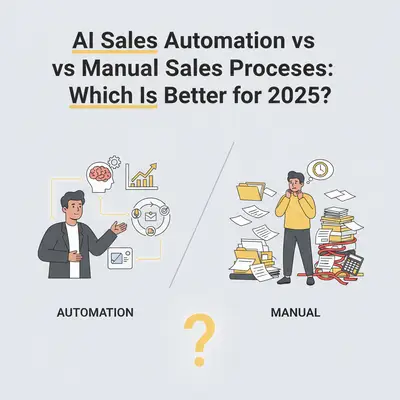
AI sales automation is reshaping the way businesses approach sales in 2025. It saves time, reduces errors, and boosts efficiency by handling repetitive tasks like lead qualification, follow-ups, and CRM updates. On the other hand, manual sales processes excel in complex, high-stakes deals requiring trust and personal interaction. The best strategy combines both: using AI for routine tasks and humans for relationship-driven activities.
Key Takeaways:
- AI Benefits: Faster lead response (under 1 minute), higher accuracy (99%), and increased conversion rates (+20%).
- Manual Strengths: Best for complex B2B deals and custom solutions, where human interaction builds trust.
- Hybrid Model: Use AI for scalability and humans for strategic, personalized interactions.
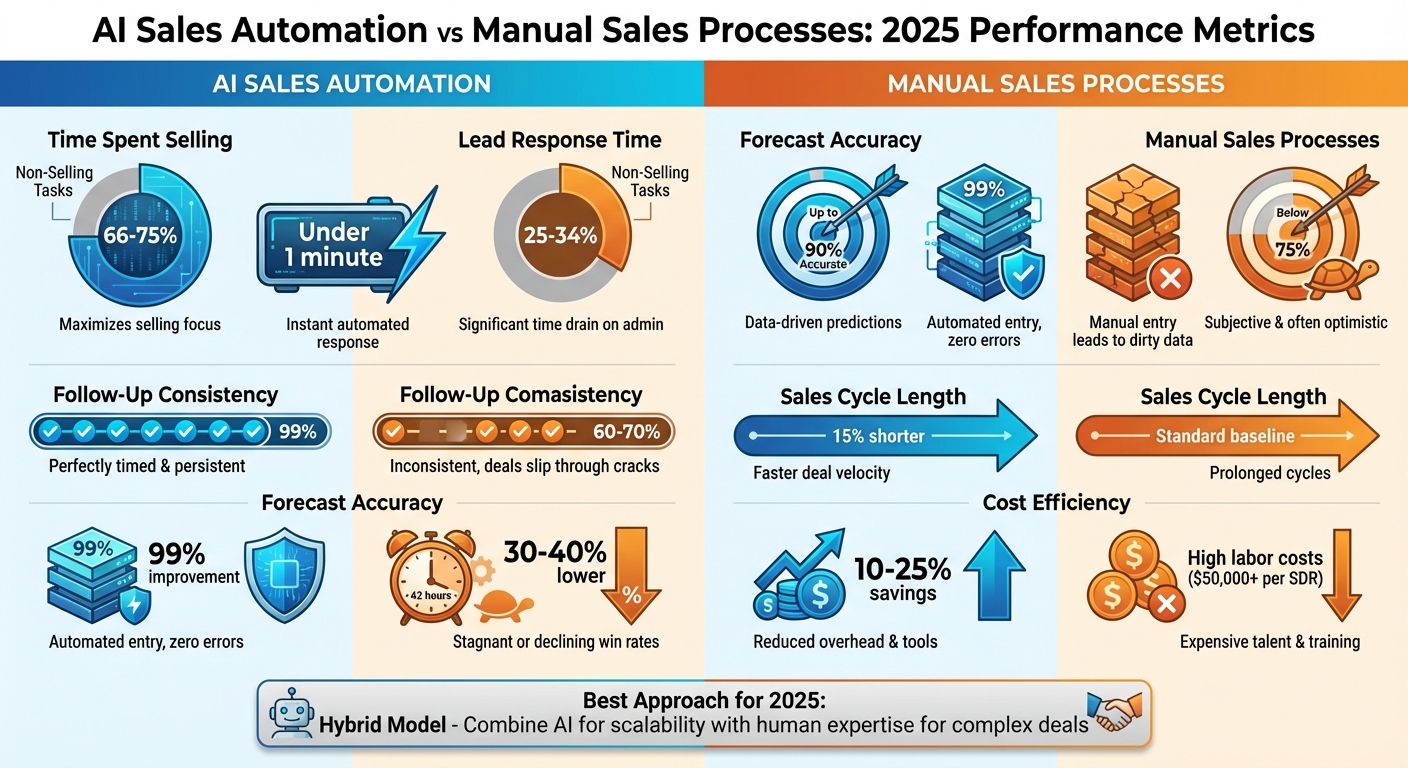
Quick Comparison
| Metric | AI Sales Automation | Manual Sales Processes |
|---|---|---|
| Time Spent Selling | 66–75% | 25–34% |
| Lead Response Time | Under 1 minute | 42 hours |
| Follow-Up Consistency | 99% | 60–70% |
| Forecast Accuracy | Up to 90% | Below 75% |
| Data Accuracy | 99% | Prone to human error |
| Cost Efficiency | 10–25% savings | High labor costs |
Bottom Line: For 2025, combining AI tools with human expertise ensures faster, more efficient sales while maintaining the personal touch needed for complex deals.
How to Boost Your Sales With AI Automation? (Complete Guide, 2025)
How AI Sales Automation Works in 2025
By 2025, AI sales automation has evolved well beyond the rigid, rule-based systems of the past. Today’s AI adapts dynamically to individual buyer behavior, engagement trends, and preferred timing. This means your outreach strategies continuously improve, guided by real-world results [6]. Instead of merely executing tasks, modern AI makes smart, data-driven decisions independently, allowing your team to focus on what truly matters - building relationships and closing deals [6][7].
One of the greatest strengths of AI is its ability to handle repetitive tasks that once drained hours of productivity. Tasks like updating CRM records, researching potential leads, and scheduling follow-ups - once time-consuming for sales reps - are now handled seamlessly by AI. This shift empowers your team to channel their energy into high-impact activities where human intuition and empathy shine.
Main AI Capabilities in Sales
At the heart of modern AI sales tools is predictive lead scoring. By analyzing past data and engagement patterns, AI pinpoints high-conversion prospects, removing the guesswork from lead qualification. This ensures your team connects with the right prospects at the right time.
Automated outreach has also come a long way from generic email blasts. AI now crafts highly personalized messages, factoring in details like industry, job role, past interactions, and engagement history. It even adapts messaging in real time based on response rates and follows up promptly when a prospect shows interest. Meanwhile, conversation intelligence tools analyze sales calls and emails to uncover key insights, identify objections, and recommend proven responses.
AI’s ability to update CRM data with precision and speed boosts system reliability, while its advanced analytics and forecasting capabilities process vast datasets to predict revenue trends, flag at-risk deals, and identify emerging opportunities. These insights, which might have taken weeks to uncover manually, are now available almost instantly.
Together, these tools create a robust foundation for tailored automation solutions.
How Evalics Supports AI-Driven Sales
Evalics offers a range of AI sales automation services designed to meet businesses at different stages of their growth. Their three service tiers provide flexibility based on your needs and goals:
-
AI Automations Package ($1,200–$12,000 over 1–4 weeks): Ideal for quick wins, this tier eliminates repetitive tasks like lead generation and outreach. Using drag-and-drop tools, it integrates seamlessly with your current tech stack to deliver immediate results.
-
Custom Solutions & Collaboration ($12,000–$48,000 over 3+ months): For businesses seeking deeper integration, this tier provides tailored AI solutions built around your workflows. It includes a thorough business audit, cross-functional workflow design, custom API integrations, and full documentation, along with team onboarding.
-
AI Accelerator Partnership ($48,000+ over 6+ months): Designed for companies ready to scale automation across their organization, this tier offers ongoing, high-touch support. It includes company-wide roadmaps, custom AI product development, continuous team training, and ROI tracking to ensure your investment delivers measurable outcomes.
Whether your business is just starting with automation or looking to scale, Evalics has a solution to help you take the next step confidently.
Strengths and Weaknesses of Manual Sales Processes
Even with the rapid rise of AI, manual sales processes still hold their own in certain situations. Knowing where they shine - and where they falter - can help you craft a more effective sales strategy.
Where Manual Sales Processes Work Best
Manual sales processes thrive in complex B2B transactions that require trust-building and adaptability. Face-to-face interactions allow sales reps to pick up on nonverbal cues and adjust their approach in real-time - something AI hasn’t quite mastered yet [1][2].
"Traditional sales methods represent the human-to-human approach that has driven business development for centuries. This methodology revolves around relationship building, personal connections, and the nuanced understanding that comes from direct interaction." - Rapid Innovation [2]
These processes are particularly effective in areas like custom deal structuring, where trust and transparency are crucial - such as founder-led businesses or first-time acquisitions [1][2]. Strategic account planning also benefits from human expertise. Experienced reps can identify upselling opportunities and craft tailored strategies for key accounts, which automated systems might miss [1]. This human touch is especially important in high-stakes situations, as 74% of buyers say personalized offers influence their brand loyalty [8]. However, the strengths of manual sales often come with notable drawbacks, especially concerning time and scalability.
Where Manual Sales Processes Fall Short
The biggest downside of manual processes? They’re time-consuming. Reps spend less than 30% of their time actually selling, while 20–30% is lost to tasks like data entry and updating records [1][2]. Without proper enablement tools, reps waste about 10 hours per week searching for or creating materials [1], adding up to over 100 hours a month spent on low-value activities that could be automated [1].
Scaling manual sales efforts is also costly, as increasing outreach usually means hiring more people. Follow-up consistency tends to lag too - manual processes achieve only 60–70% consistency [1][2]. On average, businesses take 42 hours to respond to leads, and 55% take more than five days [1][2]. Considering that 79% of U.S. sales leaders identify lead generation as the biggest bottleneck in the sales process [9], these inefficiencies can be a major roadblock. On top of that, 50% of sales teams work with incomplete or inaccurate data [3], and teams relying solely on human judgment often see conversion rates drop by 30–40% [3]. In today’s fast-moving market, these challenges make it tough to stay competitive.
AI Sales Automation vs Manual Sales: Direct Comparison
The following comparison highlights key performance metrics for 2025.
Comparison Table: 2025 Performance Metrics
| Metric | AI Sales Automation | Manual Sales Processes |
|---|---|---|
| Time Spent Selling | 66–75% of rep time [1] | 25–34% of rep time [1] |
| Lead Response Time | Under 1 minute [1] | 42 hours on average [1] |
| Follow-Up Consistency | 99% [1] | 60–70% [1] |
| Forecast Accuracy | Up to 90% [1] | Below 75% for 80% of teams [1] |
| Data Accuracy | Approaching 99% [1] | Subject to human error |
| Conversion Rate Impact | +20% improvement [1] | 30–40% lower [3] |
| Sales Cycle Length | 15% shorter [1] | Standard baseline |
| Cost Efficiency | 10–25% reduction [1] | High labor costs (e.g., $50,000+ per SDR) [1] |
Efficiency and Cost Savings
AI automation has transformed the way sales teams operate. By saving sales representatives around 2–3 hours every day, AI adds up to nearly three months of extra selling time each year [1]. This means AI-powered teams spend 66–75% of their time actively selling, compared to just 25–34% for teams relying on manual processes. Automated email campaigns alone drive 320% more revenue than their non-automated counterparts [1].
The financial benefits don’t stop there. Companies using AI report cost reductions of 10–25% [1]. For example, manual order entry errors can cost businesses as much as $500,000 annually, while AI tools minimize these mistakes. AI also slashes call times by 70% and reduces operational costs by 60% [4], enabling businesses to scale their outreach without needing to proportionally increase staff. These savings directly contribute to stronger revenue performance.
Revenue Growth and Conversion Rates
AI-driven sales strategies are proving to be game-changers for revenue growth. Companies adopting AI technologies report revenue increases of 13–15% [1], and sales teams using AI achieve a 27% higher close rate [1]. A significant 81% of users also report shorter deal cycles when leveraging AI solutions [4].
Specific AI capabilities, like predictive lead scoring, improve pipeline conversion rates by up to 20% and close rates by 27% [1]. Similarly, AI-powered upselling strategies can increase deal sizes by 19% [1]. With features like instant buyer insights, predictive timing, and automated follow-ups, deals close up to 40% faster [1]. Among AI users, 69% report sales cycles shortening by at least one week, and 68% note an increase in closed deals overall. Early adopters have seen win rates rise by over 30%, and sales professionals using AI tools are 3.7 times more likely to hit their quotas [4].
Personalization and Relationship-Building
Sales success isn’t just about speed and cost - it’s also about creating meaningful connections with prospects. AI excels in delivering hyper-personalized experiences by analyzing behavioral patterns, engagement history, and firmographics to craft tailored content for thousands of prospects at once [8]. This approach improves customer conversion rates by up to 57% and raises customer satisfaction scores by 20% [8].
With 80% of B2B buyer interactions now happening digitally, AI ensures timely, personalized outreach across platforms like email, LinkedIn, phone, and chat, boosting overall engagement by up to 40% [8]. However, manual processes still shine in high-stakes, trust-based interactions. Face-to-face communication allows sales reps to pick up on nonverbal cues and adjust their strategies in real time - critical for complex B2B transactions and sensitive negotiations [1].
A hybrid model that combines AI-driven scalability with human expertise for strategic interactions delivers the best results in 2025. This balanced approach leverages the strengths of both AI and human sales efforts to maximize efficiency and build lasting relationships.
Choosing the Right Approach for 2025
Deciding between AI automation and manual sales isn’t a one-size-fits-all scenario. The best choice depends on factors like the complexity of your sales process, the volume of leads, available resources, and your growth goals. Companies that align their approach with their operational needs tend to achieve better outcomes than those simply chasing trends. Let’s explore when each method works best to help shape your strategy.
When AI Sales Automation Works Best
AI automation shines in scenarios where the sheer volume of leads surpasses what a human team can handle. In such cases, AI steps in to provide quick responses, ensuring opportunities aren’t missed due to delays. This approach is particularly suited to transactional sales environments with shorter cycles and standardized offerings. Industries like e-commerce, SaaS with predefined pricing structures, and subscription-based services often see immediate advantages.
AI thrives in creating consistent, repeatable workflows. Tasks like automating email sequences, scoring leads, and following up can be handled efficiently without deviations. However, for AI to deliver these results, it requires solid historical data to learn from and seamless integration with tools like CRMs, email platforms, and communication systems. Proper setup and data management are crucial to unlocking productivity benefits.
When Manual Sales Still Matters
Manual sales approaches remain invaluable for high-stakes, complex B2B deals where building trust and fostering relationships are essential. In these scenarios, human sales professionals excel at addressing unique customer needs and navigating nuanced conversations.
Early-stage businesses, which may not yet have extensive customer data or are refining their sales strategies, also benefit from manual methods. A hands-on approach - often led by founders - offers direct insights into customer objections and helps fine-tune messaging for future efforts, including potential automation.
Building a Combined Sales Model
The best approach for 2025 is a balanced combination of AI automation and manual sales. Start by mapping out your sales process to identify tasks that are repetitive and data-driven versus those requiring human judgment and relationship-building skills.
Use AI for tasks like lead qualification, initial outreach, scheduling, data entry, and routine follow-ups. Meanwhile, human sales efforts should focus on discovery calls, understanding client needs, customizing proposals, negotiating, and managing relationships.
This hybrid model can reduce sales costs by up to 25% [1] while preserving the personal touch needed to close complex deals. To implement this approach effectively, begin by automating one or two high-impact processes. Measure the outcomes, refine your strategy, and gradually expand automation across your sales operations.
Conclusion: Finding the Balance Between Automation and Human Touch
As we look toward 2025, the most effective sales strategies combine the strengths of AI automation with the irreplaceable qualities of human expertise. Leading sales organizations understand that while AI shines in managing high volumes and fast-paced tasks, human sales professionals excel at building meaningful relationships and making strategic decisions [2].
AI should take on the repetitive, time-consuming tasks that often dominate up to 75% of a salesperson's day - things like data entry, lead scoring, scheduling, and routine follow-ups [4][5]. Companies adopting this hybrid model have reported impressive results, including a 30% boost in sales productivity and a 25% reduction in costs [1]. Additionally, nearly 80% of employees say automation allows them to focus more on strengthening customer relationships [1].
Think of AI as a collaborative partner, taking care of the repetitive, data-heavy work so that human professionals can focus on what they do best: connecting with customers on a deeper level, offering creative solutions, and fostering trust. AI delivers speed, consistency, and data-driven insights, while humans bring empathy, understanding, and strategic thinking to the table. This synergy between AI and human effort ensures not just scalability but also lasting customer loyalty. By blending the efficiency of AI with the nuanced approach of human salesmanship, organizations are set to achieve outstanding results in 2025.
FAQs
1. How does AI sales automation help businesses respond to leads faster than manual methods?
AI-driven sales automation empowers businesses to connect with leads in record time by streamlining tasks such as lead routing and follow-ups. Instead of waiting hours - or worse, days - companies can reach out to potential customers within minutes. This quick response not only increases engagement but also has a noticeable impact on conversion rates.
By removing bottlenecks tied to manual processes, AI ensures leads are handled promptly and efficiently. This kind of responsiveness doesn't just smooth out the sales workflow - it can also set businesses apart in competitive, fast-moving industries.
2. What are the key benefits of using a hybrid sales model in 2025?
In 2025, the hybrid sales model strikes a balance between AI-driven automation and the personal touch of human interaction, offering a well-rounded approach that brings clear benefits. With automation, businesses can respond to inquiries in minutes, ensure consistent follow-ups, and scale operations to manage larger customer bases efficiently. Meanwhile, human involvement adds the critical element of personalized communication and the ability to handle complex negotiations effectively.
This approach also taps into AI-powered insights, helping businesses spot trends, refine strategies, and make smarter decisions, all while preserving the relationship-building that customers appreciate. By blending the strengths of technology and human expertise, companies can remain competitive, grow, and adapt to the ever-changing U.S. market.
3. When is manual sales a better choice than AI automation?
Manual sales shine in scenarios where personal connections and relationship-building take center stage. This approach is particularly effective in industries involving high-value deals, specialized markets, or situations that demand trust and a strong human connection.
Think about complex sales negotiations or tailored solutions - these are moments where manual efforts excel. When timing and messaging require precise control by a skilled sales professional, the human element often becomes the key to building rapport and sealing the deal.