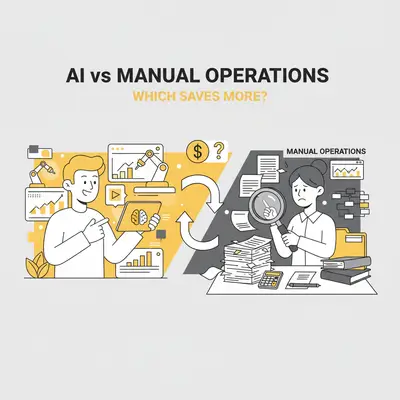
AI systems save money over time by reducing labor costs, minimizing errors, and scaling efficiently. While manual operations may seem cheaper initially, they come with ongoing expenses like wages, training, and error corrections, which grow as businesses expand. AI-powered tools, on the other hand, handle tasks faster, operate 24/7, and maintain accuracy even under heavy workloads.
Key Takeaways:
- Cost: AI has higher upfront costs but lower long-term expenses. Manual processes incur recurring costs tied to labor and errors.
- Time: AI completes tasks faster and works continuously, unlike manual methods limited by human capacity.
- Errors: AI reduces mistakes through automation, while manual work is prone to errors that lead to rework and inefficiencies.
- Scaling: AI scales easily with minimal additional costs, whereas manual processes require more staff and resources as demand grows.
Quick Comparison:
| Metric | AI Systems | Manual Processes |
|---|---|---|
| Cost | High upfront, low ongoing | Low upfront, high ongoing |
| Time Efficiency | Fast, 24/7 operation | Slower, limited by human hours |
| Error Rates | Minimal | Higher |
| Scalability | Scales easily | Requires more staff/resources |
If you're looking to cut costs, save time, and grow efficiently, AI offers a clear advantage over manual methods.
AI vs Manual Testing - Which Saves More?
Cost Analysis: AI vs Manual Operations
When comparing the financial impact of AI-powered operations to manual processes, it's important to look at the full picture. While AI comes with upfront costs, manual processes bring ongoing expenses that can add up significantly over time. Let’s break down the cost components for each approach.
AI Implementation and Operating Costs
Investing in AI requires an initial outlay, but it quickly reduces labor and training expenses. The setup costs typically include subscription fees and maintenance, but AI tools also have the advantage of shorter training periods compared to manual methods. This combination highlights the potential for cost efficiency with AI.
Manual Process Expenses
Manual operations come with more than just wages. Labor costs are the primary expense, but factors like overtime during busy periods can significantly increase the total. As businesses grow, these recurring expenses can strain budgets, making manual processes less financially sustainable.
Comparing Costs Side by Side
AI systems can scale with minimal additional costs, while manual processes see expenses grow in proportion to the workload. Although AI requires a higher initial investment, the savings in labor, maintenance, and error-related costs often lead to a quicker return on investment and long-term financial benefits.
Time Savings and Productivity Results
The contrast between AI-driven operations and manual processes becomes striking when you consider how each handles everyday business tasks. Manual work relies on the pace of human effort, scheduled breaks, and a step-by-step approach. Meanwhile, AI systems operate nonstop, handling multiple tasks at once with remarkable efficiency.
How AI Speeds Up Work
AI takes time-consuming tasks and turns them into automated, efficient workflows. For instance, it can handle payroll processing, analyze complex data from multiple sources in seconds, and respond to countless customer inquiries all at once. This automation allows employees to focus on higher-value, strategic work. On the other hand, manual methods often fall short due to their inherent time limitations.
Time Limits of Manual Work
Manual work is naturally bound by human capacity. Fixed schedules, the need for breaks, and sequential task handling mean that interruptions - like fixing errors - can derail workflows. Add to that the difficulty of multitasking and constantly switching between tasks, and it’s easy to see how manual processes can struggle to maintain efficiency. These limitations emphasize the clear gap in productivity between manual and AI-powered approaches.
Time and Output Comparison
While manual processes require ongoing human effort, AI accomplishes tasks in a fraction of the time, delivering consistent productivity boosts. Its ability to work around the clock - unaffected by standard working hours - makes it a clear winner when it comes to maximizing output and freeing up time for more strategic priorities. This continuous operation highlights the significant productivity edge AI brings to the table.
Error Rates and Quality Control
AI systems have a proven track record of performing with higher accuracy compared to manual operations. While human error is an unavoidable aspect of manual work, AI systems are designed to maintain precision throughout their tasks. Let’s break down how each approach handles accuracy.
How AI Prevents Mistakes
AI keeps mistakes at bay by relying on fixed algorithms and consistent processes. These systems thrive at repetitive tasks, ensuring they’re performed the same way every time. Tools like pattern recognition and data validation allow AI to automatically verify details - for example, confirming that invoice amounts align with purchase orders or ensuring customer data adheres to the correct format. This level of consistency helps eliminate errors that might otherwise slip through in manual workflows.
Common Errors in Manual Work
Manual processes are prone to errors like typos, miscalculations, and missed deadlines. Even a seemingly minor mistake, such as entering the wrong email address for a customer, can disrupt communication. Similarly, inaccuracies in inventory counts can ripple into broader operational inefficiencies. On top of that, manual quality control requires significant staff time and tends to falter under heavy workloads. These challenges highlight why AI is a powerful ally in ensuring reliable quality control.
Growth and Scaling Capabilities
As businesses grow, keeping operations efficient becomes a top priority. The contrast between AI-driven operations and traditional manual processes becomes especially noticeable when workloads expand, customer expectations rise, and companies venture into new markets. Understanding how these two approaches handle growth is key to staying efficient and sustaining momentum.
Let’s dive into how each approach manages scaling.
How AI Systems Scale
AI systems tend to scale with ease because they don’t require a one-to-one increase in resources as demand grows. Many AI solutions are built with scalable architectures and cloud-based components that automatically adjust computing power based on usage. This means you pay only for the resources you actually need. During demand spikes, AI can handle the extra workload without requiring additional staff. Plus, AI platforms are often designed to adapt to new business rules or regional requirements through updates, avoiding the need for a complete system overhaul. Over time, AI systems also improve through continuous data processing, which boosts predictive accuracy and operational efficiency.
Challenges of Scaling Manual Processes
Scaling manual processes, on the other hand, comes with a host of challenges. Growth typically requires proportional increases in staff, office space, and equipment. Hiring skilled workers in competitive markets can be both time-consuming and expensive. Onboarding new employees delays productivity, which can lead to bottlenecks during periods of rapid growth. As teams expand, maintaining consistent quality becomes harder due to increased communication and coordination complexities. Expanding into new regions adds another layer of difficulty, as it often requires local hiring and compliance with regional regulations.
Comparing Scaling Requirements
Here’s a side-by-side look at how AI-powered operations and manual processes handle key scaling factors:
| Scaling Factor | AI-Powered Operations | Manual Processes |
|---|---|---|
| Resource Growth | Minimal additional resources needed | Requires proportional increases in staff and assets |
| Cost Structure | Fixed initial investment with usage-based fees | Directly tied to workforce and overhead costs |
| Time to Scale | Rapid scaling through automation | Slower due to hiring and training demands |
| Quality Consistency | Maintains steady performance at scale | Quality may decline as team size grows |
| Geographic Expansion | Deployable without physical presence | Requires local hiring and compliance |
| Peak Demand Handling | Automatically adjusts to surges | May involve overtime or temporary staffing |
When operational demands grow, AI-powered systems clearly provide an edge. They offer cost savings, faster scalability, and better consistency, even in fast-growing or geographically dispersed markets. This ability to scale efficiently not only reduces expenses but also strengthens productivity and quality, reinforcing the benefits of AI highlighted earlier.
How to Implement AI in Your Business
Integrating AI into your business doesn’t have to be complicated. By building on your current operations and following a clear plan, U.S. businesses can achieve meaningful results and maximize their investments.
Assess Your Current Operations
Start by examining your existing workflows. Identify tasks that consume the most time, create bottlenecks, or are prone to frequent errors. This step is essential for spotting areas where AI can make the biggest difference.
Pay special attention to financial management tasks. Did you know that 64% of small business owners spend over 10 hours a week on these activities? [1]. By understanding how much time and effort these tasks require, you can better estimate the potential benefits of automation.
Also, consider compliance challenges specific to U.S. regulations. For instance, 45% of small businesses fail to meet financial compliance standards, leading to penalties and fines [1]. Pinpointing these high-risk areas early can help you prioritize which processes could benefit most from AI.
Ask yourself these key questions:
- Which tasks are the most time-consuming?
- Where do errors happen most often?
- What processes require extensive staff training?
- Which activities would benefit from 24/7 automation?
Answering these questions will help you uncover the best opportunities for AI implementation. Once you’ve identified your pain points, you can move forward with targeted AI solutions.
Set Up AI Tools
After identifying priority areas, it’s time to implement AI tools. Start small with pilot projects to test and refine your systems before rolling them out on a larger scale.
Take expense management, for example - a common challenge for many U.S. businesses. AI-powered tools can cut processing time by up to 70% and improve accuracy by up to 90% [1]. These tools automatically categorize expenses, flag policy violations, and streamline approval workflows. Setting them up typically involves connecting to your existing accounting software, uploading historical data for training, and configuring approval rules.
Companies like Evalics offer several approaches for implementing AI, depending on your business’s needs:
- AI Automations Package: Costs between $1,000 and $10,000 and takes 1–4 weeks. Focuses on quick solutions for repetitive tasks.
- Custom Solutions & Collaboration Package: Priced at $10,000–$40,000 over 3+ months. Includes a detailed audit, custom integrations, and team training.
- AI Accelerator Partnership: Starts at $40,000 for 6+ months. Offers a comprehensive roadmap, tailored product development, and ongoing optimization.
Make sure the tools you choose integrate smoothly with your current systems. Many AI platforms provide APIs that connect with popular business software. Also, prepare your data carefully - clean and well-organized data is critical for optimal performance.
Lastly, train your team and manage the transition thoughtfully. Since 71% of small business owners see financial management as a major challenge [1], showing how AI can ease these burdens will help get your team on board and ensure a smoother adoption process.
Monitor and Improve Performance
To get the most out of your AI systems, regular monitoring and refinement are crucial. Keeping an eye on performance not only improves efficiency but can also lead to significant cost savings over time. Set clear KPIs that align with your goals, such as reducing processing times, improving accuracy, and cutting overall costs.
Track both quantitative metrics - like processing times and error rates - and gather qualitative feedback from your team. Businesses that actively monitor their AI systems often see a 20% boost in employee productivity and a 15% drop in financial errors [1].
During the initial phase, conduct monthly performance reviews. Once your systems are stable, shift to quarterly evaluations. Look for recurring issues, such as errors or bottlenecks, that may require adjustments or additional training. While AI systems improve over time through machine learning, they still benefit from regular oversight to address your business’s specific needs.
It’s also a good idea to track long-term ROI. Many companies using AI-powered expense management tools report an average ROI of 300% within the first year [1]. This is often due to lower processing costs, fewer errors, better compliance, and freeing up employees to focus on more valuable tasks.
Finally, plan for scalability. As your business grows, your AI systems should evolve without requiring a proportional increase in resources. Regular updates and adjustments will ensure your AI investment continues to support your growth, paving the way for long-term efficiency and success.
Which Option Saves More Money
AI-driven operations can lead to significant cost savings over time, even if the upfront investment is higher. This is largely due to reduced ongoing expenses and increased efficiency.
Main Results Summary
AI systems consistently outperform manual processes in ways that directly affect your bottom line. Businesses report that AI simplifies operations and reduces costs, while manual workflows often lead to rising expenses. By handling routine tasks at a much faster pace than human workers, AI saves valuable time.
Another major advantage is error reduction. AI minimizes mistakes, cutting down on costs linked to rework, compliance violations, and missed opportunities. In contrast, manual processes are prone to errors, which can lead to additional expenses and impact customer satisfaction.
AI also shines when it comes to scaling with business growth. Expanding a manual operation typically requires hiring more staff, conducting training, and increasing overhead. On the other hand, AI systems can manage larger workloads without a proportional rise in labor costs. Automating tasks like financial management not only saves money but also allows your team to focus on activities that drive revenue. These benefits highlight the financial advantages of adopting AI.
Next Steps for Your Business
To make the most of these cost-saving opportunities, the next step is to develop an AI strategy tailored to your business. Begin by analyzing your current operational costs for routine tasks, including salaries, training, and error correction. This will give you a clear baseline to evaluate the potential return on investment from AI solutions.
Choose an AI approach that fits your budget and timeline. Implementation options range from quick automation tools to full-scale transformation projects. Refer back to earlier guidance for detailed advice on selecting the right path.
Focus on areas with the greatest impact, such as financial management, customer service, or data processing, to see immediate improvements. Keep in mind that successful AI adoption is an ongoing process. Regularly monitor and refine your system to ensure it continues delivering value as your business grows and evolves.
FAQs
What are the first steps to successfully transition from manual processes to AI-driven operations?
To shift from manual processes to AI-driven operations, start by setting clear goals for what you want AI to accomplish. This could include cutting costs, boosting efficiency, or expanding operations. Then, take a close look at your current workflows to pinpoint where AI can have the biggest impact - think repetitive tasks or areas where human error is common.
After identifying these opportunities, focus on selecting AI tools that fit your specific business needs and can smoothly integrate with your existing systems. Lastly, invest in employee training and change management to ensure your team feels confident with the new technology and can use it to its full potential.
How can a business determine the ROI of switching from manual processes to AI solutions?
To figure out the potential return on investment (ROI) from adopting AI solutions, businesses need to weigh a few essential factors: initial setup costs, ongoing operational expenses, and expected savings. AI can often cut costs by 20–28%, reduce errors, and increase productivity - all of which can have a noticeable effect on profitability.
Start by comparing what you're currently spending on manual processes, like labor, time, and fixing errors, with the projected costs and benefits of implementing AI systems. Make sure to also consider scalability and the long-term advantages, such as enhanced efficiency and quicker decision-making. This kind of analysis can give you a clearer picture of the financial and operational value AI could bring to your business.
What challenges do businesses face when scaling with AI instead of manual processes, and how can they overcome them?
Scaling with AI comes with its fair share of hurdles that businesses need to tackle. These include higher initial costs to get systems up and running, the importance of training employees to work with new tools, and the critical task of maintaining strong data protection to secure sensitive information.
To address these issues, businesses can take a step-by-step approach. Starting with gradual implementation allows teams to adjust at a manageable pace. Investing in thorough training programs ensures employees feel confident and capable when using AI-powered tools. On top of that, emphasizing strong cybersecurity protocols helps protect valuable data throughout the scaling process. While these challenges may seem daunting at first, the long-term benefits - like better resource use, fewer errors, and improved scalability - can lead to significant savings and higher productivity over time.