On February 20, 2026 — two days ago — something unusual happened in financial markets.
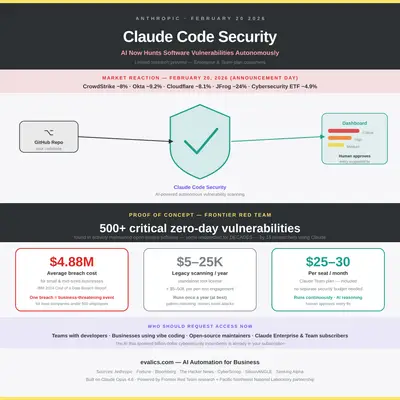
Cybersecurity software stocks, which had been quietly performing well, suddenly collapsed:
- CrowdStrike: down 8%
- Okta: down 9.2%
- Cloudflare: down 8.1%
- JFrog: down 24%
- Global X Cybersecurity ETF: down 4.9%, lowest since November 2023
A lot of value destroyed in a single afternoon — for companies with no bad quarterly results, no executive scandals, and no product failures.
So what happened?
Anthropic announced Claude Code Security.
And investors immediately understood something that most business owners have not yet processed.
What Anthropic Launched (And Why Investors Panicked)
Claude Code Security is a new capability in limited research preview for Enterprise and Team plan customers on claude.ai. In plain terms: you connect it to your GitHub repository, and Claude scans your software codebase for security vulnerabilities — automatically, continuously, and using genuine AI reasoning rather than rule-matching.
The market's reaction was not to a press release. It was to a demonstration.
Anthropic's Frontier Red Team — 15 researchers — used Claude Opus 4.6 (the model released two weeks earlier on February 5) to hunt for security vulnerabilities in production open-source software. Software that had been actively maintained, publicly reviewed, and professionally audited for years. Some of it for decades.
They found more than 500 critical zero-day vulnerabilities.
These were not obscure edge cases. These were bugs sitting in code that millions of businesses rely on — undetected by all the traditional security tools those businesses were paying for.
Investors did not panic because of a product announcement. They panicked because that result is a direct challenge to the value proposition of every company selling automated security scanning software. If Claude — already bundled into an existing subscription — finds what JFrog and CrowdStrike and legacy scanners missed for decades, what exactly are you paying those software licenses for?
How It Works (Without the Jargon)
Traditional security scanning tools work like spell-checkers: they compare your code against a list of known bad patterns. If your code matches a pattern on the list, it flags it. If the vulnerability is new, or subtle, or spans multiple files in a non-obvious way, the spell-checker misses it.
Claude Code Security reads code the way a human security researcher does. It traces how data flows through your application. It understands how different parts of the system interact. It reasons about what the code is trying to do — and identifies where that logic breaks down in ways that an attacker could exploit.
This is why it finds things that legacy tools do not. It is not matching patterns. It is understanding intent.
The workflow is straightforward:
- Connect Claude to your GitHub repository
- Claude scans the codebase
- Findings appear in a dashboard, sorted by severity and confidence score
- A developer reviews each finding with Claude's plain-language explanation
- Developer approves or rejects each suggested fix
- Nothing is applied automatically — ever
That last point is important and deliberate. Anthropic's position is explicit: Claude Code Security is a tool that empowers security professionals, not one that replaces them. Every decision stays with the human.
🔐 alt text: Workflow diagram: GitHub repository → Claude Code Security scan → findings dashboard (severity ratings, confidence scores) → human developer reviews and approves → optional patch applied
The Business Case in Plain Numbers
Cybersecurity is one of those areas where the cost of inaction is catastrophic and easy to underestimate — until you experience it.
The breach cost: A breach bill is not one number. It is regulatory fines, customer notification, legal fees, remediation, and reputational damage, arriving together. A single breach is a business-threatening event for most companies under 500 employees.
The current protection cost: Enterprise-grade automated vulnerability scanning typically runs $5,000–$25,000+ per year for a standalone tool. Penetration testing engagements (where a security firm manually reviews your code) run $5,000–$50,000 per engagement — and are typically done once a year, if at all.
The new math: A Claude Team plan subscription runs approximately $25–$30 per seat per month. Claude Code Security is included for Enterprise and Team customers. You are not adding a new line item. You are activating a capability you are already paying for.
The return on investment argument does not require a spreadsheet.
Why the Timing Matters — The Vibe Coding Security Debt
Anthropic made a point of addressing why they built this now. And it connects directly to a trend that every business owner building software should understand.
Vibe coding — using AI to generate software from plain-language descriptions — has exploded in the past 12 months. Y Combinator reports that 25% of their current batch of startups have codebases that are 95%+ AI-generated. Microsoft says AI writes 30%+ of its own code. The tools (Cursor, Lovable, Bolt, Replit) have made it possible for non-developers to build functional software without deeply understanding what they are building.
This is genuinely transformative. It also creates a security problem.
AI-generated code is code. Code has bugs. Security researchers have found that approximately 45% of AI-generated code contains vulnerabilities — some of them serious. And unlike code written by experienced developers, AI-generated code often lacks the implicit understanding of what parts are security-critical and what parts are not.
The result: businesses are generating more software than ever, much of it without the security expertise to review it properly. The attack surface is growing faster than the human capacity to audit it.
Claude Code Security is Anthropic's direct response to this problem. As AI generates more code, AI must also be capable of reviewing more code. The alternative is an exponentially growing pile of unreviewed software running in production environments — an attacker's dream.
What This Means for You Specifically
If you have developers on your team:
Claude Code Security gives your existing developer the output of a full security review team, working continuously rather than during an annual engagement. Your developer still makes every decision — Claude surfaces and explains the problem, your developer decides what to do about it.
The productivity multiplier is similar to what happened with AI coding assistance over the past two years: developers who use AI tools are measurably more productive. Claude Code Security applies the same logic to the security review side of development.
If you are using AI to build software:
This applies to you specifically. If you have been using vibe coding tools to build internal dashboards, automate workflows, or create customer-facing applications — and you do not have dedicated security expertise on your team — you have accumulated security debt you may not be aware of. Claude Code Security is the tool that audits what your AI-generated code actually contains.
If you are not building software:
Claude Code Security does not directly apply to your operations today. But the market reaction tells you something about the direction of AI in every professional service category: the tools that people pay large annual fees for are increasingly susceptible to being disrupted by AI capabilities bundled into general-purpose subscriptions. It is worth watching which of your existing software bills falls into that category.
How to Access It Now
Claude Code Security is available in limited research preview today for:
- Claude Enterprise plan customers
- Claude Team plan customers
- Open-source project maintainers (expedited access available — contact Anthropic directly)
If you are already on a Team or Enterprise plan, request access through your account settings or contact your Anthropic account representative. If you are on an individual plan and want access, upgrading to Team ($25–30/seat/month, billed annually) is the path.
Anthropic says broader availability is coming — no specific timeline has been announced.
What the Market Reaction Actually Signals
The 8–24% single-day drops across cybersecurity software stocks are worth dwelling on for a moment.
Markets are not always right. But when multiple companies in the same category lose significant market value on the same day — following a specific product announcement — the signal is hard to dismiss.
The market is saying: the category of software that automates security review is being disrupted. The moat that companies like CrowdStrike, Okta, and JFrog built — deep domain expertise encoded into specialized software — is now accessible to a general-purpose AI model that tens of millions of people already have in their subscription.
This does not mean those companies disappear. They will adapt, integrate AI, and find new positioning. But it means the price you pay for that category of software is under pressure — and the capability floor for what an AI-augmented lean team can accomplish in security has risen dramatically.
For business owners who have been deferring security investments because they could not justify the cost: the justification just changed.
Key Takeaway: Claude Code Security, launched February 20, 2026, is the clearest example yet of AI disrupting a specific, expensive category of enterprise software — not by replacing it entirely, but by making its core function available inside an existing subscription at a fraction of the cost. If you have developers and run software, request access now. If you are using AI to build code without a security review process, this tool was designed specifically for your situation. The average SMB breach costs $4.88 million. A Claude Team subscription costs $25–30 per seat per month.
Official Sources
- Claude Code Security announcement — Anthropic
- Fortune exclusive: AI can now hunt software bugs autonomously
- Bloomberg: Cyber stocks slide as Anthropic unveils Claude Code Security
- The Hacker News: Anthropic Launches Claude Code Security for AI-Powered Vulnerability Scanning
- CyberScoop: Anthropic rolls out embedded security scanning for Claude
- SiliconANGLE: Cybersecurity stocks drop after Anthropic debuts Claude Code Security
- Seeking Alpha: Cybersecurity stocks fall — Anthropic unveils Claude Code Security
By Kevin Michael Schindler, AI Automation Expert at Evalics