Two years ago, the advice for business owners was: "hire a developer who knows how to prompt AI."
One year ago, it became: "any employee can use AI for research and drafting."
On February 5, 2026, Anthropic changed the framing again — with a single phrase from Scott White, head of product for enterprise, at the Claude Opus 4.6 launch:
"I think that we are now transitioning almost into vibe working."
Vibe working. The successor concept to vibe coding. And it matters enormously for every business owner who has ever thought "I wish I could just tell someone to take this project and come back with a result."
From Vibe Coding to Vibe Working
If you missed it, vibe coding — popularized by OpenAI co-founder Andrej Karpathy in early 2025 — is the practice of describing software in plain English and letting AI write the code. Non-technical founders building apps by describing them. Developers moving ten times faster. MIT Technology Review named it one of the breakthrough technologies of 2026.
Vibe coding changed software development. Vibe working extends the same principle to everything else:
- Financial analysis
- Legal research
- Strategic planning
- Product management
- Board reports and investor decks
- Competitive intelligence
The idea is the same: describe what you want, set the level of ambition, and hand it over. Claude Opus 4.6 handles the planning, the sub-tasks, and the delivery.
What makes this possible — technically — are three things that launched together on February 5: agent teams, a 1 million token context window, and native Microsoft Office integration. Each one alone is incremental. Together, they create a different category of tool.
Agent Teams: The AI You Delegate To Has a Team
Previous AI models worked sequentially. You asked, they answered. Even agentic models that could use tools — browse, run code, search databases — still worked through a single thread of activity.
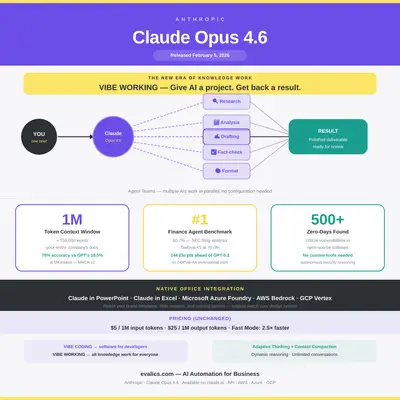
Agent teams change this. Claude Opus 4.6 can now split a large task into specialized sub-tasks, spin up multiple sub-agents to handle each one in parallel, and then coordinate and merge their outputs — without you configuring any of this.
Practical example: "Review our entire codebase for security vulnerabilities." A single agent working sequentially would take hours. With agent teams, Claude spawns sub-agents, each responsible for a different module. They work simultaneously. A combined report comes back.
The same principle applies to non-technical work. "Analyze these 40 competitor SEC filings and give me a summary table with revenue trends, hiring signals, and product investment patterns." Previously, that meant 40 separate prompts or a lot of manual stitching. With agent teams, Claude plans the task, delegates the filings, and synthesizes the result.
You are no longer using AI one question at a time. You are delegating a project.
🔭 alt text: Diagram showing vibe working: a business owner gives one high-level instruction on the left; the center shows Claude splitting it into five parallel agent streams (research, analysis, formatting, fact-checking, synthesis); the right shows the final deliverable
The 1 Million Token Context Window
This number sounds technical. The business translation is straightforward.
One million tokens ≈ 750,000 words ≈ your entire company's documentation.
Previous Opus models topped out around 200,000 tokens. That is still large — about 150,000 words. But it forced a choice: what do you include in a given prompt? Your Q3 data or your Q4 data? The first half of the legal agreement or the second?
With 1 million tokens, you do not choose. You include everything.
This matters most for:
- Due diligence: Feed every document in the data room at once. Get a comprehensive risk analysis without summarizing first.
- Legal review: Provide the full contract archive. Claude identifies cross-document inconsistencies and missing clauses.
- Financial analysis: Load multiple years of transactions, your entire chart of accounts, and the full management accounts. The model sees everything simultaneously and does not lose thread.
- Strategic research: Every industry report, every competitor analysis, every internal memo — in one session.
Critically, Anthropic built a new retrieval mechanism to maintain coherence at this length. Opus 4.6 scores 76% on MRCR v2 at 1 million tokens. OpenAI's GPT-5.2 scores 18.5% at the same length. The gap is not small.
Claude in PowerPoint and Excel: AI Where You Already Work
The previous version of office integration worked like this: ask Claude to build a PowerPoint, download the file, upload it to PowerPoint, fix everything it got wrong because it did not know your brand templates.
Claude Opus 4.6 closes this loop.
Claude now lives as a side panel inside PowerPoint. It reads your existing slide masters, font styles, brand colors, and layout templates. When it generates slides, they look like they came from your internal design team — not from a generic AI with no brand awareness. Available now in research preview for Max, Team, and Enterprise plan users.
In Excel, Claude has become substantially more capable with long-running financial models. Complex multi-step calculations, large datasets, iterative modeling — these no longer cause the model to lose track halfway through or start making errors of convenience.
And for organizations on Microsoft Azure Foundry, Claude Opus 4.6 goes further: it can pull context from Microsoft 365 (emails, documents, SharePoint), Microsoft Fabric data, and the web — all in a single prompt. You are not copying and pasting data into Claude anymore. Claude comes to the data.
The Benchmark Numbers (For Those Who Track Them)
Benchmarks rarely translate directly to real work. But two of Opus 4.6's results are worth knowing:
Finance Agent (#1 at 60.7%): This benchmark, run by Vals AI, evaluates models on SEC filing analysis — the kind of work financial analysts, private equity associates, and corporate finance teams do every day. Opus 4.6 is first place. The improvement over its predecessor is 5.47 percentage points — large for a task this specific.
GDPval-AA (144 Elo ahead of GPT-5.2): GDPval measures performance on economically valuable professional work across finance, legal, and other knowledge domains. Leading by 144 Elo — roughly a 70% head-to-head win rate — is a significant margin on a benchmark designed to capture what actual expert work looks like.
ARC-AGI-2 (37.6% → 68.8% in one generation): This is the abstract reasoning test. Going from 37.6% to 68.8% in a single model generation is unusually large. The entire field moved roughly 10 points on this benchmark over the previous two years combined.
These numbers translate to one practical conclusion: for knowledge workers doing analytical, document-heavy, or research-intensive work, Claude Opus 4.6 is currently the best-performing model available.
The Security Story (And What It Says About Capability)
Before releasing Opus 4.6, Anthropic's Frontier Red Team put the model inside a sandboxed environment and asked it to find security vulnerabilities in open-source software. No custom tools, no specialized prompting, no task-specific scaffolding.
Claude found more than 500 critical zero-day vulnerabilities across major open-source libraries — autonomously.
This story is significant not because most business owners are running security audits. It is significant because it demonstrates the model's ability to read complex technical systems with human-like understanding of logic and intent — not keyword matching, not pattern lookup, but genuine comprehension of what a piece of code is trying to do and where that logic breaks down.
That same capability is what makes Opus 4.6 useful for contract review, financial model auditing, and any task where surface-level reading is insufficient.
What Pricing Looks Like
Anthropic kept pricing flat at launch:
- Standard: $5 per million input tokens / $25 per million output tokens
- Extended context (1M window): Premium pricing (details on Anthropic's pricing page)
- Fast Mode: Up to 2.5x faster output at premium pricing — useful for time-sensitive workflows
For context: a comprehensive analysis task that uses 100,000 input tokens and generates 10,000 output tokens costs roughly $0.75. That is a financial analyst's morning coffee for a task that would have taken hours.
Vibe Working in Practice: Three Scenarios
Scenario 1 — The Board Report
Old approach: Export data from three systems. Write an outline. Draft sections. Iterate. Format. Four hours minimum.
Vibe working approach: "Here is our Q4 data export, our previous three board reports, and our strategic plan. Write the Q4 board report in our established format. Flag any metric that moved more than 15% vs. the prior quarter with a brief explanation."
Claude reads all three sources simultaneously (1M context), matches the format from previous reports, identifies the variance flags automatically, and returns a first draft ready for light editing.
Scenario 2 — Competitive Analysis
Old approach: Assign an analyst. Two days. A summary document you wish was more actionable.
Vibe working approach: "Here are the 10-K filings for our five main competitors for the last three years. Summarize revenue trends, R&D investment patterns, hiring signals from the job postings I've attached, and any product announcements. Give me a two-page competitive brief."
Claude runs five parallel analyses (agent teams), synthesizes across sources, and delivers the brief.
Scenario 3 — Client Proposal
Old approach: Start from a template. Customize manually. Three hours.
Vibe working approach: "Here is our standard proposal template, the client discovery notes from our last three meetings, our past work with similar clients, and their company's annual report. Write a tailored proposal that references their specific priorities on pages 12 and 27 of their report."
Claude reads all sources at once, generates a genuinely personalized proposal — not a mail-merged template.
The Bottom Line for Business Owners
Vibe coding gave non-technical founders access to software development. Vibe working gives every professional access to a capable, context-aware colleague who can take a project brief and deliver meaningful output.
Claude Opus 4.6 is the first model capable enough, with a large enough context window, with tight enough Office integration, to make this practical — not just in demos, but in actual daily work.
Two things to do this week:
- Try it with a real project. Something you normally spend two to three hours on. Hand it to Claude with all the relevant documents and a clear brief. See what comes back.
- Think about where your bottlenecks are. Which recurring tasks involve reading a lot of material, synthesizing it, and producing a document? Those are vibe working's first targets.
The shift from chatbot to colleague has been promised many times. With agent teams, a million-token window, and native Office integration — February 2026 is when it starts to look real.
Key Takeaway: Vibe working is not about coding. It is about giving AI a full project brief instead of a single question — and getting back a meaningful deliverable instead of a draft you have to rewrite from scratch. Claude Opus 4.6 makes this viable today for any knowledge worker: financial analysts, lawyers, operations leads, marketers. If you have not tested a full-project prompt yet, now is the time.
Official Sources
- Introducing Claude Opus 4.6 — Anthropic
- Anthropic releases Opus 4.6 with new 'agent teams' — TechCrunch
- Anthropic launches Claude Opus 4.6 as AI moves toward a 'vibe working' era — CNBC
- Claude Opus 4.6 brings 1M token context and agent teams — VentureBeat
- Claude Opus 4.6 on Microsoft Azure Foundry — Microsoft Azure Blog
- Advancing finance with Claude Opus 4.6 — Anthropic
- Claude Opus 4.6 Finds 500+ High-Severity Flaws — The Hacker News
By Kevin Michael Schindler, AI Automation Expert at Evalics