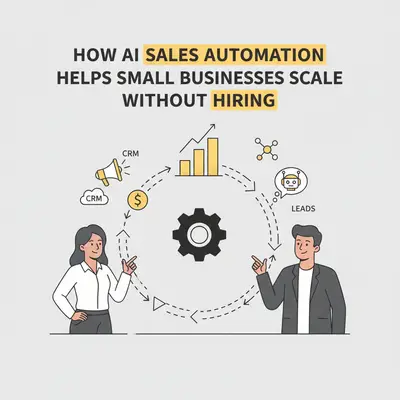
Small businesses often struggle with growth due to limited resources and repetitive tasks. AI sales automation can help by handling time-consuming processes like lead scoring, follow-ups, and scheduling - allowing teams to focus on closing deals.
Here’s what you’ll learn:
- How to identify tasks that can be automated (e.g., data entry, follow-ups).
- The benefits of AI tools like real-time lead scoring and personalized outreach.
- How analytics and AI forecasting improve decision-making and growth planning.
- Evalics offers tailored plans to help businesses automate sales tasks, from basic tools to advanced solutions for scaling operations.
Start by auditing your sales workflow to find inefficiencies, then use AI to improve productivity without increasing payroll.
8 AI Sales Automations That Feel Like Cheating (PROVEN Systems)
Finding Sales Tasks to Automate
Before diving into AI tools, it’s smart to figure out where automation can make the biggest difference. On average, entrepreneurs lose up to 16 hours a week on repetitive tasks - time that automation could reclaim, saving around 15 hours and cutting operating costs by 30% [6][8].
Start by reviewing your daily sales activities. Pinpoint tasks that eat up time but don’t require your expertise - things like data entry, sending follow-up emails, updating contact records, or tracking lead engagement. These are often repetitive, time-consuming, and prone to mistakes. For example, sales teams typically spend only about 25% of their time actually selling. By automating routine work, they can focus more on revenue-generating activities [9]. Conducting a workflow audit is a good way to identify these inefficiencies.
How to Audit Your Sales Workflow
To get started, map out your sales process from the first contact to closing the deal. Note who handles each task, how long it takes, and where delays occur. Track your team’s activities over a week to spot repetitive time sinks, like entering lead information into your CRM, responding to inquiries, setting up meetings, or sending follow-ups. This will help you zero in on processes that are repeated often and could benefit from automation.
Pay special attention to bottlenecks. For example, leads can go cold if follow-ups are missed, or deals might stall due to inefficient manual tracking. Considering that 73% of leads aren’t ready to convert right away, automated nurturing is essential for keeping prospects engaged and moving through the sales funnel [7].
Also, audit your data for issues like duplicates, blank fields, or inconsistencies. Clean data gives AI tools a better foundation to work with [9][10]. With this understanding, you’ll be ready to compare manual efforts against automated solutions.
Manual vs. Automated Sales: A Comparison
Once you’ve identified inefficiencies, it’s time to compare manual processes with AI-powered alternatives. Manual tasks - like entering lead data, drafting personalized emails, scoring leads, and coordinating meeting schedules - can be both time-consuming and prone to errors. Automation, on the other hand, simplifies these tasks by:
- Automatically capturing lead information from digital interactions.
- Sending personalized follow-ups based on lead behavior.
- Scoring leads in real time based on engagement metrics.
- Streamlining appointment scheduling with calendar integrations.
- Providing real-time dashboards to track your sales pipeline.
This shift doesn’t just save time; it ensures every lead gets consistent, timely follow-ups. In fact, companies that are effective at nurturing leads generate 50% more sales-ready prospects [7].
AI-Powered Lead Generation and Scoring
After completing your workflow audit, AI can step in to optimize both lead generation and scoring, ensuring your team spends less time chasing unqualified prospects. AI-driven tools handle the grunt work - gathering leads from various sources, enriching them with company details and industry updates, and pinpointing the prospects most likely to convert [10]. This gives your team the freedom to focus on leads with the highest potential.
What sets AI apart from traditional automation is its ability to learn and adapt. Instead of rigidly following predefined rules, AI analyzes patterns in buyer behavior, industry trends, and user engagement to refine its approach [10]. For instance, if a prospect frequently visits your pricing page, downloads resources, or engages actively with email campaigns, the AI can flag them for immediate follow-up. This level of insight can boost win rates by over 30% at every stage of the sales funnel [9]. By integrating these capabilities with Evalics' AI tools, you can seamlessly enhance your existing systems.
Setting Up Automated Lead Generation
To get started, connect Evalics' AI tools to your existing platforms, such as your website, CRM, email service, and other lead capture channels. The AI will automatically gather lead information from forms, chatbots, and social media platforms [3][4]. This eliminates hours of manual data entry, letting your team concentrate on strategic sales efforts.
Next, configure the AI to enrich lead data in real time. Using AI-powered research, it can pull in critical details like company size, industry, and recent news - giving you a clearer picture of who you're engaging with [10]. You can also set up automated outreach sequences that trigger based on specific lead actions. The AI personalizes these messages by analyzing behavior and engagement history, ensuring each prospect receives relevant communication.
Configuring Lead Scoring for Higher Conversions
Once the lead data has been enriched, AI takes lead scoring to the next level. Unlike traditional systems that rely on static rules - like assigning points for job titles or company size - AI evaluates a broader range of indicators to assess purchase intent [10]. It combines behavioral signals (such as site visits, email clicks, content downloads, pricing page views, and social media interactions) with firmographic data (like company size, industry, location, and revenue) to rank leads in real time.
To implement this in Evalics, start by defining what a qualified lead looks like for your business. Identify key criteria such as target industries, company sizes, and specific buying signals. The AI will then automatically score each lead, updating rankings as prospects engage with your content. High-scoring leads are routed directly to your sales team, while lower-scoring leads are placed into automated nurturing sequences until they're ready to convert. This ensures your team focuses only on prospects who are prepared to buy.
Considering that 73% of leads aren't ready to convert immediately, automated nurturing keeps these prospects engaged until they are [7]. With 75% of marketers already leveraging AI to reduce manual tasks, this intelligent prioritization has become essential for maintaining a competitive edge [2].
Automating Personalized Customer Engagement
AI is transforming how businesses maintain personalized communication with their leads. Once you've identified qualified prospects, keeping the conversation going is crucial. AI-powered tools analyze customer behavior to craft messages that truly connect. For example, they can create tailored email versions, tweaking subject lines and product recommendations based on a prospect's actions. These tools also simplify testing by letting you experiment with different subject lines, layouts, or calls-to-action while using real-time data to fine-tune your strategy [4].
Setting Up Personalized Email and Message Automation
By linking Evalics' AI tools with your CRM and customer data, you can automate outreach in a way that feels personal. Evalics uses data like past purchases, browsing habits, and engagement history to create messages tailored to each recipient. Its AI-driven email assistants can generate personalized subject lines, body text, and even unique openers that adapt based on a recipient's previous interactions. You can also set up automated sequences to send follow-ups when specific actions occur - like downloading a resource, revisiting the pricing page, or abandoning a shopping cart. With 41% of sellers reporting that AI has reduced time-consuming tasks, this automation frees up your team to focus on meaningful, high-value conversations [5][11].
Automating Meeting Scheduling and Follow-Ups
Evalics takes the hassle out of scheduling by syncing with your calendar to manage appointments seamlessly. The AI handles booking, sends reminders to ensure prospects are prepared, and even captures meeting details for follow-ups [12][13]. Afterward, it schedules next steps and recommends the best times to reach out based on engagement data [11]. Multi-channel sequences also adapt to a prospect's behavior - if an email goes unanswered, the system can trigger a LinkedIn message or phone call. This 24/7 automation ensures no lead is overlooked while maintaining the personal touch that drives conversions.
Using Analytics and Forecasting to Drive Growth
Relying on gut instincts for decision-making often leads to missed opportunities. Instead, analytics powered by AI can transform your sales data into a clear roadmap for growth, offering actionable insights into where your best opportunities lie. In fact, 96% of business leaders report making better decisions when using automated data analysis tools [2].
Evalics takes your sales data and processes it automatically, identifying high-potential leads, deals at risk, and messaging trends that resonate most effectively [10]. It provides instant clarity on what's driving your revenue and what obstacles are holding you back. By analyzing pipeline health, historical close rates, and deal velocity, Evalics delivers accurate projections that help you decide where to focus your resources [10]. The result? A streamlined view of your business, wrapped into easy-to-use dashboards.
Creating Real-Time Performance Dashboards
Evalics brings all your sales data into a single, real-time dashboard, giving you a comprehensive view of key metrics. Track revenue growth, monitor customer churn, and calculate ROI with ease [2]. The platform also evaluates drip campaigns, tracks email and LinkedIn activity, and assesses team performance, helping you fine-tune your strategies as situations evolve [14].
You can customize dashboards to focus on the metrics that matter most - such as monthly recurring revenue, lead response times, and conversion rates. With real-time sales intelligence, you’ll get up-to-date insights into your prospects and competitors, making it easier to identify high-potential leads and adapt to market changes [5]. Knowing which campaigns drive qualified leads and which team members close deals fastest lets you prioritize efforts where they’ll have the biggest impact.
Improving Sales Forecasting with AI
Traditional forecasting often relies on outdated methods like manual calculations and historical averages, which can quickly lose relevance. AI-driven forecasting takes a smarter approach, analyzing both historical patterns and current data to generate precise sales predictions [5][1]. It highlights deals most likely to close and flags those requiring immediate attention, enabling you to coach your team effectively and minimize revenue risks [10].
Businesses using AI for sales report a 30% boost in win rates, thanks to improved conversion rates at every stage of the sales funnel [9]. These predictive insights help small businesses allocate resources more wisely, avoiding unnecessary expenses. That said, success depends on proper implementation. A study of 1,000 global organizations found that 74% had not achieved measurable value from their AI investments [15]. To get the most out of AI, you need clean, reliable data - standardize entries, eliminate duplicates, and fill in gaps within your CRM [10]. When your data is accurate and your team knows how to act on AI-driven recommendations, sales forecasting becomes a true competitive edge.
Selecting the Right Evalics Plan
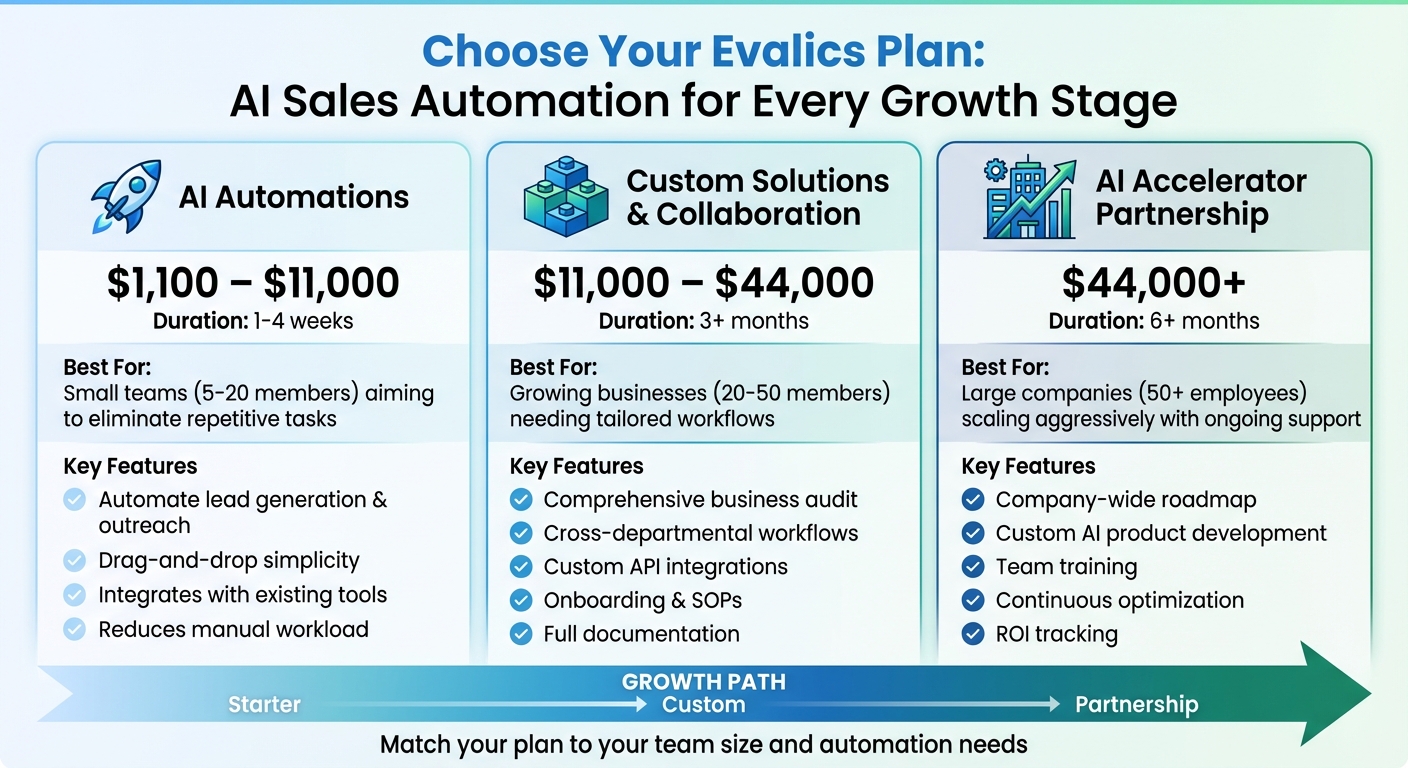
Choosing the right Evalics plan means aligning it with where your business is now and where you want it to go. Evalics offers three service tiers, each tailored to different growth stages and automation needs. These plans are designed to integrate seamlessly into your sales operations, ensuring AI-driven improvements are applied effectively.
Evalics Plan Comparison
| Plan Name | Price / Duration | Best For | Key Features |
|---|---|---|---|
| AI Automations | $1,100 – $11,000 (1-4 weeks) | Small teams aiming to eliminate repetitive tasks | Automate lead generation & outreach, Drag-and-drop simplicity, Integrates with existing tools, Reduces manual workload |
| Custom Solutions & Collaboration | $11,000 – $44,000 (3+ months) | Growing businesses needing tailored workflows | Comprehensive business audit, Cross-departmental workflows, Custom API integrations, Onboarding & SOPs, Full documentation |
| AI Accelerator Partnership | $44,000+ (6+ months) | Large companies scaling aggressively with ongoing support | Company-wide roadmap, Custom AI product development, Team training, Continuous optimization, ROI tracking |
Matching Plans to Your Business Needs
For small teams of 5–20 members, the AI Automations plan is an excellent starting point. It focuses on automating lead generation and outreach, freeing up your team to focus on closing deals instead of repetitive tasks.
As your business grows to 20–50 team members, the Custom Solutions & Collaboration plan becomes a better fit. It’s designed to handle more complex workflows and integrate multiple departments. The in-depth business audit ensures that the automation aligns with your unique processes, avoiding one-size-fits-all solutions.
For larger companies with 50+ employees, the AI Accelerator Partnership offers the strategic resources needed for significant expansion. This plan provides ongoing support, including team training, continuous optimization, and ROI tracking - essential for ensuring automation decisions positively impact company-wide operations and future investments [16].
Conclusion
Grow your business without increasing payroll - AI automation takes care of repetitive tasks, allowing your team to focus on closing deals and driving results [17].
Start by auditing your sales workflow to uncover bottlenecks. Once identified, AI tools can help scale your operations efficiently, without the need to add more staff [17]. This approach lays the groundwork for smarter, more efficient business growth.
Evalics offers flexible plans to suit businesses at different stages of growth. The AI Automations plan is perfect for small teams looking to eliminate busywork quickly. For those needing deeper integration and ongoing support, the Custom Solutions & Collaboration and AI Accelerator Partnership plans provide tailored options to meet evolving needs.
FAQs
1. How does AI sales automation help small businesses save money and work more efficiently?
AI-driven sales automation enables small businesses to cut costs by taking over repetitive tasks like data entry and follow-ups. This reduces the reliance on extra staff while also lowering the chances of expensive mistakes. Plus, it boosts efficiency by automating key workflows such as lead scoring and managing customer interactions.
By streamlining these operations, small businesses can redirect their energy toward growth while keeping expenses in check - achieving meaningful savings without sacrificing productivity.
2. What's the difference between manual and AI-powered lead scoring?
Manual lead scoring relies on predefined criteria and human judgment, which can sometimes be inconsistent and subjective. Plus, it often works with a smaller pool of data, making it challenging to pinpoint the most promising leads.
On the other hand, AI-powered lead scoring takes a smarter approach. It uses advanced algorithms to analyze real-time data like website visits, email engagement, and buying patterns. This method delivers precise and objective rankings, allowing businesses to zero in on leads with the highest potential to convert - saving time and cutting out the guesswork.
3. How can AI enhance sales forecasting and help businesses make better decisions?
AI transforms sales forecasting and decision-making by diving into real-time customer data to predict trends and pinpoint high-value leads. This means businesses can rely on precise, data-driven insights instead of guesswork.
Using tools like predictive analytics and lead scoring, AI helps businesses focus on the right opportunities, allocate resources wisely, and even fine-tune pricing on the fly. These features simplify the sales process, cut down on manual tasks, and give small businesses the ability to grow efficiently - without needing to expand their team.