A lead visits your pricing page three times in one day. Your competitor's sales rep calls them first. By the time your team notices the activity in your CRM—two days later—the opportunity is gone.
This scenario happens daily for sales teams relying on stale CRM data. While your sales reps manually research leads and wait for batch updates, prospects are making decisions. Real-time data changes that equation. When a prospect shows buying intent, your team knows immediately. When a lead needs enrichment, it happens automatically. When a high-value opportunity appears, alerts prioritize it instantly.
Key Insight: Companies using real-time sales data report 25% higher conversion rates and respond to leads 10x faster than teams relying on batch updates. The difference isn't just speed—it's the ability to engage prospects when they're actively evaluating solutions. According to research on real-time data in sales, businesses leveraging immediate insights see significant improvements in adaptability, forecast accuracy, and buyer engagement.
Real-time data transforms sales from reactive to proactive. Instead of chasing cold leads days after initial interest, your team engages prospects at the moment of highest intent. This guide shows you exactly how real-time data improves sales processes, from understanding what it means in practice to implementing automation workflows that make it possible.
The Problem with Stale Data in CRMs
Most CRMs update data in batches. A lead fills out a form on Monday, but the enrichment data doesn't appear until Wednesday's scheduled sync. A prospect visits your website five times, but your sales team doesn't see those signals until the weekly report runs. By then, the moment has passed.
Stale data creates three critical problems for sales teams:
Missed opportunities: When leads show buying intent—visiting pricing pages, downloading resources, or engaging with content—delayed notifications mean your team responds too late. Research shows that companies responding to leads within 5 minutes are 100x more likely to connect than those responding after 30 minutes. With stale data, you're always behind.
Inefficient prioritization: Without real-time signals, sales reps can't distinguish between hot prospects and cold leads. Everyone looks the same in a CRM that updates weekly. Your top salesperson spends an hour crafting outreach for a lead who already bought from a competitor, while a highly engaged prospect sits uncontacted.
Wasted research time: Sales development representatives (SDRs) spend 15-20 hours per week manually researching leads that should already be enriched. They're looking up company sizes, verifying email addresses, and checking LinkedIn profiles—tasks that automation handles instantly with real-time data. For a deeper look at how AI can automate this process, see our guide on what AI lead qualification is and how it works.
Real-world example: A 12-person marketing agency's sales team was losing deals to faster competitors. Their CRM updated lead data once daily at 6 AM. By the time sales reps saw website visit alerts at 9 AM, prospects had already scheduled demos with competitors who responded immediately. After implementing real-time data workflows, they reduced response time from 24 hours to under 5 minutes, increasing conversion rates by 30%. This aligns with industry research showing that real-time sales intelligence significantly improves decision-making and customer engagement.
Reality Check: Most sales teams don't realize how much stale data costs them. If your CRM updates less frequently than every hour, you're likely missing 20-30% of qualified opportunities simply because you're responding too late. The cost isn't just lost deals—it's the time your team spends on leads that have already moved on.
What Real-Time Data Means in Sales Context
Real-time data in sales means information updates instantly as events happen, not on a schedule. When a prospect takes an action—visiting your website, opening an email, or submitting a form—your CRM and sales tools reflect that change within seconds, not hours or days.
Types of real-time sales data signals:
Website activity: Instant alerts when prospects visit high-intent pages like pricing, features, or case studies. These signals indicate active evaluation and buying readiness.
Form submissions: Immediate notifications when leads complete contact forms, request demos, or download resources. Real-time processing means your team can respond while the prospect is still engaged.
Email engagement: Real-time tracking of email opens, link clicks, and replies. This helps sales reps time follow-ups perfectly—calling right after a prospect opens your pricing email, for example.
CRM updates: Instant synchronization when lead data changes. If a prospect's company raises funding or hires a new executive, your CRM reflects that immediately, enabling timely, relevant outreach.
Lead enrichment: Automatic data updates the moment a new lead enters your system. Company size, industry, technology stack, and contact information populate instantly, eliminating manual research.
The difference between real-time and batch updates:
Batch updates run on schedules—hourly, daily, or weekly. Your CRM might sync with enrichment services every night at 2 AM. A lead that enters your system at 10 AM on Monday doesn't get enriched until Tuesday morning. Real-time updates happen continuously. A lead enters at 10 AM, and enrichment completes by 10:00:15 AM.
For sales teams, this difference is critical. Batch updates mean you're always working with yesterday's information. Real-time data means you're working with current information, enabling faster responses and better decisions.
Pro Tip: Start with real-time alerts for your highest-value signals. Website visits to pricing pages, demo requests, and form submissions should trigger immediate notifications. You can add more signals later, but these three will have the biggest impact on conversion rates.
Instant Lead Enrichment for Better Conversations
Manual lead research kills sales productivity. An SDR spends 20 minutes researching a single lead: checking company size, verifying the contact's role, understanding their tech stack, and confirming they're not a competitor. Multiply that by 50 leads per week, and you're looking at 16+ hours of research time that could be automated.
Real-time lead enrichment eliminates this manual work. The moment a lead enters your system—through a form submission, website tracking, or imported list—automation enriches their profile instantly with company data, contact information, and buying signals.
What gets enriched in real-time:
Company information: Employee count, annual revenue, industry classification, headquarters location, and company website. This helps sales reps immediately understand if a prospect fits your ideal customer profile (ICP).
Contact details: Job title, seniority level, department, direct email, and phone number. Sales reps know who they're talking to and whether they have decision-making authority.
Technology stack: What software and tools the company uses. This enables sales reps to reference specific integrations or mention how your solution works with their existing tools.
Buying signals: Recent funding rounds, hiring announcements, office expansions, or technology purchases. These signals indicate growth and potential budget for new solutions.
Competitor detection: Automatic checks against your competitor list. This prevents awkward outreach to companies that are direct competitors or already customers.
Impact on first conversations:
When sales reps have enriched data before the first call, conversations are more relevant and productive. Instead of asking "What does your company do?" they can say "I noticed you're a 50-person marketing agency using HubSpot. We've helped similar agencies automate client reporting." This level of personalization increases engagement and builds trust immediately.
Real-world example: A B2B SaaS company's sales team was spending 12 hours per week manually researching leads. After implementing real-time enrichment, that time dropped to zero. More importantly, their first-call conversion rate increased from 15% to 28% because reps had context before dialing. They could reference specific company details, mention relevant integrations, and address pain points common to companies of that size and industry. For a detailed case study on implementing AI-powered lead qualification, see how we built an automated lead vetting system.
Quick Win: Real-time enrichment pays for itself quickly. If your SDRs spend 10+ hours per week on manual research, automation frees that time for actual selling. At $50,000 annual salary, that's $12,000+ in recovered productivity per SDR per year—more than enough to cover enrichment tool costs.
Real-Time Alerts for Prioritization
Not all leads are created equal. A prospect who visits your pricing page five times in one day is significantly more likely to buy than someone who downloaded a generic ebook three months ago. Real-time alerts help sales teams identify and prioritize these high-intent prospects immediately.
How real-time alerts work:
When a prospect takes a high-value action, automation triggers an instant alert to the appropriate sales rep. These alerts can come through email, Slack, your CRM, or a mobile app—wherever your team works most effectively.
High-value actions that trigger alerts:
Website behavior: Multiple visits to pricing or features pages, time spent on specific content, or returning visitor patterns. These signals indicate active evaluation.
Form submissions: Demo requests, contact form submissions, or resource downloads. These are explicit expressions of interest.
Email engagement: Opening pricing emails multiple times, clicking through to your website, or replying to outreach. These show engagement with your messaging.
CRM activity: Lead score changes, opportunity stage updates, or task completions. These indicate progress through the sales funnel.
Prioritization logic:
Real-time alerts don't just notify—they prioritize. Automation can rank alerts by lead score, company size, engagement level, or deal value. A $100,000 enterprise opportunity gets flagged before a $5,000 small business lead, even if both triggered alerts simultaneously.
Most engaged prospects identification:
Real-time data helps identify which prospects are actively evaluating solutions. A lead who visits your pricing page, then your case studies, then requests a demo—all within 24 hours—is clearly in buying mode. Real-time alerts ensure your sales team knows immediately and can respond while the prospect is still engaged.
Example alert system:
A 25-person consulting firm implemented real-time alerts for their sales team. When a prospect visits the pricing page, an alert goes to the assigned sales rep within 30 seconds. If that same prospect visits again within 24 hours, the alert is marked as "high priority" and includes their full engagement history. This system helped them increase response time from 4 hours to under 2 minutes, resulting in a 40% improvement in demo-to-close rates.
Key Insight: Real-time alerts are most effective when they're actionable, not just informational. Instead of "Lead visited pricing page," send "Lead visited pricing page 3x today—call within 5 minutes for 10x higher conversion." This gives sales reps clear direction on what to do next.
Automation as the Engine
Real-time data doesn't happen by accident. It requires automation workflows that connect your CRM, website, email tools, and enrichment services. Automation platforms like n8n and Make.com enable sales teams to build these workflows without coding, creating real-time data pipelines that update instantly. For a comprehensive overview of AI-powered sales automation, check out our guide on AI-powered sales automation and how it transforms revenue generation.
How automation enables real-time processes:
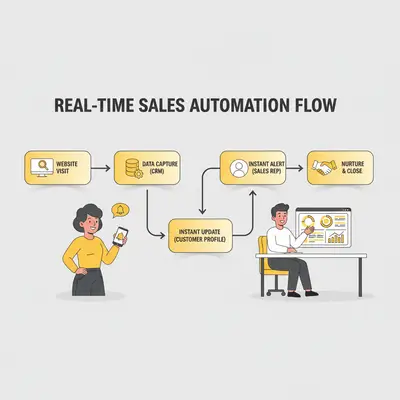
Event triggers: When a prospect takes an action—submitting a form, visiting a page, or opening an email—automation detects it immediately and triggers a workflow.
Data enrichment: Automation calls enrichment APIs (like Clearbit or Apollo.io) the moment a new lead enters your system, populating CRM fields with company and contact data within seconds.
Alert distribution: Automation routes alerts to the right sales rep based on territory, lead score, or workload, ensuring high-priority opportunities get immediate attention.
CRM synchronization: Automation keeps your CRM updated in real-time, syncing data from multiple sources so sales reps always have current information.
Workflow examples:
Real-time lead enrichment workflow: A prospect submits a contact form on your website. The form data triggers an n8n workflow that immediately enriches the lead with Clearbit, verifies the email with Hunter.io, checks against your competitor database, and creates a CRM record with all data populated. This entire process completes in 3-5 seconds.
Website visit alert workflow: A known prospect visits your pricing page. Make.com detects the visit through your website tracking tool, checks their lead score in your CRM, and if they're a high-value prospect, sends an instant Slack alert to their assigned sales rep with their full engagement history.
Email engagement tracking workflow: A sales rep sends a pricing email. When the prospect opens it, automation logs the engagement in your CRM, updates their lead score, and if they click through to your website, triggers a high-priority alert for immediate follow-up.
Integration with CRMs:
Real-time automation works with any CRM—HubSpot, Salesforce, Pipedrive, or custom solutions. The key is using webhooks and APIs to enable instant data flow. Most modern CRMs support webhooks that trigger workflows when records are created or updated, enabling true real-time synchronization.
Implementation considerations:
Tool selection: Choose automation platforms that support real-time triggers. n8n and Make.com both offer webhook triggers that respond instantly to events, making them ideal for real-time sales workflows.
Error handling: Real-time workflows need robust error handling. If an enrichment API fails, the workflow should retry automatically and still create the CRM record with available data, rather than blocking the entire process.
Cost management: Real-time enrichment can get expensive at scale. Set up usage limits and only enrich high-value leads automatically, using batch enrichment for lower-priority prospects.
Team training: Sales teams need to understand how real-time data works and trust the alerts. Provide training on interpreting signals and taking action quickly.
Reality Check: Building real-time automation workflows takes 2-4 weeks initially, but the ongoing maintenance is minimal. Most workflows run reliably for months without changes. The upfront investment pays off quickly through improved response times and higher conversion rates.
Common Pitfalls and How to Avoid Them
Implementing real-time data isn't without challenges. Here are the most common mistakes sales teams make and how to avoid them:
Alert fatigue: Too many alerts overwhelm sales reps, causing them to ignore notifications. Solution: Only alert on high-value actions. Set up filtering so sales reps only see alerts for leads above a certain score or companies of a certain size.
Incomplete data: Real-time enrichment sometimes misses data points, leaving gaps in lead profiles. Solution: Use multiple enrichment sources and fallback logic. If one API doesn't have company data, try another before marking the lead as incomplete.
Integration complexity: Connecting multiple tools for real-time workflows can become complicated. Solution: Start simple with one or two real-time signals, then expand gradually. Use automation platforms that simplify integrations.
Cost overruns: Real-time enrichment APIs charge per lookup. High-volume teams can rack up significant costs. Solution: Set enrichment rules—only enrich leads that meet certain criteria, use batch enrichment for lower-priority prospects, and monitor usage regularly.
Timing issues: Real-time alerts that arrive at 2 AM aren't helpful if sales reps aren't working. Solution: Set up business hours logic in your automation workflows. Queue alerts during off-hours and deliver them when sales reps are active.
Conclusion: Transforming Sales with Real-Time Data
Real-time data transforms sales from reactive to proactive. Instead of responding to leads days after initial interest, your team engages prospects at the moment of highest intent. Instead of manually researching every lead, automation enriches profiles instantly. Instead of guessing which prospects are hot, real-time alerts prioritize opportunities automatically.
The three key takeaways:
Speed matters: Leads contacted within 5 minutes convert 100x more often than those contacted after 30 minutes. Real-time data enables this speed by alerting your team immediately when prospects show buying intent.
Context enables personalization: Real-time enrichment gives sales reps company and contact details before the first conversation, enabling personalized outreach that increases engagement and builds trust.
Automation makes it possible: Real-time data requires automation workflows that connect your CRM, website, and enrichment services. Platforms like n8n and Make.com make this achievable without coding, enabling any sales team to implement real-time processes.
The transition from stale to real-time data isn't just about technology—it's about changing how your sales team operates. When alerts prioritize high-intent prospects and enrichment happens automatically, sales reps focus on selling, not researching. When response times drop from hours to minutes, conversion rates increase significantly.
Ready to transform your sales process with real-time data? Book a demo with Evalics to see how we can help you implement real-time workflows that prioritize prospects, enrich leads instantly, and increase conversion rates.
FAQ
1. What is real-time data in sales?
Real-time data in sales means information that updates instantly as events happen, rather than on a schedule. When a prospect visits your website, submits a form, or opens an email, your CRM and sales tools reflect that change within seconds. This enables sales teams to respond immediately when prospects show buying intent, rather than waiting for batch updates that might run hours or days later.
2. How does real-time data differ from batch updates?
Batch updates run on schedules—your CRM might sync with enrichment services every night at 2 AM, or website visit data might update once daily. Real-time updates happen continuously. A lead that enters your system at 10 AM gets enriched immediately, not the next morning. For sales teams, this difference is critical: batch updates mean working with yesterday's information, while real-time data means working with current information.
3. What tools are needed for real-time sales data?
You need three components: an automation platform (like n8n or Make.com) to build workflows, enrichment APIs (like Clearbit or Apollo.io) to populate lead data, and a CRM that supports webhooks and real-time updates (most modern CRMs do). The automation platform connects everything together, triggering enrichment and alerts instantly when prospects take actions.
4. How much does real-time lead enrichment cost?
Enrichment API costs vary by provider and volume. Clearbit charges around $0.10-0.50 per enrichment lookup depending on your plan. Apollo.io offers plans starting at $49/month for limited enrichments. For a team processing 500 leads per month, expect to spend $50-200 monthly on enrichment. The time saved on manual research typically pays for this cost within weeks.
5. How long does it take to implement real-time sales workflows?
Initial implementation takes 2-4 weeks: one week for discovery and planning, one week for building workflows, and one week for testing and refinement. Most automation platforms like n8n and Make.com don't require coding, so sales operations staff can build workflows with proper training. Ongoing maintenance is minimal—most workflows run reliably for months without changes.
6. What's the ROI of real-time sales data?
Companies implementing real-time data report 25% higher conversion rates and 10x faster response times. For a sales team closing $500,000 monthly, a 25% conversion improvement means $125,000 additional revenue. Combined with time savings from automated enrichment (10-15 hours per week per SDR), the ROI typically pays for implementation within 2-3 months.
7. What are common challenges with real-time sales data?
The main challenges are alert fatigue (too many notifications overwhelming sales reps), integration complexity (connecting multiple tools), and cost management (enrichment API costs at scale). These are manageable with proper setup: filter alerts to high-value actions only, start with simple workflows and expand gradually, and set enrichment rules to control costs. Most teams overcome these challenges within the first month of implementation.
By Kevin Michael Schindler, AI Automation Expert at Evalics