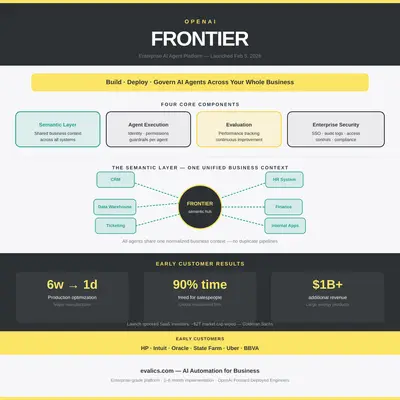
On February 5, 2026, OpenAI made its most serious move into the enterprise yet.
The product is called Frontier — and it is not another chatbot upgrade or a better API tier. It is a full platform for building, deploying, and managing AI agents across an entire organization, with named customers like HP, Intuit, Oracle, State Farm, Uber, and BBVA already running on it.
The announcement spooked investors enough that Goldman Sachs estimated $2 trillion was wiped from SaaS stock market valuations in the days that followed. Salesforce eliminated around 1,000 roles and shuffled its executive leadership. The Workday CEO stepped down.
Whether you are a large enterprise or a small business, this matters. Here is what OpenAI Frontier actually is, what it does, who it is built for right now, and what it signals for your automation strategy.
What Frontier Actually Is
Frontier is OpenAI's answer to a problem it has been watching for two years: companies can run impressive AI demos, but struggle to get AI to work reliably and consistently across their actual business.
The gap between "this works in a pilot" and "this works at scale, across every team, every day" is enormous. Frontier is designed to close that gap.
It does this through four integrated components:
1. Business Context (the Semantic Layer)
This is Frontier's most important and most novel feature. The semantic layer connects your disconnected business systems — Salesforce, internal databases, ticketing tools, data warehouses, HR systems — and creates a unified understanding of how information flows through your organization.
OpenAI describes it as giving AI agents the same onboarding a new employee would receive: company structure, workflows, important metrics, institutional memory, and decision-making context. Instead of each agent needing its own custom data pipeline, they all draw from the same normalized business context.
Without this, AI agents are powerful but blind. With it, they can answer questions like "what is our current pipeline by region?" or "which support tickets are most at risk of churn?" by actually understanding what those terms mean in your specific business — not just pattern-matching on keywords.
2. Agent Execution
Agents on Frontier have access to a shared execution environment: they can use tools on a computer, run code, work with files, and navigate your connected applications. Each agent gets its own identity with explicit permissions and guardrails — defining exactly what systems it can access, what actions it can take, and what requires human approval.
This is the governance layer that most ad-hoc agent setups lack. In an n8n flow or a ChatGPT session, the "who can do what" question is often answered implicitly or not at all. Frontier makes it explicit.
3. Evaluation and Optimization
Frontier includes built-in tools for measuring how well agents are performing and improving them over time. Agents do not just run and forget — their outputs are evaluated, patterns are identified, and performance compounds. This transforms agents from one-time deployments into improving systems that get better as they process more of your actual work.
4. Enterprise Security and Governance
Single sign-on, access controls, audit logs, and compliance-ready infrastructure are built in from the start. Frontier works with existing enterprise security stacks and connects through open standards, so organizations do not have to choose between AI capability and their existing governance requirements.
🏗️ alt text: Architecture diagram of OpenAI Frontier showing four layers: Semantic Layer (connected business systems) → Agent Execution (identity + permissions) → Evaluation (performance tracking) → Governance (security + compliance)
The Results Early Customers Are Seeing
OpenAI published three specific outcomes at launch:
Manufacturing: A major manufacturer used Frontier agents to optimize production planning. A process that previously took six weeks now takes one day. That is not a productivity improvement — it is a fundamentally different capability.
Financial services: A global investment company deployed agents end-to-end across its sales process. Salespeople now have 90% more of their time freed from administrative and research work. The agents handle research, data entry, follow-up scheduling, and pipeline updates.
Energy: A large energy producer deployed agents to optimize output. The result was up to a 5% increase in production — which translated to over $1 billion in additional annual revenue.
These are large-enterprise results achieved by organizations with dedicated AI engineering teams and months of implementation work. They are not what a 20-person company should expect from a first deployment. But they establish the ceiling — and that ceiling is transformative.
Who Frontier Is For Right Now
Frontier is enterprise software. This is important to say clearly because the launch generated a lot of coverage that could mislead smaller businesses into thinking they should sign up immediately.
In practice, a meaningful Frontier implementation takes 2–6 months with the support of OpenAI's Forward Deployed Engineers — specialists who embed with your team to connect your systems, define your semantic layer, and build out your agent workflows. That is a major strategic initiative, not a product you activate in an afternoon.
The resource bar — both financial and engineering — is significant. If your business does not have a dedicated IT team and a clear multi-year AI strategy, Frontier is not your next step.
That said, the platform's direction matters even if it is not your immediate destination. OpenAI has 1 million+ business customers. The architecture and patterns that Frontier establishes will flow downstream into lighter-weight products. What large enterprises are deploying on Frontier today will influence what SMB tools look like in 2027.
What Frontier Means for Your SaaS Stack
The investor reaction to Frontier was not irrational. The logic is straightforward:
If one AI platform can connect to your CRM, HR system, ticketing tool, and financial software — and then run agents that understand and act across all of them — the value proposition of buying five separate point solutions weakens. You are paying five subscription fees for software that a unified agent layer can increasingly replicate, extend, and surpass.
This does not mean Salesforce or Workday are going away next year. They have data, domain expertise, decades of customer relationships, and they are adapting rapidly. Salesforce has already partnered with OpenAI, bringing frontier models into Agentforce and Agentforce capabilities into ChatGPT. The boundary between "Frontier partner" and "Frontier competitor" is deliberately blurry.
But the pressure is real. Workday's CEO stepping down and Salesforce reshuffling its executive leadership in the same week as the Frontier announcement is not coincidence. These companies are reorganizing around AI at a speed they have not shown in years.
For business owners, the practical implication is: the cost of enterprise software is under more pressure than at any point since cloud replaced on-premise. That is good news for buyers.
What This Means If You Run an SMB
Most businesses reading this are not going to deploy Frontier in 2026. The resource bar is too high and the platform is not designed for sub-100-person companies yet.
But Frontier matters for your strategy in three ways:
1. Validate your automation investment
The direction of travel is clear: AI agents that share business context and operate with defined governance are the future of business software. Every automation workflow you build now — whether in n8n, Make, or ChatGPT Agent — is practice for that future. Teams that understand workflows, data, and agent behavior today will have a massive head start when more accessible agent platforms emerge.
2. Think about your semantic layer
You do not need Frontier to start building business context that AI can use. The principles are the same at any scale: document your processes, structure your data, define what terms like "active customer," "high-priority lead," or "at-risk account" actually mean in your business. Companies that have done this groundwork will deploy AI faster and more effectively when the tooling catches up.
3. Watch your SaaS renewals
As AI agents get better at covering the functional territory of point-solution software, subscription pricing for legacy SaaS tools will face increased scrutiny. When you renew your CRM or project management contract this year, it is worth asking: what does this tool give me that an AI agent workflow could not? The answer may still be "a lot" — but asking the question is the right instinct.
How Frontier Fits the Bigger Picture
In the past 30 days, three major AI infrastructure products have launched or significantly updated:
- Model Context Protocol (MCP) — the open standard for connecting agents to tools
- ChatGPT Agent — Operator and Deep Research merged into a unified task agent
- OpenAI Frontier — the enterprise layer for governing agents across an organization
These are not competing products — they are layers of the same emerging stack. MCP handles tool connectivity at the protocol level. ChatGPT Agent handles individual task execution. Frontier handles organizational governance, context, and scale.
For most businesses, the practical entry point today is MCP-connected agents in n8n or ChatGPT Agent for one-off tasks. Frontier is the direction that journey leads for organizations that get serious about AI at scale.
Key Takeaway: OpenAI Frontier is the clearest signal yet that AI agents are moving from experiments to enterprise infrastructure. Its semantic layer — a shared, normalized understanding of how your business works — is the architectural idea every organization should be thinking about, even if the full Frontier platform is not your immediate next step. The companies that will get the most from AI in 2026 and beyond are the ones building clean, documented business context now.
Official Sources
- Introducing OpenAI Frontier — OpenAI
- OpenAI Frontier Product Page — OpenAI
- OpenAI launches Frontier — TechCrunch
- Frontier could reshape enterprise software — Fortune
- OpenAI's enterprise chief on Frontier — CNBC
By Kevin Michael Schindler, AI Automation Expert at Evalics