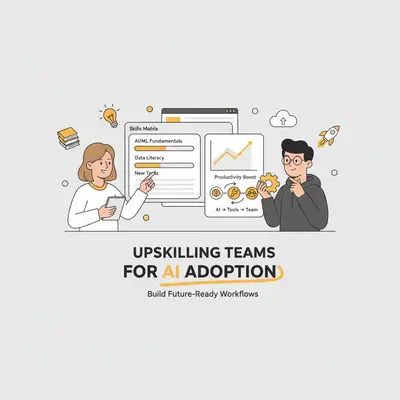
AI adoption isn't just about implementing technology - it's about preparing your team to use it effectively. Upskilling focuses on teaching employees how to integrate AI into their current roles, making their work more efficient and impactful. Here’s how to get started:
- Assess Current Skills: Identify your team’s technical and soft skills. Use tools like skills matrices or AI-driven assessments to pinpoint gaps.
- Set Clear Goals: Define specific, measurable objectives tied to business outcomes, such as reducing task times or improving decision-making.
- Build AI Literacy: Introduce basic AI concepts across the organization to ensure everyone understands what AI can and can’t do.
- Provide Role-Specific Training: Tailor learning to each department’s needs - e.g., sales teams can learn AI-powered lead scoring, while HR focuses on AI in recruitment.
- Start Small: Begin with simple, low-risk AI applications, such as automating repetitive tasks, and scale gradually.
- Develop Soft Skills: Teach critical thinking, ethical reasoning, and problem-solving to ensure responsible AI use alongside technical skills.
- Offer Continuous Learning: Use personalized, on-demand training platforms to keep up with AI advancements and evolving team needs.
- Measure Impact: Track progress through metrics like productivity improvements, AI usage, and employee feedback to refine your approach.
AI Awareness to AI Adoption: A People First Approach
Assess Your Team's Current Skills and AI Readiness
Understanding your team's current skills is the cornerstone of effective AI training. A clear assessment ensures that your efforts are focused on areas that deliver immediate, practical value. Without this clarity, you might end up spending time and money on generic training that doesn’t meet your team’s actual needs.
Conduct a Skills Inventory
Start by taking stock of what your team already knows. Go beyond job titles and dig into each employee’s specific skills. Use performance data, certifications, past training, and project histories to build a detailed map of your workforce's capabilities.
Machine learning tools can help analyze this data, pinpointing areas where AI-related training is needed [1]. This approach is far more reliable than asking employees to self-report their skills, which can often lead to inaccurate assessments due to overconfidence or underestimation.
Document both technical and soft skills. On the technical side, note who has experience with programming, data analysis, or using automation tools. For soft skills, look for employees who excel at problem-solving, critical thinking, or adapting to new workflows. These individuals often make great early adopters and advocates for AI-related changes.
To make this process more actionable, create a skills matrix. This visual tool allows you to see which departments or roles have certain competencies. For example, you might find that your sales team is strong in analytical skills but lacks technical expertise, while your operations team understands automation but needs training in AI ethics. This kind of insight helps you prioritize training efforts effectively.
Once you’ve mapped out your team’s skills, the next step is identifying which roles are most likely to be affected by AI-driven automation.
Identify Automation Risks and Opportunities
AI impacts roles differently, so it's essential to assess which tasks or jobs are most likely to change. Focus on roles or tasks that are highly repetitive or heavily dependent on routine processes, as these are prime candidates for AI automation.
Start by analyzing the daily tasks within each role. Activities like repetitive data entry, basic customer inquiries, scheduling, and report generation are often the first to be automated. For roles that rely heavily on these tasks, upskilling becomes a priority - not to replace these positions but to prepare employees for new responsibilities.
But don’t just focus on potential risks - consider the opportunities AI creates. When routine tasks are automated, what new value can employees bring? For example, customer service reps could shift their focus to resolving complex issues, while accountants freed from data entry could engage in strategic financial planning. Identifying these opportunities allows you to design training programs that align with the evolving roles of your team.
Also, pay attention to departments where AI could have the biggest impact. If your sales team spends hours manually qualifying leads, for instance, AI could streamline this process. This signals a need for training on tools like AI-powered lead scoring systems.
Once you’ve identified key areas for upskilling, technology can help refine your assessment even further.
Use Technology for Skills Assessment
Traditional skills surveys are often slow, outdated, and cumbersome, making it hard to keep an accurate view of your team’s capabilities [2]. AI tools can simplify and modernize this process.
By analyzing internal data - like job descriptions, resumes, performance reviews, and even communication platforms like Slack - AI can infer employees’ likely skills [2]. This method is faster and more accurate than manual surveys, providing a real-time snapshot of your workforce’s capabilities.
These tools can also analyze patterns in how employees communicate, the projects they’ve worked on, and the problems they’ve solved. The result is a dynamic, up-to-date view of your team’s skills.
Additionally, AI-powered learning platforms can identify skill gaps and deliver personalized training content. These platforms assess employees as they interact with training materials, making the process seamless and integrated into their learning journey [3]. This eliminates the need for separate, time-consuming assessments.
The insights gathered from these tools also allow you to track progress over time. You can measure how skills improve across the organization, identify which training methods are most effective, and adjust your strategy based on real-world data. This feedback loop ensures that your upskilling efforts become more effective with each iteration.
Set Clear Objectives for AI Training and Adoption
Once you've assessed your team's current skills, the next step is to define clear, actionable goals for AI training and adoption. A vague goal like "learn AI" won't cut it. You need specific, measurable objectives that directly tie your training efforts to business outcomes.
Start by identifying what you want AI to achieve for your organization. For example, are you aiming to cut manual data entry time by 40%? Or perhaps you want to speed up customer response times by automating initial inquiries? Let’s say your goal is to improve sales efficiency - this could mean using AI to qualify leads more effectively. Whatever your goal, make it specific, measurable, and tied to a trackable metric.
Think about objectives on two levels: organizational and individual. At the organizational level, focus on broader outcomes. For instance, if you're deploying AI to streamline operations, you might aim to reduce routine task processing times by 30% within six months. This gives you a clear target and a timeline.
At the individual level, translate these business goals into specific skills your team needs to develop. For example, if your goal is to automate lead qualification, your sales team might need training on how to interpret AI-generated lead scores, understand the data behind those scores, and adjust their outreach strategies. Clearly outline the skills required for each role and their practical applications.
Match training objectives with real-world workflow changes. Avoid wasting time on tools or skills that won’t be used. Before setting training goals, map out exactly which processes will change and how. For example, if your customer service team will rely on AI chatbots to handle basic inquiries, train them on monitoring chatbot performance and managing escalations effectively.
Set realistic timelines based on the complexity of the skills being taught. Basic AI literacy - such as understanding what AI is, how it works, and its limitations - can often be covered in a few weeks through workshops or online courses. However, more advanced skills, like working with AI analytics platforms or fine-tuning AI outputs, may require months of hands-on practice.
Break larger goals into smaller, manageable milestones. Instead of saying, "The marketing team will master AI tools by the end of the year", create quarterly benchmarks. For instance:
- By the end of Q1, team members should understand basic AI concepts and identify three areas where AI could enhance their work.
- By Q2, they should be actively using at least one AI tool in their daily tasks.
- By Q3, they should be evaluating the tool’s effectiveness and suggesting improvements.
This milestone-based approach ensures steady progress and accommodates different learning speeds.
Speaking of learning speeds, not everyone on your team will progress at the same pace. Some employees may already have technical backgrounds, making it easier for them to grasp AI concepts, while others might need more foundational training. Build flexibility into your plan to address these differences without lowering standards.
Make sure your objectives are well-documented and shared across the team. Every employee should know what they’re expected to learn, why it matters, and how their progress will be measured. Transparency reduces anxiety about AI adoption and helps employees view training as an opportunity for growth rather than a threat to their job security.
Link training objectives to career growth. When employees see that mastering AI skills can lead to promotions, new responsibilities, or expanded roles, they’re more likely to engage with the training. Be upfront about how AI proficiency will factor into performance reviews and career advancement opportunities within your organization.
Finally, revisit your objectives regularly. Build in checkpoints to assess whether your goals are still realistic and relevant. Adjust them if initial targets prove too ambitious or if circumstances shift. Your objectives should be clear enough to guide action but flexible enough to adapt as you learn what works best.
Develop Basic AI Literacy Across the Organization
Creating a foundational understanding of AI across your organization is key to unlocking its potential. This shared knowledge sets the stage for more focused, hands-on learning down the line. It doesn’t mean turning everyone into AI experts, but it does mean giving every team member a clear sense of what AI can and cannot do - and how to use it responsibly. For example, the finance team might learn to compare AI-driven forecasting with traditional models, HR could explore AI’s role in candidate screening and reducing bias, and operations might experiment with integrating automation into existing workflows.
Introduce Basic AI Concepts
Start with short, accessible sessions that explain what AI is, how it works, and how generative AI differs from traditional AI. Employees should understand that AI can automate repetitive tasks, provide data-driven insights, and assist in decision-making - but it’s not perfect and has its limitations.
Take inspiration from Kraft Heinz’s "Ownerversity Day", which included introductory sessions on AI and generative AI to build a solid knowledge base [4]. Keep these sessions interactive and engaging. Workshops tend to work better than long presentations, as they allow employees to ask questions and explore ideas in real time. Aim for 60–90-minute sessions, breaking down complex topics into smaller, digestible parts. Use real-world examples from your industry to show how AI is already making an impact.
From the outset, emphasize responsible AI use. Provide clear guidelines around privacy and security, detailing what data can and cannot be input into AI systems. Addressing potential risks early on and setting clear boundaries helps build confidence and avoids costly mistakes [6].
PwC offers a great example of how to scale AI training effectively. They rolled out e-learning modules for all 75,000 employees in the U.S. and Mexico, supplemented by in-person seminars, gamified content, and hands-on workshops. Leah Houde, PwC’s Chief Learning Officer, explained:
"We want our employees to feel empowered and engaged throughout their learning journey, not intimidated or overwhelmed with emerging topics like gen AI." [4]
Once employees grasp the basics, shift to training that aligns with their specific roles.
Provide Role-Specific AI Training
After laying a common foundation, customize training to fit the unique needs of different teams. A one-size-fits-all approach won’t cut it - what a sales representative needs to know about AI differs from what’s relevant for an HR manager or a financial analyst. Tailored training ensures employees gain practical, job-specific skills they can use immediately.
- Sales: Teach teams to use AI for lead qualification, customer behavior analysis, and personalized outreach.
- Operations: Introduce tools for process automation, predictive maintenance, and supply chain optimization.
- HR: Focus on AI applications in recruitment and performance management, while addressing ethical considerations and bias reduction.
- Marketing: Equip professionals to use AI for content generation, audience segmentation, and campaign improvement without losing the brand’s voice.
- Finance and Accounting: Train teams to leverage AI for forecasting, fraud detection, and financial reporting, with an emphasis on validating outputs and identifying anomalies.
Design learning paths that progress from basic to advanced skills. For example, a customer service team might start by understanding what tasks AI chatbots can manage, then learn how to monitor their performance, and eventually analyze conversation data to refine the system. Highlighting how AI aligns with your company’s goals and workflows reinforces its relevance and value [5].
Once role-specific skills are in place, move on to practical, hands-on applications.
Teach Practical AI Applications
With foundational knowledge and role-specific training established, the next step is hands-on experience. Theory is important, but employees need to practice using AI tools to build confidence and proficiency. Start with simple tasks like crafting prompts for AI chatbots or collaborating with AI assistants. Encourage experimentation - small tweaks to prompts can lead to vastly different outputs, and this trial-and-error process is key to understanding AI’s capabilities.
Teach employees how to critically evaluate AI outputs. Show them how to identify biases, verify accuracy, and cross-check results [4][6]. For teams working with data, focus on using AI for analytics - interpreting visualizations, asking the right questions, and turning insights into actionable strategies. Similarly, automation training should begin with straightforward tasks, like automating data entry, before moving on to more complex workflows.
Doug Rose, an AI strategist and consultant, emphasizes:
"It won't just be about learning how to interact with AI systems but also about getting better at tasks where humans still have a distinct advantage." [4]
To streamline adoption, create a centralized repository of approved AI tools, complete with tutorials, use cases, and support resources. This minimizes the risks of using unvetted tools and ensures consistency across teams [6]. Platforms like Evalics can help by offering a secure, centralized space for accessing trusted AI tools and training materials.
Finally, build practice time into your training programs. After introducing a new tool or concept, let employees experiment in safe environments, such as sandbox accounts, where errors won’t affect live systems. Pair less experienced staff with more AI-savvy colleagues to foster a supportive culture where questions are encouraged and learning is shared. This collaborative approach helps teams grow together while building confidence in their AI skills.
Implement a Gradual, Phased Approach to AI Upskilling
Bringing AI into your organization isn’t something you should rush. Instead of rolling it out everywhere all at once, take a step-by-step approach. This way, employees - especially those less comfortable with tech - can adapt at a manageable pace. A gradual rollout builds confidence and creates the momentum needed for long-term success [7].
Starting small has another advantage: it lets you show quick wins. When employees see the immediate benefits of AI in low-risk areas, they’re more likely to support further changes. This approach also gives your organization time to figure out what works, tweak strategies, and build internal expertise - all without disrupting daily operations. It’s a practical way to integrate AI while sticking to your training goals and objectives.
As Paylocity explains:
"Introducing AI doesn't require a complete overhaul. Employers should take a phased approach to prevent employees, particularly those less tech-savvy, from feeling overwhelmed." [7]
The secret? Start small, prove the value, and expand gradually. This approach avoids dramatic changes and lays the groundwork for sustainable progress.
Start with Simple Use Cases
Begin with tasks that are repetitive, time-consuming, and low-risk. These are perfect for quick validation of AI’s benefits. Examples include AI-assisted email drafting, automated meeting scheduling, or basic data entry [7]. When employees see how AI simplifies these tasks, they’ll better understand its potential.
Use a "test-and-expand" strategy. Identify areas in your organization - like ticket triage systems, content operations, or routine reporting - where experimenting with AI won’t cause major disruptions [8]. Start small with a pilot group, measure the results, and then scale up. Document both successes and challenges so you can refine your approach for the next phase [10].
To ease the transition, pair employees unfamiliar with AI with those who’ve already mastered the basics. Structured rotations or shadowing sessions encourage peer-to-peer learning, creating a supportive environment where questions are welcomed. This natural flow of knowledge helps bridge the gap between traditional roles and AI-enhanced ones [8].
Avoid Overhauling Entire Workflows
Sweeping changes can create chaos, so focus on enhancing existing workflows instead of replacing them entirely [7]. Think of AI as a helpful assistant that works alongside your current processes. This complements the step-by-step upskilling strategy, ensuring AI integrates smoothly into day-to-day operations without disrupting them.
For instance, instead of overhauling a well-established workflow, automate just the repetitive tasks. This approach respects your team’s institutional knowledge while targeting inefficiencies. AI should amplify your team’s expertise, not replace it. Small, targeted improvements are often the most effective.
Phyllis Furman, Senior Editor at Group SJR, sums it up well:
"In truth, organizations don't need immediate overhauls - they instead need immediate momentum, even when that means starting small." [9]
Building momentum through small successes is key. Each win boosts confidence, proves AI’s value, and creates advocates within your team. When planning your rollout, align changes with your team’s readiness and your business priorities. Set realistic timelines that consider learning curves, adjustment periods, and potential obstacles. Give teams the freedom to experiment in low-pressure environments so they can develop skills before tackling more complex AI applications.
Throughout the process, keep communication open. Regular check-ins with your teams will help you understand what's working and what needs adjustment. This collaborative approach ensures AI adoption feels like a shared effort, fostering buy-in and engagement. By taking these small, deliberate steps, you'll prepare your team to build stronger AI capabilities over time.
Build Soft Skills Alongside Technical Expertise
While technical training is crucial for mastering AI systems, developing soft skills is just as important for using AI responsibly and effectively. It's not enough to know how to operate AI tools - your team also needs to understand when to question outputs, how to make ethical decisions, and how to adapt to new challenges. These soft skills bridge the gap between technical know-how and thoughtful AI application.
AI enhances human judgment, but it’s the people with strong soft skills who truly make AI work. These abilities form the foundation for using AI responsibly across your organization. When combined with technical expertise, they create a solid framework for adopting AI in a sustainable way.
Preparing your workforce for this shift requires effort at every level - individual, team, and organizational. It’s about understanding how AI reshapes roles, changes workflows, and influences company culture [5]. By fostering these skills alongside technical training, you’ll build a team ready to embrace AI’s potential.
Develop Critical Thinking and Ethical Reasoning
AI systems can produce outputs that seem convincing, but they’re not always accurate or appropriate. That’s why your team needs to develop the ability to critically assess and validate AI-generated results before acting on them. Encourage them to ask questions like: Does this output make sense? What assumptions are behind it? Could there be biases at play?
Teaching critical thinking about AI isn’t just about spotting errors - it’s about understanding the system’s limitations. When employees grasp these constraints, they can use AI more thoughtfully and catch potential issues before they escalate.
Equally important is fostering ethical reasoning. As AI becomes more integrated into business processes, your team should regularly consider the broader effects of AI-driven decisions. Questions around fairness, transparency, and accountability need to be part of daily discussions. For instance, if an AI tool recommends candidates for hiring or suggests pricing strategies, employees must evaluate whether those recommendations align with your company’s values and legal requirements.
Creating an environment of psychological safety is key. Make it clear that AI is a tool to enhance, not replace, human roles [5]. When employees feel secure, they’re more likely to voice concerns, question AI outputs, and engage in the kind of critical evaluation your organization needs.
While critical thinking ensures ethical AI use, adaptability and problem-solving skills empower teams to unlock AI’s potential in a constantly changing landscape. If you want a practical overview of governance, privacy, and bias mitigation, see this ethical AI implementation guide.
Encourage Adaptability and Problem-Solving
AI technology evolves at a rapid pace, with new tools emerging all the time. Your team’s ability to adapt will determine how quickly your organization can take advantage of these advancements. Being flexible in learning new systems and creatively applying AI to workflows gives your company a competitive edge.
To cultivate this adaptability, foster a culture of continuous learning and innovation. Encourage experimentation and treat failures as opportunities to learn. When employees feel free to try new approaches with AI, they often uncover uses you might not have anticipated.
Problem-solving skills also need to evolve. Instead of just tackling challenges manually, employees should think about how AI can assist - or where human judgment remains essential. Shift the focus from “how to complete tasks” to “how to blend human expertise with AI effectively.”
Leadership plays a pivotal role here. When executives actively engage with AI tools and demonstrate a willingness to learn, it sets the tone for the rest of the organization [2]. This top-down commitment shows that adaptability isn’t just expected - it’s valued and modeled at every level.
Encourage your team to share their successes and strategies with AI. When someone discovers a smart way to use an AI tool, that knowledge should spread quickly across the organization. Peer-to-peer learning not only reinforces adaptability but also builds collective expertise that benefits everyone.
Enable Personalized and Continuous Learning Opportunities
A cookie-cutter approach to training simply doesn’t cut it when preparing your team for AI adoption. Your sales team, for example, will need different AI skills than your operations staff. Similarly, a junior analyst's training should look nothing like that of a senior manager. Tailored learning programs ensure employees get training that’s relevant to their roles and responsibilities.
To keep up with the fast pace of AI advancements, it’s crucial to build a learning ecosystem that evolves alongside both your workforce and the technology itself. Static training programs become outdated quickly in a field where new features and tools emerge every month. Instead, focus on creating systems that deliver timely, role-specific content and adapt to individual learning paths.
Here’s how you can make personalized, ongoing learning an integral part of your organization.
Use AI for Adaptive Learning Paths
AI-powered platforms can take training personalization to the next level. These tools analyze an employee’s skill set, job role, learning style, and performance to recommend customized training paths. They also adjust in real time, ensuring that employees are always working on material that matches their current abilities - neither too basic nor too advanced.
For instance, if a sales team member struggles with interpreting AI-generated customer insights, the system might suggest additional modules on data interpretation before moving on to advanced topics like predictive analytics. Meanwhile, a colleague who excels in these areas can skip ahead to training on AI-driven sales forecasting tools.
These platforms also prioritize training based on how employees use AI in their day-to-day work. Someone who frequently interacts with natural language processing tools would receive training tailored to those tasks, while skipping less relevant topics like image recognition systems. This targeted approach ensures employees spend their time learning skills that directly impact their performance.
What’s more, these systems improve over time by analyzing which training methods and modules yield the best results. As they gather data, they refine their recommendations, creating increasingly effective and personalized learning experiences for every team member.
Integrate AI Training into Existing Learning Systems
Instead of creating a standalone AI training program, embed AI education into your existing learning management system (LMS) and HR platforms. This integration makes AI training a seamless part of professional development, rather than an isolated initiative.
By housing AI training alongside other required courses and certifications, employees can easily track their progress, managers can monitor team development, and HR can ensure compliance with training goals. Plus, employees won’t need to learn a new system just to access AI-related content - they can use the same platform they’re already familiar with.
This approach also connects AI training with broader career development plans. For example, if an annual performance review identifies an area for growth, managers can assign relevant AI training modules directly through the HR system. It’s a straightforward way to tie professional goals to actionable learning opportunities.
Don’t overlook the onboarding process, either. New hires should receive foundational AI training tailored to their roles from day one. By incorporating AI literacy into your standard onboarding workflow, you ensure every employee starts with a solid understanding of how your organization leverages AI.
Offer On-Demand Learning Resources
Employees often need answers at the moment they’re tackling an AI-related challenge or trying to apply a new tool. That’s where on-demand resources come in. Video tutorials, interactive workshops, documentation libraries, and quick reference guides can provide immediate support.
Create a centralized knowledge hub where employees can search for specific topics, watch tool demonstrations, and follow step-by-step guides for common tasks. This hub should cater to a range of experience levels, offering both introductory content for beginners and advanced materials for seasoned users.
Consider partnering with reputable organizations that offer AI certifications relevant to your industry. Subsidizing or covering the cost of these certifications can be a great way to encourage participation. Not only do these credentials boost employee confidence, but they also reinforce your organization’s commitment to building AI expertise.
Regular workshops focused on solving real-world business challenges with AI can also be highly effective. Pair these with mentorship programs to encourage peer-to-peer learning. Mentors deepen their own skills by teaching others, creating a cycle of continuous learning across your team.
Finally, make sure all resources are mobile-friendly and accessible from anywhere. Employees might want to complete a training module during their commute or reference an AI guide while working remotely. Offering flexibility in how and where learning materials are accessed makes it easier for employees to engage with training, ensuring that learning remains both practical and effective.
Measure the Impact of Upskilling Initiatives
To make sure your AI training efforts deliver real business value, focus on metrics that reflect actual skill application - not just course completions.
Measuring impact is about understanding what’s effective, spotting areas for improvement, and adjusting your approach as needed. It’s not enough to know employees finished a course; you need to evaluate whether they’re using their new skills to drive meaningful business results.
Track Learning Activity and Business Outcomes
Once your training is underway, it’s time to measure its impact. To calculate your return on learning investment (ROLI), connect training activities to tangible business outcomes [5].
A useful framework here is the Kirkpatrick method, which evaluates training effectiveness across four levels: learning experience, competency development, productivity gains, and business outcomes [5].
Focus on metrics that highlight efficiency improvements and time savings achieved through AI adoption [9][12][4]. For instance, if your sales team has been trained on automated lead scoring, track how much time they save by reducing manual lead qualification tasks. This can be a clear indicator of success.
Another key step is monitoring AI usage to confirm employees are applying their skills [12]. It’s also worth assessing how comfortable and confident they feel using AI tools [11]. If your team hesitates or lacks confidence, it may signal a need for further support or adjustments to the training.
To better isolate the effects of your training program, consider running A/B tests or pilot programs with control groups. This approach helps you account for other factors that might influence business outcomes [5].
Collect Feedback from Teams
Numbers tell part of the story, but employee feedback fills in the gaps. Use surveys, one-on-one discussions, or focus groups to gather insights from your team. This qualitative feedback can uncover practical challenges they face and highlight areas that need improvement.
When you combine this feedback with your quantitative data, you’ll get a clearer picture of what’s working and where to adjust your strategy.
Adjust Programs Based on Performance Data
Just as training should evolve to meet the needs of your team, your measurement approach should also adapt over time. Think of AI training as an ongoing process. Use performance metrics and employee feedback to fine-tune your initiatives regularly. By reviewing and refining your metrics, you’ll ensure your upskilling efforts stay aligned with business goals and continue to support your team’s growth.
Conclusion
Equipping your team with the skills needed to embrace AI enables them to work more efficiently and focus on what they do best. By evaluating current skills, setting clear goals, fostering AI understanding, and implementing training in manageable steps, you create a workplace where employees and technology can excel together.
Begin by identifying your team’s strengths and areas for growth. Introduce AI concepts tailored to their roles, and encourage the development of both technical know-how and interpersonal skills through ongoing, role-specific learning opportunities. Track progress not just by completed courses but by tangible improvements in productivity and measurable business results. This practical, results-driven approach lays the groundwork for integrating AI into everyday workflows.
For example, AI-powered tools like Evalics can take on repetitive tasks such as lead generation and data entry. By automating these processes, Evalics helps free up time for more strategic work, boosting efficiency across sales, operations, and analytics.
When employees see AI as a tool that supports rather than replaces them, they’re more likely to embrace training and experimentation. This mindset leads to quicker sales cycles, smoother operations, and sharper insights.
The key to success with AI lies in prioritizing your team and fostering a culture of continuous improvement. Start with small, achievable steps, stay consistent, and ensure your people remain the centerpiece of your AI strategy.
FAQs
1. How can we evaluate our team's skills and readiness for adopting AI?
To get your team ready for adopting AI, begin by pinpointing skill gaps in crucial areas such as data analysis, machine learning, and the use of AI tools. It's also important to gauge your team's mindset toward AI - how comfortable they feel and their willingness to learn new concepts. Lastly, take a close look at your organization's technical infrastructure to determine if it's equipped to support AI integration. By covering these bases, you'll set the stage for a smoother and more effective shift toward AI adoption.
2. What are some examples of AI training tailored to specific roles within different departments?
AI training can be tailored to fit the specific needs of different teams within a company. For instance, sales teams might focus on mastering AI-driven customer relationship management (CRM) tools to better analyze leads and anticipate customer behavior. On the other hand, operations teams could benefit from learning how to use AI for tasks like automating inventory management or streamlining workflows. For analytics teams, the emphasis might be on advanced AI tools that support data modeling and predictive analysis.
Customizing training to align with each department's goals helps employees acquire the right skills to seamlessly incorporate AI into their daily responsibilities, boosting efficiency and encouraging new ways of working.
3. How can we evaluate the success of our AI upskilling efforts to ensure they align with our business objectives?
To gauge the success of your AI upskilling initiatives, it's essential to focus on clear, measurable outcomes that tie directly to your business objectives. Begin by gathering employee feedback to understand their satisfaction with the training and whether they feel it met their needs. Then, monitor progress in areas like skill development, productivity, and noticeable behavioral shifts stemming from the program.
On a larger scale, evaluate how these efforts impact your business. Look for signs of improved efficiency, cost reductions, or revenue growth. Tools like the Kirkpatrick model can be incredibly useful here, as they help you assess results on four levels: the learning experience, how skills are applied, individual performance improvements, and the overall effect on business outcomes. By consistently reviewing these metrics, you can ensure your training remains aligned with your goals and delivers real, measurable benefits.