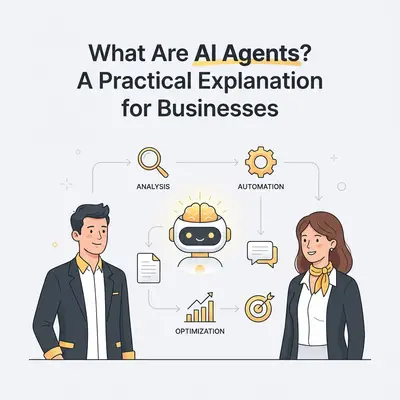
You've seen "AI agents" hyped as the next big thing, but for your business, it's about practical value: can they handle real operations without constant oversight? AI agents are software systems that act autonomously to complete tasks, making decisions based on goals and available tools.
This guide cuts through the buzz with a straightforward explanation, differences from familiar tech like bots, business examples, misconceptions, and when to use—or skip—them. If you're a business owner weighing AI investments, start here to decide if agents fit your needs.
Quick Win: Think of AI agents as digital assistants that don't just respond—they plan and execute, like automating lead qualification end-to-end.
A Non-Hype Definition: What AI Agents Actually Are
An AI agent is an autonomous program that observes its environment, reasons about objectives, and takes actions to achieve them. Powered by large language models (LLMs) like GPT or Gemini, agents use tools—such as APIs, databases, or web searches—to interact with the real world.
Unlike static scripts, agents adapt dynamically. For instance, if a goal is "qualify a sales lead," an agent might check CRM data, analyze email tone, and schedule a call if criteria match. They're built for flexibility, but they rely on clear goals and safeguards to perform reliably.
Key components include:
- Perception: Gathering data from inputs like emails or sensors.
- Reasoning: Using AI to plan steps and make decisions.
- Action: Executing via tools, like updating a database.
- Learning: Some agents improve over time with feedback.
In business terms, agents bridge simple automation and human-like problem-solving, but they're tools—not magic. For more depth, see IBM's overview on AI agents.
Reality Check: Agents aren't fully independent like sci-fi robots; they operate within defined scopes and need human setup.
How AI Agents Differ from Workflows and Bots
It's easy to confuse AI agents with familiar tech, but the differences matter for choosing the right tool.
-
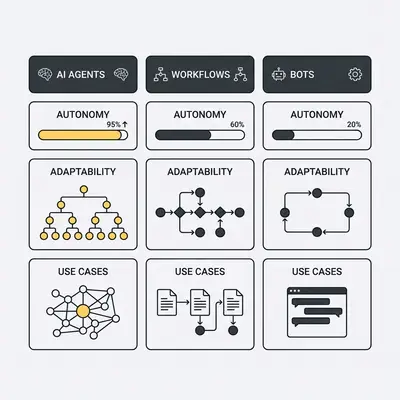
AI Agents vs. Workflows: Workflows follow predefined steps, like a Zapier zap that emails a report on trigger. Agents decide steps dynamically—if a workflow fails on missing data, an agent might fetch it from elsewhere. Workflows are rigid and efficient for routine tasks; agents handle variability but add complexity. For more on automation types, see our guide on rule-based vs AI automation.
-
AI Agents vs. Bots/Chatbots: Bots are rule-based or scripted, reacting to inputs without planning. A chatbot might answer FAQs via keywords, but an agent could diagnose a customer issue, pull order history, and initiate a refund if policy allows. Bots are simple and fast; agents are proactive but riskier if not monitored.
In short: Bots respond, workflows automate sequences, agents think and adapt. For business ops, use agents when tasks involve uncertainty, like dynamic customer support.
Real Examples in Business Operations
AI agents are already streamlining ops across industries. Here are practical cases from real companies:
-
Sales and Lead Management: Uber uses financial data agents to analyze trends and forecast, automating insights that once took hours. In smaller setups, agents qualify leads by scoring emails and routing hot ones to reps.
-
Customer Support: Delivery Hero's agents build product knowledge bases, pulling data from inventories to answer queries accurately. Agents can summarize tickets, suggest resolutions, and escalate complex issues.
-
HR and Operations: In pharma, Creatio's agents automate candidate screening by parsing resumes and matching skills. For finance, agents reconcile accounts by cross-checking transactions across systems.
-
Marketing: Anthropic's web research agents gather competitor data, generating reports for strategy. Ecommerce uses agents for inventory optimization, predicting stock needs based on sales patterns.
These examples show agents excelling in multi-step, data-driven tasks. For more, check BCG's report on AI agents' business impact.
Pro Tip: Start small—pilot an agent for one process, like email triage, to measure ROI before scaling.
Common Misconceptions About AI Agents
Hype leads to myths that can derail adoption. Here's the truth:
-
Myth: Agents Are Just Advanced Chatbots. No—they plan and act beyond conversation, using tools for real outcomes. Chatbots chat; agents execute.
-
Myth: Agents Replace Humans Entirely. They handle routine work but lack judgment for ethics or creativity. Oversight prevents errors like biases or hallucinations.
-
Myth: Agents Are Uncontrollable. With proper guardrails, like role-based access and audits, they're predictable. But poor design can lead to unintended actions.
-
Myth: Agents Learn Infinitely. Most improve via feedback, but they're not infallible—regular updates are needed.
-
Myth: Agents Are Plug-and-Play. Setup requires defining goals, tools, and monitoring; skipping this invites failures.
Debunking these keeps expectations realistic. As Andrew Ng notes, agents thrive on structured workflows, not vague hopes.
When AI Agents Make Sense (and When They Don't)
Agents shine in specific scenarios but aren't universal.
When to Use Them:
- Variable Tasks: For ops with changing conditions, like dynamic pricing or personalized marketing.
- Multi-Step Processes: When combining data from multiple sources, such as supply chain optimization.
- Scale Efficiency: High-volume routines, like support ticket routing, freeing humans for high-value work.
- If ROI Justifies: Use agents when traditional automation falls short but complexity is manageable. Agents earn their extra complexity when a task genuinely needs autonomy and a wrong step is cheap to correct.
When to Avoid Them:
- Simple, Repetitive Tasks: Stick with workflows or bots for low-variability jobs like basic notifications.
- High-Stakes Decisions: Areas needing empathy, like negotiations or ethical calls—humans handle nuance better.
- Limited Resources: If your team lacks AI expertise, start with no-code tools before agents.
- Regulatory Risks: In finance or healthcare, where errors could violate compliance; add human review.
Assess with this framework: If the task benefits from autonomy without high risk, agents add value. Otherwise, simpler AI suffices.
If you started this guide wondering whether AI agents fit your business, you now have a clear picture: they're autonomous systems that excel at variable, multi-step tasks but require careful setup and oversight. They're not magic—they're tools that bridge simple automation and human-like problem-solving.
Next steps: Start with a low-risk pilot in one process area, like email triage or lead qualification. Measure ROI before scaling. If you're new to automation, consider starting with workflow automation basics before diving into agents.
If evaluating agents for your ops, test a low-risk pilot. For guidance, book a quick chat.
By Kevin Michael Schindler, AI Automation Expert at Evalics.