AI Won't Replace You, But Someone Using AI Will: A Guide for the Modern Business
You've seen the headlines, and they're hard to ignore: "AI will replace 85 million jobs," "ChatGPT is coming for your career." It’s a narrative of disruption and replacement that causes legitimate anxiety for any forward-thinking business owner or professional. But here's what the headlines miss: AI isn't the villain in this story. It's the powerful new tool.
The real threat isn't being replaced by AI; it's being outcompeted by someone who has learned to leverage it.
This guide is designed to shift your perspective from fear to action. We'll reframe the conversation from replacement to collaboration, showing you how to treat AI as a "co-pilot" that augments your skills, not automates your job away. We will explore the real-world skills that are becoming more valuable in the age of AI and provide a simple framework to identify powerful collaboration opportunities in your own business.
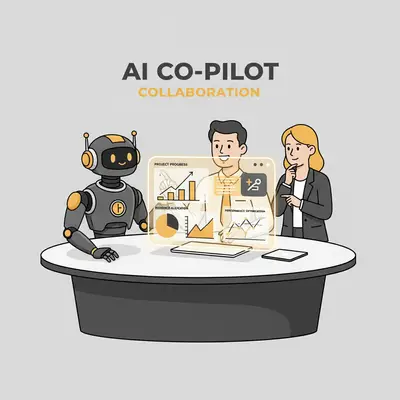
Reframing the Conversation: AI as Your Co-Pilot
Think of AI not as an autonomous entity but as a digital employee or a brilliant intern who never sleeps. It can process vast amounts of data, identify patterns, and handle repetitive tasks with superhuman speed and accuracy. However, like any intern, it lacks genuine understanding, strategic insight, and emotional intelligence. It needs your direction, your domain expertise, and your judgment to be effective.
- AI's Strengths: Data analysis, pattern recognition, content generation, task automation.
- Human Strengths: Strategic thinking, emotional intelligence, complex problem-solving, creativity, and ethical judgment.
Key Insight: The most successful businesses of the next decade won't be the ones that replace the most people with AI. They will be the ones that learn how to create powerful human-AI teams, where each party does what it does best. According to a report from McKinsey, generative AI is poised to add trillions of dollars in value to the global economy, primarily by augmenting and automating the work of human employees, not replacing them.
Real-World Examples: AI Handling the Tedious, Humans Driving the Strategy
Let's move beyond theory. Here’s how this collaboration looks in practice across different business functions, freeing up humans for higher-value work.
1. Customer Service:
- AI's Role: An AI chatbot handles 80% of initial customer inquiries—password resets, order tracking, and FAQ answers—24/7. It instantly triages support tickets based on sentiment and keywords.
- Human's Role: Customer service agents are freed from repetitive queries to focus on complex, high-stakes issues that require empathy and creative problem-solving. They use AI-generated summaries of past interactions to get up to speed instantly.
2. Content Creation:
- AI's Role: An AI tool generates a first draft of a blog post based on a detailed prompt, including research and data points. It can create multiple headline variations and social media snippets.
- Human's Role: The content strategist refines the draft, injects the brand's unique voice and perspective, adds strategic insights, and ensures the content aligns with broader marketing goals.
3. Data Analysis & Reporting:
- AI's Role: AI processes thousands of rows of sales data from your CRM in seconds, identifying trends, outliers, and correlations that would take a human hours to find.
- Human's Role: The business analyst interprets the AI's findings, asks "why," and translates the data into a strategic business decision—like shifting marketing spend or identifying a new product opportunity.
4. Email Management:
- AI's Role: AI tools like Google Workspace Flows can triage your inbox, label important messages, and draft standard replies to common inquiries.
- Human's Role: You review the drafted responses, add a personal touch, and spend your focused time on emails that require strategic thought and relationship-building.
The Skills That Matter Most in the AI Age
As AI handles more of the technical and repetitive tasks, "soft" skills and strategic capabilities become even more valuable. These are the uniquely human abilities that AI cannot replicate.
- Critical Thinking: The ability to evaluate the output of an AI, spot biases or errors, and make a sound final judgment is paramount.
- Prompt Engineering: This is the new digital literacy. Knowing how to ask the right questions and provide the right context to an AI is the key to unlocking its power.
- Process Design: You need individuals who can look at a business workflow, deconstruct it, and intelligently decide which parts are best suited for AI and which require a human touch.
- Emotional Intelligence: Building relationships with clients, negotiating complex deals, and leading a team are all deeply human endeavors that AI can't replace.
- Strategic Thinking: AI can analyze the present, but it can't set a vision for the future. The ability to plan, innovate, and make long-term strategic decisions remains a human domain.
- Domain Expertise: Your deep, nuanced knowledge of your industry, customers, and business is the critical context that makes AI-generated output relevant and valuable.
Pro Tip: Don't just learn to use AI tools. Focus on building the strategic and critical thinking skills that allow you to direct them effectively.
A Simple Framework to Find AI Collaboration Opportunities
Ready to get practical? Use this five-step framework to audit your own role or business and identify the best opportunities to start collaborating with AI.
Step 1: Task Audit
- For one week, write down every single task you do. Be granular. Don't just write "answer emails"; break it down into "drafting new client proposals," "responding to internal questions," etc.
Step 2: Categorize Your Tasks
- Group your tasks into three buckets:
- Low-Value Repetitive: Data entry, copy-pasting, scheduling, standard reports.
- Medium-Value Creative & Technical: Writing first drafts, designing graphics, analyzing data sets, coding simple functions.
- High-Value Strategic: Making final decisions, building client relationships, strategic planning, mentoring your team.
Step 3: AI Readiness Assessment
- Look at your "Low-Value" and "Medium-Value" lists. Which of these tasks are based on clear rules, involve processing data, or require generating content from a template? These are your prime candidates for AI collaboration.
Step 4: Design the Collaboration
- For each identified task, define the roles.
- AI's Role: "Draft the initial monthly sales report by pulling data from the CRM."
- Your Role: "Review the AI's report for accuracy, add a section with my strategic analysis, and present the findings to the leadership team."
Step 5: Pilot and Iterate
- Choose one task to start with. Use a readily available AI tool (like ChatGPT, Gemini, or a built-in tool in your existing software) to assist you for two weeks. Measure the time saved and the quality of the output. If it works, make it a permanent part of your workflow and move to the next task.
Worked Example: Where an AI Co-Pilot Fits in a Small Agency
Take a boutique marketing agency struggling with administrative overhead. The creative team spends its week on non-creative tasks: writing repetitive social media updates, assembling project status reports by hand, and transcribing client calls.
Note: this is a worked example showing how the tasks divide between the AI and the person. It is not a report of a specific agency's results.
Before AI Collaboration:
- Process: Reports built by copy-pasting data from multiple sources. Social media posts written from scratch for each client, every day. Client call notes transcribed by hand.
- Challenge: Creative talent spent on tedious work, which is both the expensive way to buy admin and the fast way to burn out a small team.
After Implementing an AI Co-Pilot Strategy: Pilot the collaboration on three tasks, splitting each one explicitly.
-
Content Drafting: An AI writing assistant, prompted with the client's brand voice and goals.
- AI's Role: Generate the first drafts of the week's social posts for each client in one batch.
- Human's Role: The social media manager refines, personalizes, and schedules the drafts. The job changes from writing to editing, which is the faster half of writing.
-
Report Automation: A simple automation connecting the project management tool and time tracker to an AI.
- AI's Role: Pull the latest data on a fixed day, summarize project progress, and draft a client-facing status report.
- Human's Role: The project manager reviews the draft, adds the strategic insight the data cannot supply, and sends it. Assembly is automated; judgement is not.
-
Meeting Transcription and Summarization: An AI transcription service on client calls.
- AI's Role: Transcribe the meeting and generate a concise summary with key decisions and action items.
- Human's Role: The account manager verifies the summary before it goes out, because a wrong action item in a client-facing recap is worse than no recap.
What the split changes:
- Where the time goes: Recovered admin time goes back into strategic client work, which is the work clients notice and the only work that is hard to replace.
- The rule that makes it work: Never set it and forget it. Every AI output gets a human pass to add the quality, strategy, and personalization the client is actually paying for.
Conclusion: The Future is a Partnership
The narrative of "human vs. machine" is compelling, but it's fundamentally flawed. The future of work isn't about replacement; it's about augmentation. AI is a tool, and like any powerful tool, its value is determined by the skill of the person wielding it. For more on this, explore our guide on What are AI Agents vs. Automations?.
By embracing AI as a co-pilot, you can offload the tasks that drain your energy and double down on the strategic, creative, and relationship-driven work that truly creates value. The choice is not whether to adopt AI, but when and how. Those who start today—learning, experimenting, and building their collaborative skills—are the ones who will lead tomorrow.
Ready to identify the AI opportunities in your business? Our AI Automation Services can help you design the perfect human-AI workflows. Book a free AI automation audit with us to discover where AI can augment your team's capabilities.
Frequently Asked Questions (FAQ)
1. Will AI really replace my job? For most professional roles, AI is more likely to transform your job than replace it. It will automate certain tasks, freeing you to focus on more strategic and creative responsibilities that require human judgment and emotional intelligence.
2. What tasks should I automate first with AI? Start with low-risk, high-repetition tasks. Things like transcribing meetings, generating standard reports from data, or categorizing emails are great starting points to learn how AI can help without disrupting critical workflows.
3. How do I learn to work effectively with AI? Start by using it. Experiment with tools like ChatGPT or Gemini for small, daily tasks. Focus on learning the art of "prompt engineering"—how to give the AI clear, context-rich instructions to get the best possible output.
4. What if I'm not technical? Can I still use AI? Absolutely. The latest generation of AI tools is built for everyone. Most are based on natural language, meaning you can interact with them just by typing in plain English. No coding is required.
5. How do I convince my team that AI is a tool, not a threat? Focus on the "co-pilot" narrative. Frame it as a way to eliminate tedious work and free them up for more interesting and valuable projects. Start a small pilot project to demonstrate the benefits firsthand.
6. What are the biggest mistakes people make when adopting AI? The biggest mistake is expecting it to be a magic bullet. AI is a tool that requires clear direction, oversight, and a willingness to experiment. Another common pitfall is using it for tasks that require deep emotional nuance or high-stakes judgment without human review.
7. How do I measure if AI collaboration is working? Track key metrics before and after implementing an AI tool. This could be time saved on a specific task, an increase in creative output (e.g., more marketing campaigns launched), or a reduction in errors in data entry.