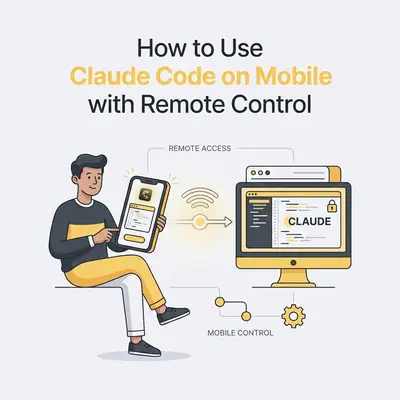
Most AI coding tools assume you are sitting at a desk with a full keyboard. That breaks the moment you step away from your computer.
Claude Code's remote control feature changes that. Start a session on your desktop, then supervise, approve, and steer the agent from your phone — in a meeting, on a commute, or anywhere away from your desk.
Here is what it is, how to set it up, and how to build a practical mobile workflow around it.
What Remote Control Actually Is
Claude Code is a terminal-based agent. It reads files, runs shell commands, edits code, and commits to Git — all autonomously. The catch is that it pauses and asks for permission before taking destructive or irreversible actions.
Without remote access, those permission prompts sit frozen on your desktop until you return.
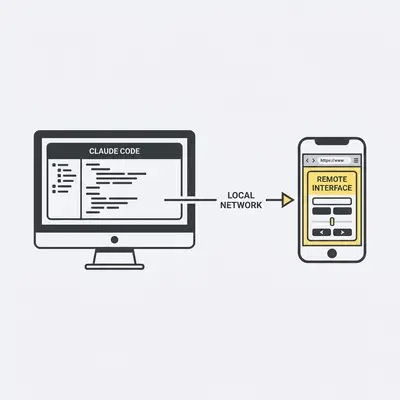
Remote control solves this by exposing a lightweight web interface alongside the terminal session. You open that address in any browser — desktop or mobile — and see a live mirror: Claude's current output, pending permission requests, and an input field for new instructions.
Key Insight: Remote control is not a way to run Claude Code on your phone. It is a window into a session already running on your machine, accessible from any device on your network.
Setting Up Remote Control
Step 1: Install and authenticate Claude Code
If you have not set it up yet, install it and authenticate:
npm install -g @anthropic-ai/claude-code
claude
Follow the login prompt. You can authenticate with a Claude.ai Max subscription or an Anthropic API key.
Step 2: Start a session with remote control enabled
Navigate to your project and start Claude Code with the --port flag:
cd /your/project
claude --port 8080
Claude Code starts normally in the terminal and simultaneously binds a web server to http://localhost:8080.
Step 3: Access from your phone on the same network
Find your desktop machine's local IP address:
# macOS / Linux
ipconfig getifaddr en0

# Windows
ipconfig
Then open http://192.168.x.x:8080 (your actual IP) on your phone's browser. You will see the live Claude Code interface — task output, permission prompts, and an input field.
Quick Win: Bookmark the local IP address on your phone's home screen. This saves you from looking it up every session.
Accessing It Over the Internet
Local network access is fine at home or in an office. For true on-the-go access, you need a secure tunnel.
Option A: Tailscale (Recommended)
Tailscale creates a private VPN mesh between your devices. Once installed on both your desktop and phone and signed in with the same account, your desktop appears at a stable private IP (e.g., 100.x.x.x) accessible from anywhere — no port forwarding, no router configuration.
Visit http://100.x.x.x:8080 on your phone.
Option B: ngrok (Quick Testing)
ngrok tunnels a local port to a public HTTPS URL. Good for quick sessions, not permanent:
ngrok http 8080
ngrok prints a URL like to open on your phone.
Reality Check: ngrok URLs are technically public. Always enable ngrok authentication or use a one-time URL. Never expose a live Claude Code session without access controls — it has permission to write files and run shell commands on your machine.
What You Can Do from Mobile
Once connected, here is what the mobile interface gives you:
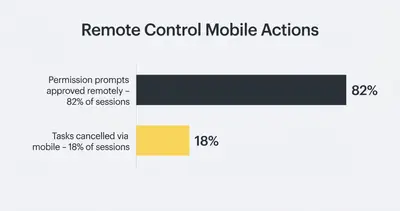
Approve or deny permission requests
This is the primary use case. Claude Code pauses before:
- Writing to or deleting files
- Running shell commands (
git push,npm install,rm) - Making network requests
On mobile, these appear as a prompt with Allow and Deny buttons. One tap unblocks the agent.
Monitor task output in real time
Watch Claude's reasoning, file reads, and command results stream by. Useful for checking progress on a long-running refactor or background task you started before a meeting.
Send short follow-up instructions
The input field works on mobile. It is not great for long prompts, but works well for quick corrections:
- "Focus only on the authentication module."
- "Stop and summarize what you have changed so far."
- "Commit and push when done."
Cancel a running task
If something looks wrong, cancel from mobile rather than rushing back to your desk.
A Practical Mobile Workflow
Here is how this actually plays out day-to-day:
Before you leave your desk:
- Start Claude Code with
--port 8080. - Give it a clearly scoped task: "Refactor the payment module to use the new Stripe SDK. Run the test suite after each file change and only proceed if all tests pass."
- Approve the first few tool calls while you are still at your desk to make sure it is on the right track.
- Once it is running smoothly, step away.
On mobile:
- Open the web interface on your phone.
- Approve permission prompts as they appear.
- Glance at the output every few minutes to confirm progress.
- Send a short correction if Claude drifts off-track.
When you return:
- Review the full session history in the terminal.
- Check the Git diff before merging.
- Run a final test suite.
Pro Tip: For approval-heavy tasks, use a clearly scoped prompt that minimizes the number of destructive operations. The fewer times Claude needs to ask for permission, the smoother the mobile experience.
Limitations to Know Before You Start
Remote control is genuinely useful, but it has real constraints.
It is supervision, not initiation. Starting a complex Claude Code task from scratch on mobile is awkward. Writing a detailed, context-rich prompt on a touchscreen is slow. Do that from your desk, then hand off supervision to mobile.
The interface is minimal. The remote web UI is functional, not polished. Think log viewer with a text input — not a full IDE. Expect it to work, not to be pretty.
Network dependency. If your tunnel drops or your phone loses signal, Claude Code keeps running on the desktop but you lose visibility until you reconnect. The session does not pause.
Approval fatigue on dense tasks. If your task triggers dozens of permission requests in quick succession, mobile approval becomes tedious. For trusted, sandboxed environments (like a local dev container), consider whether you actually need approval on every action.
When This Makes Sense
Remote control on mobile is not a daily workflow for most developers. It earns its place in specific situations:
- Long-running refactors you kick off before a meeting and check in on between sessions
- Dependency updates or test sweeps where you just need to approve the final commit
- Remote server work where Claude Code is running on a cloud VM rather than your laptop
- Travel days where you want to keep a task progressing while you are away from your desk
For quick edits or anything requiring heavy prompting, wait until you have a keyboard.
Conclusion
Claude Code's remote control feature quietly fixes one of the most frustrating parts of agentic AI: the agent stops cold while you are nowhere near your computer.
Pair the --port flag with Tailscale, and your phone becomes a lightweight control panel — enough to approve, redirect, monitor, and cancel, without being tied to your desk.
The setup takes about 10 minutes. After that, any long-running Claude Code task becomes something you can manage from your pocket.
Ready to explore what Claude Code can automate? Book a free consultation with Evalics and we will walk through which agentic workflows make sense for your team.
Related Resources
- Introduction to Claude Code: Anthropic's Agentic CLI Tool Explained
- How to Automate Web App QA with Claude Desktop
- AI Agents in 2025: What's Real, What's Hype
- n8n MCP vs Claude Code: Which Automation Approach Wins
Official Sources
By Kevin Michael Schindler, AI Automation Expert at Evalics