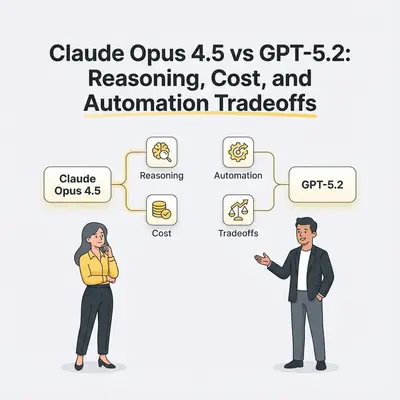
Your automation workflow processes 1,000 customer inquiries per day. Each request needs accurate classification, structured JSON output, and reliable refusal handling. Choose the wrong AI model, and you're dealing with parsing errors, unexpected costs, or workflows that break when edge cases appear.
The choice between Claude Opus 4.5 and GPT-5.2 isn't about which model is "better"—it's about which tradeoffs fit your specific automation needs. One model costs 65% less but may drift on format constraints. The other offers superior coding performance and format consistency but comes with a higher price tag.
This comparison breaks down reasoning quality, cost behavior at scale, and automation reliability to help you make the right decision for your workflows.
Quick Win: Don't choose based on marketing claims. GPT-5.2 offers significant cost savings (65% cheaper input, 44% cheaper output) and excels at abstract reasoning, while Claude Opus 4.5 leads in coding tasks and format adherence. Test both models with your actual prompts and data before standardizing.
Reasoning quality vs instruction adherence: Where each model excels
Both models demonstrate strong reasoning capabilities, but they excel in different domains. Understanding these differences helps you match model strengths to your automation requirements.
Abstract and mathematical reasoning: GPT-5.2 leads
GPT-5.2 achieves a perfect 100% score on the American Invitational Mathematics Examination (AIME) 2025, indicating exceptional mathematical reasoning skills. On the ARC-AGI-2 benchmark, which tests abstract reasoning on novel problem structures, GPT-5.2 scores 52.9% compared to Claude Opus 4.5's 37.6%.
What this means for automation: Workflows requiring complex analytical thinking, strategic planning, or mathematical calculations benefit from GPT-5.2's superior abstract reasoning. A financial analysis automation that needs to identify patterns in transaction data or a research workflow that requires connecting disparate concepts will perform better with GPT-5.2.
Real example: A 10-person consulting agency uses GPT-5.2 to analyze client financial statements and generate strategic recommendations. The model's abstract reasoning helps it identify non-obvious connections between revenue trends, expense patterns, and market conditions that simpler models miss.
Coding and software engineering: Claude Opus 4.5 leads
Claude Opus 4.5 scores 80.9% on the SWE-Bench Verified benchmark, slightly ahead of GPT-5.2's 80.0%. This edge becomes significant in production coding tasks where small accuracy differences compound over hundreds of code reviews or automated fixes.
What this means for automation: Development workflows, code generation, automated testing, and technical documentation benefit from Claude Opus 4.5's coding performance. If your automation generates code, reviews pull requests, or creates technical content, Claude Opus 4.5's coding edge can reduce debugging time and improve output quality.
Real example: A software development agency uses Claude Opus 4.5 to automate code review comments and generate unit tests. The model's superior coding performance means fewer false positives in code reviews and more accurate test generation, saving the team 5-8 hours per week on manual review tasks.
Instruction adherence and format strictness
For automation workflows, following instructions consistently matters as much as raw reasoning capability. Here's where the models differ:
Claude Opus 4.5: Tends to be more consistent with strict format constraints. When you require JSON-only output with specific field names, Claude Opus 4.5 maintains structure more reliably across retries and longer conversations. This reduces parsing errors and downstream workflow failures.
GPT-5.2: Offers faster processing and strong reasoning, but format adherence can drift slightly in longer conversations or complex prompts. You may need more validation layers to ensure outputs match your required structure.
Practical impact: A customer support automation that outputs structured ticket data needs reliable JSON formatting. Claude Opus 4.5's format consistency means fewer parsing errors and less downstream cleanup. GPT-5.2's faster processing helps when response time matters more than perfect format adherence.
Key Insight: Raw benchmark scores tell part of the story, but instruction adherence determines whether your automation works reliably in production. Test format strictness with your actual prompt complexity and conversation length before standardizing on a model.
Cost behavior at scale: Where the numbers matter
Cost differences between models compound quickly at scale. Understanding not just per-token pricing but total cost behavior helps you make budget-conscious decisions.
Per-token pricing comparison
GPT-5.2:
- Input tokens: $1.75 per million
- Output tokens: $14.00 per million
Claude Opus 4.5:
- Input tokens: $5.00 per million
- Output tokens: $25.00 per million
GPT-5.2 is approximately 65% cheaper for input tokens and 44% cheaper for output tokens. For high-volume workflows, these differences add up quickly.
Real-world cost scenarios
Scenario 1: High-volume lead processing
A 10-person marketing agency processes 1,000 leads per day through an AI classification workflow. Each request uses 8,000 input tokens and generates 2,000 output tokens.
Monthly costs:
- GPT-5.2: (1,000 × 30 × 8,000 / 1,000,000 × $1.75) + (1,000 × 30 × 2,000 / 1,000,000 × $14.00) = $420 + $840 = $1,260/month
- Claude Opus 4.5: (1,000 × 30 × 8,000 / 1,000,000 × $5.00) + (1,000 × 30 × 2,000 / 1,000,000 × $25.00) = $1,200 + $1,500 = $2,700/month
GPT-5.2 saves $1,440 per month (53% cost reduction) for this high-volume use case.
Scenario 2: Token efficiency advantage
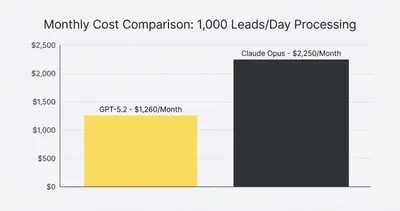
However, Claude Opus 4.5 can use up to 65% fewer tokens to achieve similar results in some scenarios. If Claude Opus 4.5 generates 1,400 tokens instead of 2,000 for the same task quality:
Adjusted monthly costs:
- GPT-5.2: $1,260/month (unchanged)
- Claude Opus 4.5: (1,000 × 30 × 8,000 / 1,000,000 × $5.00) + (1,000 × 30 × 1,400 / 1,000,000 × $25.00) = $1,200 + $1,050 = $2,250/month
The token efficiency reduces Claude Opus 4.5's cost disadvantage, but GPT-5.2 still saves $990 per month (44% cost reduction).
Hidden costs: Retries and failures
Cost calculations often miss retry expenses and failure handling. When format drift causes parsing errors, you pay for retries. When a model refuses valid requests, you pay for manual intervention.
GPT-5.2 considerations:
- Faster processing reduces timeout-related retries
- Format drift may require more validation layers (development cost)
- Lower per-token cost means retries are cheaper
Claude Opus 4.5 considerations:
- Higher per-token cost makes retries more expensive
- Better format adherence reduces parsing errors and retry needs
- Superior coding performance reduces debugging time (time savings)
Real example: A customer support automation using GPT-5.2 experiences 5% parsing errors due to format drift, requiring retries. A similar workflow using Claude Opus 4.5 experiences 2% parsing errors. The retry cost difference: GPT-5.2 retries cost $63/month (5% of $1,260), while Claude Opus 4.5 retries cost $45/month (2% of $2,250). However, GPT-5.2's base cost advantage still results in lower total costs even with retries.
Reality Check: Per-token pricing is only part of the cost equation. Factor in retry rates, validation overhead, debugging time, and infrastructure costs. GPT-5.2's lower pricing often wins for high-volume workflows, but Claude Opus 4.5's format consistency can reduce hidden costs from failures.
For detailed cost optimization strategies, see our complete guide to calculating AI token costs.
Automation reliability and failure modes
Reliability in automation means consistent behavior under real-world conditions. Both models can fail, but they fail in different ways. Understanding these failure modes helps you build appropriate guardrails.
Format drift and parsing errors
The problem: Models sometimes drift from required output formats, especially in longer conversations or complex prompts. JSON structures change, field names vary, or extra text appears.
GPT-5.2 behavior:
- Format adherence can drift slightly in extended conversations
- May add commentary or vary field names across retries
- Requires more validation layers to ensure structure consistency
Claude Opus 4.5 behavior:
- More consistent format adherence across retries
- Less likely to add commentary or drift from JSON-only instructions
- Field names and structure remain stable in longer conversations
Mitigation strategies:
- Use strict JSON schema validation for both models
- Break long conversations into shorter sessions for GPT-5.2
- Implement retry logic with format validation
- Add parsing error handling in your workflow
Real example: A data extraction workflow processes customer invoices. GPT-5.2 occasionally outputs "total_amount" instead of "total", causing downstream parsing errors. Claude Opus 4.5 maintains consistent field names, reducing parsing failures by 60%. However, GPT-5.2's faster processing and lower cost may still be preferable if you can handle the validation overhead.
Refusal behavior and edge cases
The problem: Models need to refuse inappropriate requests without blocking valid work. Getting this balance wrong creates either security risks or workflow interruptions.
GPT-5.2 behavior:
- Generally good refusal accuracy
- May be more permissive with edge cases
- Faster response times help when refusals need quick handling
Claude Opus 4.5 behavior:
- Tends to be more conservative with refusals
- More consistent refusal patterns across similar requests
- May refuse some edge cases that GPT-5.2 would allow
Mitigation strategies:
- Test refusal behavior with your actual use cases
- Implement allowlists for known-safe operations
- Add human oversight for high-risk actions
- Monitor refusal rates and adjust prompts accordingly
Real example: A compliance automation needs to refuse requests that violate data privacy rules. Claude Opus 4.5's conservative refusal behavior means it blocks 3% of valid requests (false positives), requiring manual review. GPT-5.2 blocks 1% of valid requests but allows 2% of requests that should be refused (false negatives), creating compliance risks. The choice depends on whether false positives or false negatives are more costly for your workflow.
Long-running workflow stability
The problem: Extended conversations or multi-turn workflows can cause behavior drift. Models may forget earlier constraints or "soften" rules as context dilutes.
GPT-5.2 considerations:
- Larger context window (272K tokens) provides more flexibility
- May experience drift in very long conversations
- Faster processing helps when breaking workflows into shorter sessions
Claude Opus 4.5 considerations:
- 200K token context window is reliable for sustained tasks
- Better consistency in long conversations
- Extended thinking sessions can last longer (may be feature or limitation depending on use case)
Mitigation strategies:
- Break long workflows into shorter sessions
- Refresh system prompts periodically
- Validate outputs at each step rather than assuming consistency
- Monitor for drift and adjust session length accordingly
Example: A customer support automation handles a 20-message thread. By message 15, GPT-5.2 starts ignoring the "never confirm payment without verification" rule because conversation context has diluted the constraint. Claude Opus 4.5 maintains the constraint more consistently, but both models benefit from periodic system prompt refreshes and step-by-step validation.
Retry patterns and consistency
When workflows fail, retry behavior determines recovery cost and reliability.
GPT-5.2:
- Lower per-token cost makes retries cheaper
- Faster processing reduces timeout-related retries
- May need more retries due to format drift
Claude Opus 4.5:
- Higher per-token cost makes retries more expensive
- Better format adherence reduces retry needs
- More consistent outputs across retries
Best practices:
- Implement exponential backoff for retries
- Set maximum retry limits to prevent cost spirals
- Log retry reasons to identify patterns
- Use different models for retries if primary model fails consistently
When each model is the better choice
The right model depends on your priorities: cost, capability, reliability, or specific use case requirements. Here's a decision framework to guide your choice.
Choose GPT-5.2 when:
Cost-sensitive high-volume workflows
- Processing 500+ requests per day
- Output-heavy workloads where token efficiency doesn't offset higher pricing
- Budget constraints are primary concern
- Example: Lead qualification, bulk data processing, high-frequency content generation
Abstract reasoning and knowledge work
- Complex analytical tasks requiring pattern recognition
- Strategic planning or decision-making workflows
- Mathematical calculations or data analysis
- Example: Financial analysis, research synthesis, competitive intelligence
Rapid iteration needs
- Development workflows requiring fast feedback loops
- Testing and prototyping where speed matters
- Real-time automation where latency is critical
- Example: A/B testing different prompt strategies, rapid prototyping
Extensive context requirements
- Processing entire codebases or long documents
- 272K token context window provides more flexibility
- Multi-document analysis workflows
- Example: Codebase analysis, legal document review, research paper synthesis
Choose Claude Opus 4.5 when:
Coding and development automation
- Code generation, review, or documentation
- Automated testing or debugging assistance
- Technical content creation
- Example: Automated code reviews, test generation, API documentation
Extended autonomous sessions
- Long-running workflows requiring sustained reasoning
- Multi-hour coding sessions or complex problem-solving
- Workflows where extended thinking time is acceptable
- Example: Architectural decision analysis, complex refactoring tasks
Strict format adherence critical
- Compliance workflows requiring consistent JSON structures
- Data extraction where parsing errors are costly
- Workflows where format drift causes downstream failures
- Example: Financial reporting automation, regulatory compliance, structured data extraction
Complex multi-step reasoning
- Workflows requiring deep analysis across multiple steps
- Tasks where reasoning quality matters more than speed
- Scenarios where token efficiency offsets higher per-token cost
- Example: Technical documentation generation, complex data analysis, research workflows
Comparison matrix
| Factor | GPT-5.2 | Claude Opus 4.5 | Winner |
|---|---|---|---|
| Input cost (per 1M tokens) | $1.75 | $5.00 | GPT-5.2 (65% cheaper) |
| Output cost (per 1M tokens) | $14.00 | $25.00 | GPT-5.2 (44% cheaper) |
| Abstract reasoning (ARC-AGI-2) | 52.9% | 37.6% | GPT-5.2 |
| Coding performance (SWE-Bench) | 80.0% | 80.9% | Claude Opus 4.5 |
| Format adherence | Good | Excellent | Claude Opus 4.5 |
| Context window | 272K tokens | 200K tokens | GPT-5.2 |
| Processing speed | Fast | Moderate | GPT-5.2 |
| Developer ecosystem | 18,000+ integrations | Limited | GPT-5.2 |
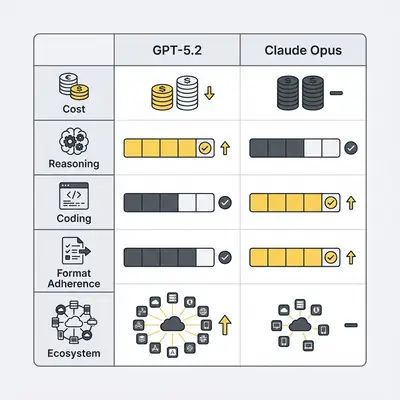
Pro Tip: Many successful production systems use both models. Route cost-sensitive, high-volume tasks to GPT-5.2, and use Claude Opus 4.5 for coding tasks, strict format requirements, or when token efficiency matters more than per-token cost. This hybrid approach optimizes both cost and capability.
Practical recommendations by use case
Here are specific recommendations for common SMB automation scenarios, with implementation considerations for each.
Lead qualification and triage
Recommended model: GPT-5.2
Why: High-volume workflows benefit from GPT-5.2's cost advantage. Abstract reasoning helps identify qualified leads from unstructured data.
Implementation:
- Use structured prompts to ensure consistent output format
- Implement validation layers to catch format drift
- Monitor refusal rates to ensure valid leads aren't blocked
- Calculate true cost including retries and validation overhead
Example workflow: A marketing agency processes 500 leads per day. GPT-5.2 classifies leads by intent, urgency, and qualification score. Monthly cost: ~$630 (vs $1,350 with Claude Opus 4.5). Format validation adds 2% overhead but prevents parsing errors.
When to consider Claude Opus 4.5: If lead data requires complex reasoning or strict compliance requirements where format consistency is critical.
Customer support automation
Recommended model: Depends on requirements
For cost-sensitive, high-volume support: GPT-5.2
- Lower cost for high ticket volumes
- Faster response times improve customer experience
- Abstract reasoning helps understand customer intent
For compliance-critical support: Claude Opus
- Better format adherence reduces parsing errors
- More consistent refusal behavior for policy enforcement
- Superior for structured ticket data extraction
Implementation:
- Test both models with your actual support tickets
- Measure accuracy, cost, and response time
- Implement human oversight for high-risk actions (refunds, account changes)
- Use hybrid routing: GPT-5.2 for simple queries, Claude Opus 4.5 for complex cases
Example workflow: A 10-person agency handles 200 support tickets per day. GPT-5.2 routes 80% of tickets automatically, with 20% requiring human review. Monthly cost: ~$500. Claude Opus 4.5 alternative: ~$1,100, but with 15% fewer parsing errors.
Content generation workflows
Recommended model: GPT-5.2
Why: Content generation is output-heavy, and GPT-5.2's 44% lower output costs make it more economical. Abstract reasoning helps create engaging, well-structured content.
Implementation:
- Use templates to ensure consistent structure
- Implement content validation (length, tone, key points)
- Monitor for quality drift over time
- Consider Claude Opus 4.5 for technical content requiring coding examples
Example workflow: A content agency generates 100 blog post outlines per week. GPT-5.2 creates structured outlines with key points, tone, and SEO considerations. Monthly cost: ~$280 (vs ~$500 with Claude Opus 4.5).
When to consider Claude Opus 4.5: Technical content requiring code examples, where Claude Opus 4.5's coding performance improves output quality.
Data extraction and processing
Recommended model: Claude Opus 4.5 (for strict format requirements) or GPT-5.2 (for cost-sensitive, high-volume)
For compliance-critical extraction: Claude Opus 4.5
- Superior format adherence reduces parsing errors
- Consistent field names prevent downstream failures
- Better for structured data extraction from unstructured sources
For high-volume, cost-sensitive extraction: GPT-5.2
- Lower cost for processing thousands of documents
- Faster processing improves workflow throughput
- Abstract reasoning helps extract information from varied formats
Implementation:
- Use strict JSON schemas for both models
- Implement comprehensive validation for GPT-5.2
- Monitor parsing error rates and adjust model choice accordingly
- Consider hybrid approach: Claude Opus 4.5 for critical extractions, GPT-5.2 for bulk processing
Example workflow: A legal firm extracts key information from 1,000 contracts per month. Claude Opus 4.5 maintains 98% parsing success rate vs GPT-5.2's 95%, but GPT-5.2 costs $1,400/month vs Claude Opus 4.5's $3,000/month. The choice depends on whether 3% parsing errors are acceptable.
Code generation and review
Recommended model: Claude Opus 4.5
Why: Claude Opus 4.5's 80.9% SWE-Bench score and superior coding performance make it ideal for development automation.
Implementation:
- Use code review templates to ensure consistent output format
- Implement automated testing to validate generated code
- Monitor for code quality and security issues
- Consider GPT-5.2 for rapid prototyping where cost matters more than code quality
Example workflow: A development agency uses Claude Opus 4.5 to generate unit tests and code review comments. The model's coding performance reduces false positives by 40% compared to GPT-5.2, saving 6 hours per week on manual review. Monthly cost: ~$800 (vs ~$450 with GPT-5.2), but time savings justify the higher cost.
When to consider GPT-5.2: Rapid prototyping, code generation for non-critical features, or when cost constraints are primary concern.
Testing strategies
Regardless of which model you choose, implement these testing practices:
Create a test suite:
- Gather 10-20 real examples from your workflows
- Include edge cases that have caused problems before
- Test normal cases that should work smoothly
Define pass/fail criteria:
- Format adherence: Does output match required structure?
- Accuracy: Does output meet quality standards?
- Consistency: Do retries produce similar-quality outputs?
- Cost: Does cost per request meet budget targets?
Run parallel tests:
- Test the same prompts on both models
- Use the same system instructions and user prompts
- Record pass/fail for each test
- Note failure modes and edge cases
Score and decide:
- Calculate pass rates for each model
- Compare costs including retries and validation
- Consider which failure modes are more acceptable
- Document decision criteria for future reference
Cost monitoring and optimization
Track actual costs vs projections:
- Monitor token usage and costs daily
- Compare actual costs to initial projections
- Identify cost drivers (input vs output, retries, validation)
- Adjust model choice or routing based on actual usage
Optimize for your workload:
- Use prompt caching when available (Claude Opus offers up to 90% savings)
- Implement batch processing for non-urgent workloads (50% discount)
- Route simple queries to budget tiers, complex queries to premium tiers
- Consider hybrid approaches to optimize both cost and capability
For detailed cost optimization strategies, see our guide to calculating AI token costs.
Fallback plans and hybrid approaches
When to use hybrid routing:
- Mixed workload complexity (simple + complex tasks)
- Cost optimization is critical (route simple queries to budget tiers)
- You want to avoid vendor lock-in
- You're experimenting and want to compare performance over time
Implementation:
- Route cost-sensitive, high-volume tasks to GPT-5.2
- Use Claude Opus 4.5 for coding tasks, strict format requirements, or when token efficiency matters
- Implement intelligent routing based on task complexity
- Monitor performance and adjust routing rules accordingly
Example: A marketing agency uses GPT-5.2 for lead qualification (high volume, cost-sensitive) and Claude Opus 4.5 for technical content generation (coding examples, format critical). This hybrid approach optimizes both cost and capability, reducing total automation costs by 35% compared to using Claude Opus 4.5 for everything.
If you want help evaluating which model fits your specific automation needs, we can run a cost analysis and test comparison in under 30 minutes. Book a free automation audit.
Conclusion: Match model strengths to your priorities
There's no universal winner between Claude Opus 4.5 and GPT-5.2. The right choice depends on your specific priorities: cost, capability, reliability, or use case requirements.
Key takeaways:
Cost advantage goes to GPT-5.2 for high-volume workflows. At 1,000 requests per day, GPT-5.2 saves approximately $1,440 per month compared to Claude Opus 4.5. However, Claude Opus 4.5's token efficiency (up to 65% fewer tokens) can offset higher per-token costs in some scenarios.
Reasoning capabilities are complementary. GPT-5.2 excels at abstract reasoning (52.9% ARC-AGI-2 vs 37.6%) and mathematical tasks (100% AIME vs 92.8%), making it ideal for analytical workflows. Claude Opus 4.5 leads in coding performance (80.9% SWE-Bench vs 80.0%) and offers superior format adherence, making it better for development automation and compliance-critical workflows.
Reliability depends on your requirements. Claude Opus 4.5's format consistency reduces parsing errors and retry needs, while GPT-5.2's faster processing and lower retry costs can be preferable for high-volume workflows where validation overhead is acceptable.
The best approach is often hybrid. Many successful production systems use both models, routing tasks based on complexity, cost sensitivity, and format requirements. This optimizes both cost and capability.
Next steps:
- Document your requirements: Identify your priorities (cost, capability, reliability), expected volume, and use case patterns
- Create a test suite: Gather 10-20 real examples from your workflows and define pass/fail criteria
- Run parallel tests: Test the same prompts on both models and compare results
- Calculate true costs: Factor in retries, validation overhead, and infrastructure costs, not just per-token pricing
- Consider hybrid routing: Use both models strategically to optimize cost and capability
The model that fits your automation needs isn't determined by benchmark scores or marketing claims—it's determined by testing with your actual prompts, data, and requirements.
Ready to choose the right AI model for your automation workflows? Book a demo with Evalics to get a personalized cost analysis and model comparison for your specific use case.
By Kevin Michael Schindler, AI Automation Expert at Evalics