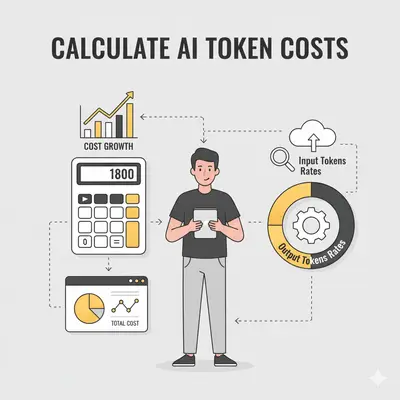
What Is an AI Token Cost Calculator and Why Is It Essential in 2025?
This token calculator provides the exact formula, copy/paste template, and free tools to calculate AI token costs for your project. Whether you're budgeting for product teams, ops automation, or enterprise AI deployments, you'll get immediate cost estimates plus optimization strategies that cut spending by 50–90%.
In 2025, worldwide AI spending is projected to reach $1.5 trillion, marking a 49.7% increase from 2024. As AI-driven automation surges, managing token costs becomes crucial for project success. Miscalculating these can lead to significant budget overruns.
Ready to optimize your AI spending? Book a free AI audit with Evalics
How Do You Calculate AI Token Costs Using the Standard Formula?
Use this formula and template to calculate AI token costs instantly:
The Formula
Total Cost = (Input Cost) + (Output Cost)
Where:
- Input Cost =
(input_tokens / 1,000,000) × price_per_1M_input_tokens - Output Cost =
(output_tokens / 1,000,000) × price_per_1M_output_tokens
Copy/Paste Template
| Variable | Value | Example |
|---|---|---|
| Input tokens | X | 12,000 |
| Input price (per 1M tokens) | $Y | $2.50 |
| Output tokens | Z | 3,000 |
| Output price (per 1M tokens) | $W | $10.00 |
| Input Cost | (X / 1,000,000) × Y | (12,000 / 1,000,000) × 2.50 = $0.03 |
| Output Cost | (Z / 1,000,000) × W | (3,000 / 1,000,000) × 10.00 = $0.03 |
| Total Cost | Input Cost + Output Cost | $0.03 + $0.03 = $0.06 |
Quick Example
Scenario: You're using GPT-4 Turbo to analyze 100 leads per day.
- Input: 12,000 tokens per request
- Output: 3,000 tokens per request
- Pricing: $2.50 per 1M input tokens, $10.00 per 1M output tokens
Calculation:
- Input cost per request:
(12,000 / 1,000,000) × 2.50 = $0.03 - Output cost per request:
(3,000 / 1,000,000) × 10.00 = $0.03 - Total per request: $0.06
- Monthly (100 requests/day × 30 days): $180
Tip: Use our free Token to Pages Visualizer to sanity-check your token counts and understand context limits before calculating costs.
Why Is AI Token Cost Management Critical for Scaling LLM Applications?
AI tokens are the building blocks of large language models (LLMs), where costs accrue per token processed.
In 2025, with GenAI spending hitting $644 billion, accurate cost calculation ensures scalability and profitability.
Trends show a shift to usage-based pricing, reducing expenses by up to 75% during off-peak hours.
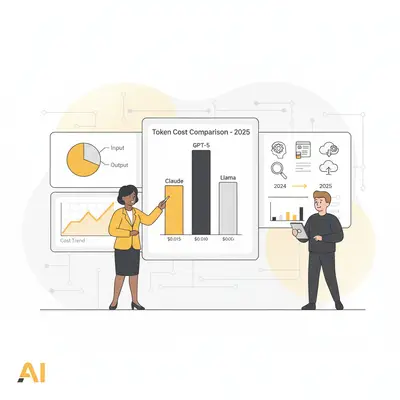
What Are the Best AI Token Cost Calculator Tools in 2025?
These tools help estimate token costs: use web calculators for quick checks; use AgentOps Tokencost when you need programmatic integration in scripts or automation workflows.
-
Evalics Token to Pages Visualizer
Free tool to visualize token counts and understand context limits (pages, words, characters).
Pros: Instant visualization, no signup; Cons: Visualizer only, not a cost calculator.
Pricing: Free.
Use to sanity-check token counts before calculating costs. Browse all free tools → -
Metaschool AI Token Calculator
Web calculator for quick token and cost estimates (OpenAI, Anthropic).
Pros: Fast, simple; Cons: Manual-only, limited model options.
Pricing: Free.
Use for quick one-off checks. -
AgentOps Tokencost
Python library for 400+ LLMs; client-side token counting and USD cost estimation.
Pros: Programmatic, broad coverage; Cons: Requires coding.
Pricing: Free.
Best for scripts and automation workflows. -
GPT for Work Pricing Calculator
Web-based estimator for OpenAI, Anthropic, and others.
Pros: Multi-provider; Cons: Manual-only, no export/API.
Pricing: Free.
Good for rough comparisons. -
YourGPT LLM Cost Calculator
Side-by-side pricing view for Claude, Gemini, OpenAI, and others.
Pros: Easy comparison; Cons: Limited controls, no automation.
Pricing: Free.
Useful for quick sanity checks. -
Jotform AI Token Calculator
Simple token-to-cost calculator (OpenAI, Gemini).
Pros: Very easy; Cons: Basic, manual-only.
Pricing: Free.
Handy for entry-level estimates.
How Can You Implement an AI Token Cost Calculation Strategy in 5 Steps?
Follow these 7 practical steps to calculate token costs accurately and efficiently.
- Understand Tokenization — Tokens are subwords; 1 token ≈ 4 characters or ~0.75 words (so 1,000 tokens ≈ 750 words).
- Count Tokens — Use a quick heuristic (
words × 1.33) for rough estimates, or a tokenizer (e.g., TikToken/OpenAI) for accurate counts. - Break Down System Stages — Identify prompts and outputs per stage (system, retrieval, generation, tools).
- Apply Pricing — Input cost =
(input_tokens / 1,000,000) × price_per_1M_input; Output cost =(output_tokens / 1,000,000) × price_per_1M_output.
Example: at $2.50 per 1M input tokens, 12,000 input tokens cost ≈$0.03. - Scale for Usage — Monthly cost =
requests_per_month × per_request_cost(by model/endpoint). - Optimize Prompts — Reduce tokens via caching, batching, compression, tighter instructions, and shorter outputs.
- Monitor and Adjust — Use dashboards and alerts to track spend and anomalies by model, endpoint, and customer.
Common Pitfall: Overestimating words.
Fix: Use real logs: export token usage from your provider (e.g., OpenAI Usage CSV with prompt_tokens/completion_tokens), compute average tokens per request by model/endpoint, then apply input/output prices to get actual cost.
Want to make your AI project 30–50% more cost-efficient?
Schedule a free token cost audit with our experts at Evalics.
How Have Businesses Successfully Optimized Their AI Token Spending?
1. High-Volume OpenAI User – Community-Reported Case
In early 2025, a Reddit user revealed spending over 9.5 billion tokens on OpenAI APIs in just one month.
After analyzing token usage, they optimized their prompts and switched to gpt-4o-mini, implementing response truncation and caching.
These changes led to a 70% reduction in output tokens and a 40% overall cost decrease, with no measurable loss in model performance.
Source: Reddit – “Spent 9.5B OpenAI tokens in January”
2. AWS Generative AI Optimization – Cloud Implementation Example
AWS engineers showcased a cost-optimization framework for generative AI workloads using token-aware prompting, batch inference, and prompt compression.
By batching similar prompts and limiting unnecessary context, organizations achieved up to 75% token cost savings while maintaining accuracy and response time.
This method is now widely referenced for enterprise-scale LLM optimization and sets the foundation for Evalics’ AI efficiency audits.
Source: AWS Machine Learning Blog – Optimizing Costs of Generative AI Applications
3. Azilen Product Company – Applied AI Cost Optimization
Azilen engineers redesigned their AI architecture using retrieval-augmented generation (RAG) and model sharding to split workloads across smaller open models instead of relying on one premium LLM.
This strategy maintained answer accuracy above 92%, cut inference costs by over 50%, and improved system scalability.
Their approach illustrates how multi-model orchestration and prompt caching can reduce expenses while boosting performance.
Source: Azilen Blog – 8 Strategies for AI Cost Optimization
What Are the Most Common Mistakes to Avoid When Calculating AI Token Costs?
- Ignoring sequence scaling → Costs grow quadratically; fix via chunking.
- No forecasting → Leads to surprise spikes; use dashboards.
- Using premium models for simple tasks → Overpaying; switch to cheaper LLMs.
- Skipping caching → Miss up to 50% savings.
- Vendor lock-in → Limits flexibility; diversify providers.
- Poor experimentation → Wastes tokens; start small with low-cost models.
What Is the Future Outlook for AI Token Pricing Beyond 2025?

Looking ahead, competition and efficiency improvements are likely to push per‑token prices down over time, though trends vary by provider and workload. Some vendors are also testing alternative pricing (e.g., outcome‑ or seat‑based) alongside token metering. To plan accurately, track official pricing updates from your providers: OpenAI Pricing, Anthropic Pricing, and Google Vertex AI Pricing.
How Can You Master Your AI Token Budget?
Mastering how to calculate token costs ensures smarter AI budgeting and long-term ROI.
Key takeaways:
Use reliable tools.
Follow structured steps.
Continuously optimize and monitor usage.
Ready to take control of your AI costs? Contact our automation experts
“In AI, tokens are currency—calculate wisely to thrive.”
Frequently Asked Questions About AI Token Cost Calculation
What are AI tokens?
AI tokens are the text units processed by LLMs, billed per input/output.
How do I estimate tokens without running the model?
Use the rule of thumb (words × 1.33) or online tokenizers like OpenAI’s.
What’s the average token cost in 2025?
Around $1.25 per 1M input tokens for GPT-5-level models.
Can I reduce token costs?
Yes — optimize prompts, use caching, and select the right model tier.
Why calculate token costs early?
It prevents overruns and scales predictably with growth.
Related Reads
- How to Choose the Best AI Model for Your Use Case — Optimize your AI model selection to reduce token costs and improve performance
- Building vs Buying AI in 2025 — Learn cost-effective strategies for implementing AI solutions
- System Prompt vs. User Prompt: The Ultimate Guide — Master prompt engineering to minimize token usage and maximize efficiency