
Google recently announced a new "notebooks" feature for Gemini, as reported by The Verge. This update allows users to aggregate files, chat history, and custom instructions into centralized knowledge bases, mirroring the functionality of ChatGPT’s Projects. You can read the full coverage here: Gemini gets notebooks to help you organize projects.
This development is a massive signal for anyone running a business. We are moving away from the era of "chatting" with AI and into the era of "collaborating" with AI. When you give an AI a persistent memory of your specific projects, you stop wasting time explaining who you are and what you need every single time you open a new chat window.
Why is Context the New Frontier for AI Automation?
Context is the "memory" that allows AI to move from a generic chatbot to a specialized business partner. Without context, AI provides surface-level answers that often miss the mark. With context, the AI understands your specific brand voice, customer history, and operational workflows. For small businesses, this shift means AI can finally handle complex, multi-step tasks without constant manual prompting.
The evolution from prompt-based AI to persistent knowledge bases changes the game. In the past, you had to copy-paste your SOPs into a prompt every time you wanted the AI to draft a client email. Now, the AI holds that information in its "notebook." It knows your tone, your pricing, and your constraints.
This context drastically reduces "hallucinations." When an AI has a defined set of documents to reference, it is far less likely to make things up. It stays within the guardrails you provide.
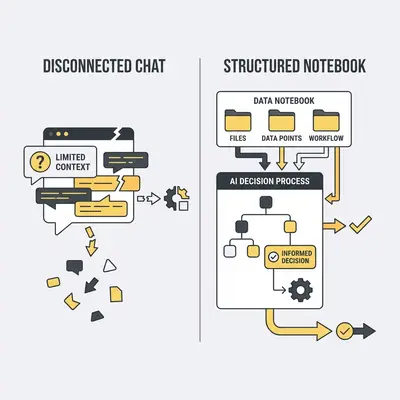
Key Insight: Context is the difference between an AI that guesses and an AI that executes. If you aren't feeding your AI your own data, you are only using 10% of its potential.
How Does Context-Aware AI Change Small Business Operations?
Context-aware AI transforms business operations by automating the "knowledge retrieval" phase of daily tasks. Instead of searching through folders or emails for client details, the AI already has the context. This allows it to draft proposals, summarize meetings, or troubleshoot issues instantly. It removes the cognitive load from your plate and accelerates decision-making.
- Streamlining client onboarding: Upload your onboarding questionnaire and past successful proposals. The AI can now draft a custom welcome package for a new lead in seconds.
- Automating internal documentation: Feed your team’s meeting notes into a notebook. When you need to know why a project stalled three months ago, you just ask the AI.
- Standardizing brand voice: Store your style guide and past marketing copy. Every piece of content the AI generates will sound like you, not a generic robot.
Reality Check: The 80/20 Rule: 80% of your business value is locked in your internal documents. Context-aware AI unlocks it.
What Are the Implications of "Notebook" Features for SMBs?
The rise of notebook-style features means that small businesses no longer need to build custom, expensive AI infrastructure to achieve personalization. By leveraging these built-in tools, you can create a "digital brain" that grows with your company. The primary implication is a lower barrier to entry for sophisticated AI automation.
We are seeing a democratization of enterprise-grade knowledge management. You don't need a team of data scientists to build a RAG (Retrieval-Augmented Generation) system anymore. You just need to organize your files and point the AI at them. This is the shift toward "AI-first" project management, where the AI is a participant in the project, not just a tool you use at the end.
| Feature | Gemini Notebooks | ChatGPT Projects |
|---|---|---|
| Primary Ecosystem | Google Workspace (Docs, Drive) | Platform-agnostic / Custom GPTs |
| Integration | Deep sync with NotebookLM | Strong file-handling & code execution |
| Best For | Google-heavy teams | Complex reasoning & coding tasks |
How Can You Prepare Your Business for Context-Driven AI?
Preparing for this shift requires organizing your digital assets so they are "AI-ready." You must move away from siloed information and toward structured, accessible data repositories. If your business data is messy or fragmented, the AI will struggle to provide value, regardless of how advanced the notebook feature is.
Follow these steps to get your house in order:
- Audit your storage: Identify where your most important SOPs, brand guidelines, and client templates live.
- Clean the data: Remove outdated versions of documents. AI works best when it isn't confused by conflicting information.
- Standardize formats: Use consistent naming conventions for your files. If your AI can't find the file, it can't use the context.
- Define the "Source of Truth": Choose one place for your core business knowledge and keep it updated.
- Test and iterate: Start by uploading one project's worth of data. See how the AI performs, then refine your documents based on the output.
Pro Tip: Garbage in, intelligence out: Your AI is only as smart as the data you feed it. Spend time cleaning your files before you upload them.
Quick Win: Create a "Brand Bible" document today. Include your mission, tone of voice, and top 5 FAQs. This is the first file you should upload to any AI notebook.
Source
Original reporting: Gemini gets notebooks to help you organize projects