
You stare at a list of 40 manual tasks happening in your business every day. Your team spends hours copying data from emails to spreadsheets, moving files between folders, and sending follow-up messages.
You know automation is the answer. But the sheer volume of work feels overwhelming. If you try to automate everything at once, the project will drag on for months, drain your budget, and likely fail.
You do not need to automate everything. You only need to automate the right things.
This is where the 80/20 rule (the Pareto Principle) changes everything. In business operations, 80% of your manual labor comes from just 20% of your tasks. If you identify and automate that magic 20%, you instantly win back dozens of hours every week.
Here is exactly how to find those tasks, what to automate first, and what to leave alone.
What is the 80/20 Rule in Automation?
The 80/20 rule states that a small percentage of inputs drives the vast majority of outputs. Applied to process automation, it means you should aggressively target the few high-volume, repetitive chores that eat up your team's day.
Many business owners make the mistake of trying to automate complex, multi-step processes first. They want an AI agent that handles an entire customer service dispute from start to finish.
That is the wrong approach. Complex processes are full of edge cases, exceptions, and human nuances. Building workflows for them is expensive and fragile.
Instead, look for the boring work.
Key Insight: The highest ROI in automation does not come from replacing human intelligence. It comes from eliminating digital chores. Focus on tasks a smart middle-schooler could do with a checklist.

How to Find Your "Magic 20%"
To find the most profitable processes to automate, you need to score your tasks using a simple matrix. You evaluate tasks based on two factors: Frequency and Complexity.
You want to target tasks in the High Frequency, Low Complexity zone.
1. High Frequency (Happens Constantly)
If a task takes 5 minutes, but you do it 10 times a day, that is 50 minutes daily. Over a year, that is 216 hours—more than five full work weeks wasted on one chore. If a task only happens once a month, ignore it.
2. Low Complexity (No Brainpower Required)
If a task requires human empathy, creative strategy, or complex negotiation, do not automate it yet. If a task involves moving data from Tool A to Tool B exactly the same way every time, automate it immediately.
Before you invest in complex custom software, try the 5-minute test to see if your business process can be automated. If you can document the exact steps without using the word "sometimes," it is a perfect candidate.
The Top 3 Processes You Should Automate First
For most small businesses, the same three processes fall into the magic 20%. They are boring, happen constantly, and cause bottlenecks.
1. Lead Routing and Data Entry
When a new prospect fills out a form on your website, what happens next?
In many companies, an email goes to a shared inbox. A sales rep reads the email, copies the name and contact info, logs into the CRM, creates a new record, and types in the data. This takes about 5 minutes per lead. If you get 20 leads a week, that is over 80 hours a year wasted on copy-pasting.
The Automated Fix: Connect your web form to Make or n8n. When a form is submitted, the workflow automatically parses the data, creates the CRM record, and pings the correct sales rep in Slack. Time spent: 0 minutes.
2. Client Onboarding
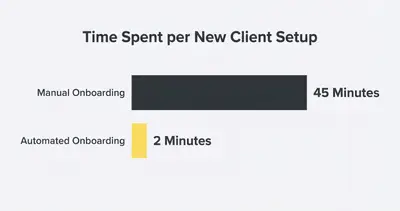
Onboarding a new client usually involves a predictable checklist. You need to send a welcome email, create a Google Drive folder, generate a standard contract, and set up an invoice in QuickBooks.
Doing this manually takes about 45 minutes per new client. If you sign 10 clients a month, you spend 7.5 hours doing administrative setup.
The Automated Fix: Trigger a workflow when a CRM deal is marked "Closed Won." The automation instantly creates the folders, drafts the contract, sends the welcome email, and creates the invoice.
3. Weekly Reporting and Analytics
Your team likely spends Friday afternoons pulling data from Facebook Ads, Google Analytics, and Stripe to create weekly performance reports. This often involves downloading CSV files, copying data into Google Sheets, and formatting charts.
The Automated Fix: Use a scheduled workflow to pull data directly via APIs every Friday at 4 PM. The workflow formats the data, creates the summary using AI, and emails a polished PDF to stakeholders.
Quick Win: Start with 5 simple n8n workflows for daily productivity. Getting a small win early builds momentum and team buy-in for larger projects.
The "Trap 80%": What You Should NOT Automate
Just as important as knowing what to automate is knowing what to avoid. Trying to automate the wrong tasks leads to frustration, broken workflows, and wasted money. Here is what you should leave to humans.
Edge Cases and Exceptions
Imagine you want to automate invoice processing. 90% of your invoices are standard PDFs. 10% are weird formats, handwritten receipts, or require special manager approval.
Do not try to build an automation that handles the 10%.
Building logic for edge cases takes exponentially more time. Build the workflow to handle the standard 90%. When the system spots an edge case, have it pause and flag a human for review. This hybrid approach is how you prevent your first AI automation from failing.
Highly Creative or Strategic Work
AI is incredible at summarizing data, formatting text, and parsing information. It is not ready to dictate your entire business strategy or handle sensitive client escalations.
If a process requires building trust, demonstrating empathy, or making high-stakes financial decisions, keep a human in the driver's seat. Use AI as an assistant to gather data for the human, but do not let it make the final call.
Reality Check: If a task only takes 10 minutes once a month, it is not worth automating. The time spent building and maintaining the workflow will exceed the time saved over five years.
A 3-Step Plan to Implement the 80/20 Rule
Ready to stop drowning in manual work? Follow this exact framework to identify your magic 20% this week.
Step 1: The One-Week Audit
Ask your team to keep a simple notepad on their desks for one week. Every time they find themselves copying data, moving files, or sending a repetitive email, they should write it down. At the end of the week, gather the lists.
Step 2: Score and Rank
List all the tasks on a whiteboard. Score them from 1-10 on frequency (how often it happens) and 1-10 on simplicity (how brainless it is). Multiply the numbers together.
The tasks with the highest scores are your priority targets. Pick the top three. Ignore the rest for now.
Step 3: Build the "Happy Path" First
Take your number one task. Map out the standard, ideal sequence of events. This is called the "happy path." Build an automation in a tool like n8n or Make that handles only this path.
Do not worry about exceptions. If an exception happens, route it to a human. Get the core automation running in production. Once it proves its value, you can slowly add more complex logic later.
Start Small, Scale Fast
Business automation is not an all-or-nothing game. You do not need an enterprise budget or a massive IT team to see massive results.
By applying the 80/20 rule, you stop wasting money on complex, fragile systems. Instead, you systematically eliminate the high-volume digital chores that slow your company down.
Pick one repetitive task today. Document the steps. Automate it. When you get that first hour back, you will see exactly how powerful this mindset is.
By Kevin Michael Schindler AI Automation Expert at Evalics
Related Resources
- The 5-Minute Test to See If Your Business Process Can Be Automated
- 5 Manual Tasks You Must Automate Before Hiring More Staff
- Why Your First AI Automation Will Fail and How to Prevent It
- True Cost of AI Automation 2025
Official Sources
- McKinsey: The automation imperative for businesses
- Harvard Business Review: How to Choose Which Processes to Automate
- HubSpot: State of AI in Marketing and Automation