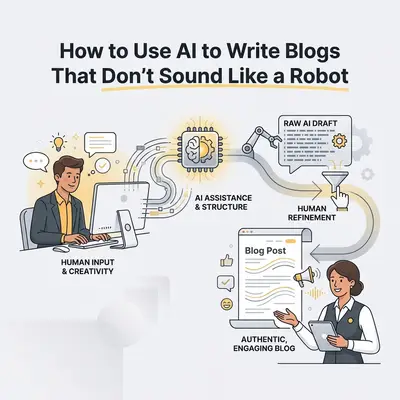
You read the first sentence, and you instantly know.
It uses words like "delve," "leverage," or "testament." It opens with "In today's fast-paced digital landscape." You just caught an AI-generated blog post red-handed.
Most business owners start using AI to write content to save time. But they quickly realize a painful truth: publishing generic, robotic content actually damages their brand. Readers bounce immediately. Search engines ignore it. It converts zero customers.
The problem isn't the AI. The problem is your prompt.
If you ask an AI to "write a blog post about X," it will give you the most statistically average, boring output possible. To get exceptional writing, you need to provide exceptional constraints.
Here is exactly how to prompt and guide AI to write blogs that actually sound like you—and more importantly, keep your audience reading.
The Anatomy of a Robotic AI Blog Post
Before you can fix bad AI writing, you need to know what causes it. AI models like ChatGPT and Claude are trained to be helpful, safe, and structured. Left to their own devices, they write like an enthusiastic but overly formal college student trying to hit a word count.
Watch out for these dead giveaways:
- The "Fluff" Intro: Taking three paragraphs to state the problem without offering any immediate value.
- The Banned Vocabulary: Words like delve, synergy, robust, pivotal, unlock, unleash, navigate, and testament.
- Perfect Symmetry: Every paragraph is exactly three sentences long. Every list has exactly five bullet points.
- Neutrality: The AI refuses to take a strong stance. It constantly uses phrases like "It is important to note" or "On the other hand."
Reality Check: Your readers are busy. If your blog post doesn't offer a unique insight or a strong point of view within the first 100 words, they will close the tab. AI cannot invent your company's unique point of view for you.
Why "Write a Blog About X" Fails
When you give a basic prompt, the AI has to guess what you want. It defaults to a generic system prompt vs user prompt behavior that favors broad, unoffensive language.
To break the robot voice, you have to constrain the AI. You must tell it exactly what not to do.
Think of the AI as a highly skilled typist who doesn't know your business. If you just hand them a topic, they will search Google and rewrite the top results. If you hand them your personal notes, a strict style guide, and a list of forbidden words, they will write something that sounds uniquely yours.
The 4-Step Framework for Human-Sounding AI Content
If you want to create high-quality content that ranks and converts, you need a process. You cannot do this in a single prompt.
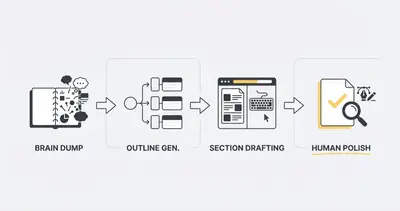
Here is the exact workflow content professionals use to get human-grade writing from AI.
Step 1: The Brain Dump (Your Secret Weapon)
AI cannot write from experience. It only knows what is already on the internet. To make your content stand out, you must inject your own expertise.
Record a 3-minute voice memo on your phone, or quickly type out a messy brain dump. Answer these questions:
- What is the specific problem?
- What is a real-world example I recently saw?
- What is the conventional advice, and why is it wrong?
- What is the exact solution?
Feed this messy text into the AI. Your prompt should look like this: "I am writing a blog post. Here are my raw thoughts, real-world examples, and opinions. Do not invent new concepts. Only use the ideas I have provided here to build an outline."
Step 2: Establish the Style Rules
Once you have your ideas, you need to set the boundaries. This is where you kill the robot voice. You need to provide a set of strict formatting and stylistic rules.
Here is a master style prompt you can copy and paste:
"You are an expert copywriter. Write in a direct, punchy, conversational style. Follow these strict rules:
- Do NOT use words like delve, leverage, robust, unlock, or synergy.
- Write at a 7th-grade reading level. Keep sentences under 20 words.
- Use active voice.
- Vary paragraph lengths. Use single-sentence paragraphs for emphasis.
- Get straight to the point. No throat-clearing introductions."
Pro Tip: If you have examples of your own past writing, paste them into the prompt and say: "Analyze my writing style in the text below. Match this exact tone, cadence, and vocabulary."
Step 3: Generate in Sections (Never All at Once)
Never ask an AI to write a 1,500-word blog post in one go. It will lose focus, hallucinate, and revert to its default robotic tone.
Instead, generate the content section by section.
Start by asking for an outline. Review the outline. Once approved, ask the AI to draft the introduction. Then, review it. Ask it to draft Section 1.
This iterative process ensures the AI stays on track and allows you to course-correct the tone before it writes the entire piece. If you are automating blog post writing with AI, you can structure this logic using multiple nodes in your workflow.
Step 4: The 80/20 Human Polish
Even the best prompt will only get you 80% of the way there. The final 20% must be human.
Read the draft out loud. Where do you stumble? Where does it sound like a corporate brochure? Fix those sections. Add a personal anecdote. Insert internal links naturally.
This step is critical. According to official guidelines from search engines, they reward helpful, original content. They do not care if AI helped you write it, but they will ignore it if it reads like spun spam.
The Real Impact on Your Production Time
Many business owners wonder if learning prompt engineering is worth the effort. They think, "I could just write it myself in the time it takes to build these prompts."
Let's look at the actual time investment. Writing a high-quality, 1,500-word blog post manually takes the average business owner about 4 hours.
Using a generic "write a blog" prompt takes 10 seconds, but leaves you with a terrible draft that takes 3 hours to heavily rewrite.
Using the structured framework above takes about 1 hour total.
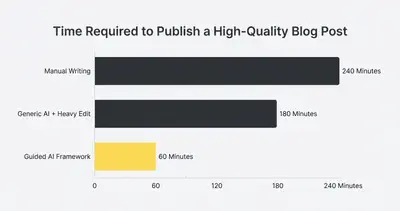
The initial setup of your style prompts takes time, but once established, you cut your content production time by 75% while maintaining human-level quality.
Which AI Model is Best for Writing?
Not all AI models write the same way. The tool you choose drastically impacts the final tone.
- Claude 3.5 Sonnet / Opus: Currently the industry standard for natural, human-sounding copy. Claude naturally follows style constraints better than other models and uses less repetitive vocabulary.
- ChatGPT (GPT-4o): Excellent for brainstorming and outlining, but struggles to shake its robotic tone. It requires heavy negative prompting ("Do not use X words") to sound natural.
- Google Gemini: Great for pulling in real-time research and integrating with Google Workspace, but often produces very dry, academic-sounding drafts.
If your primary goal is are AI SEO writers worth it for your business, Claude is generally the most reliable choice for the drafting phase.
Quick Win: Stop using default ChatGPT for final drafts. Take your ChatGPT outline, move it to Claude, and ask Claude to write the sections using your style guide. You will instantly see a difference in tone.
Summary: Stop Delegating the Thinking
AI is a writing assistant, not a strategy replacement. If you delegate the core thinking to the AI, you will get robotic content.
Bring your unique ideas, your strong opinions, and your industry experience to the table. Use the AI to format, structure, and draft those ideas into a readable format. Give it strict rules on vocabulary and sentence structure.
When you treat AI like an editor and a typist rather than a subject matter expert, your content will immediately stop sounding like a robot.
Ready to scale your content without losing your brand voice? If you are tired of spending hours fighting with ChatGPT to get good results, it's time to build a proper workflow. Book a demo with Evalics today, and let's build an automated content engine that actually sounds like you.
By Kevin Michael Schindler, AI Automation Expert at Evalics
Related Resources
- Automating Blog Post Writing Ai N8n
- Prompt Engineering Step By Step Checklist
- System Prompt Vs User Prompt
- Are Ai Seo Writers Worth It 2025