
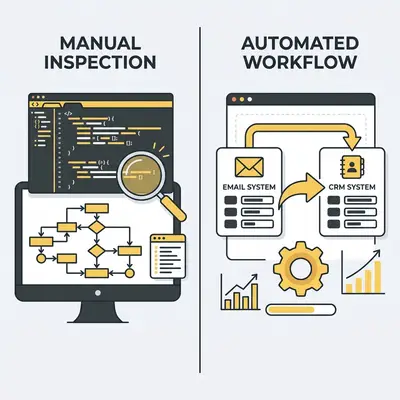
In a recent deep dive, Sebastian Raschka—a leading voice in AI research—revealed his personal workflow for reverse-engineering LLM architectures. He argues that technical papers are increasingly opaque, forcing developers to inspect raw code and configuration files on Hugging Face to understand how models actually function. You can read his full breakdown here: My Workflow for Understanding LLM Architectures.
This post reacts to Raschka’s findings by applying them to the small business context. While researchers like Raschka have the luxury of manual inspection, small business owners face a different reality: the "black box" of proprietary models versus the complexity of open-weight models. We will explore why "reading the paper" is a trap for business owners and how to decide between building custom AI or buying automated solutions.
Why Is Technical Documentation Misleading for Business Owners?
Technical documentation often focuses on theoretical performance rather than operational reliability. For an SMB, a model’s architecture is less important than its latency, cost-per-token, and integration capability. Relying on white papers leads to "analysis paralysis," where owners spend time evaluating model specs instead of solving business bottlenecks.
Reality Check: If you are spending more time reading about model parameters than you are automating your lead follow-up, you are losing money. Your business needs results, not a PhD in transformer architecture.
When you read a technical paper, you are looking at a snapshot of a model's potential. You aren't seeing the reality of how that model behaves when it hits a rate limit or hallucinates on a specific customer query. Business owners need to stop treating AI like a science project and start treating it like a utility.
What Are the Core Options for SMB AI Adoption?
| Option | Best For | Primary Risk |
|---|---|---|
| Proprietary APIs (GPT-4, Claude) | Rapid deployment, high-level tasks | Vendor lock-in, data privacy |
| Open-Weight Models (Llama 3, Mistral) | Data sovereignty, custom tuning | High maintenance, infrastructure cost |
| Managed Automation (Evalics) | Workflow integration, ROI | Less control over model internals |
Pro Tip: Don't build the engine if you just need to drive the car. Most SMBs need an automated workflow, not a custom-tuned LLM architecture.
How Do You Choose Between Building and Buying?
Choosing between building a custom AI stack and buying an automated solution depends on your technical overhead. If your business core competency is not software engineering, building is a liability. Buying or outsourcing automation allows you to focus on business logic while experts handle the model architecture and maintenance.
When you build, you own the complexity. If the model breaks, your team is responsible for the fix. When you buy or use managed automation, you shift that burden to the provider. For 95% of the businesses I work with at Evalics, the goal is to get a process running in hours, not weeks.
What Is the Framework for AI Implementation?
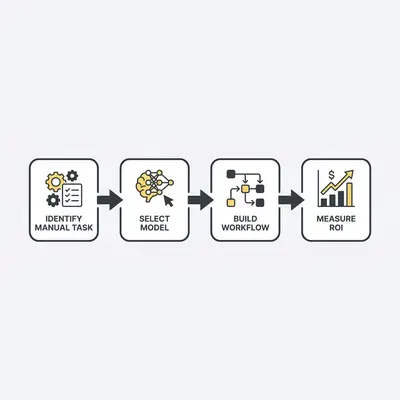
- Identify a high-frequency, low-complexity task (e.g., lead qualification).
- Audit your data availability (do you have the inputs ready?).
- Select a model based on privacy requirements, not just performance benchmarks.
- Prototype the workflow using low-code automation tools.
- Measure the time-saved-per-dollar-spent.
- Iterate based on output quality, not model architecture updates.
How Can You Avoid the "Technical Debt" Trap?
Technical debt occurs when you adopt a model architecture that requires constant manual updates or specialized engineering talent to maintain. To avoid this, prioritize "model-agnostic" automation. By building your workflows in a way that allows you to swap the underlying LLM, you protect your business from the rapid obsolescence of specific model architectures.
Key Insight: The best AI strategy is one that works regardless of which model is currently trending on Hugging Face.
If you hard-code your business logic into a specific model's quirks, you are setting yourself up for a rewrite in six months. Use orchestration layers that let you swap out the "brain" of your automation without breaking the "limbs" of your workflow.
Source
Original reporting: My Workflow for Understanding LLM Architectures