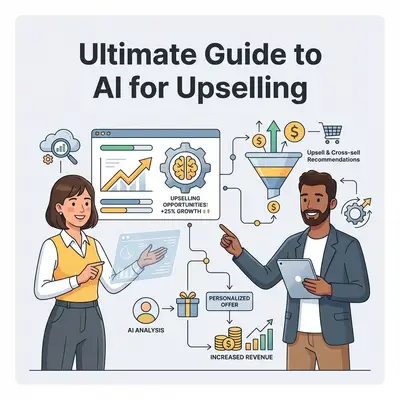
AI is transforming upselling by making it personalized, data-driven, and effective. Businesses can now leverage AI to analyze customer data, predict needs, and deliver tailored recommendations that increase revenue and improve the customer experience. Here's why AI-powered upselling matters:
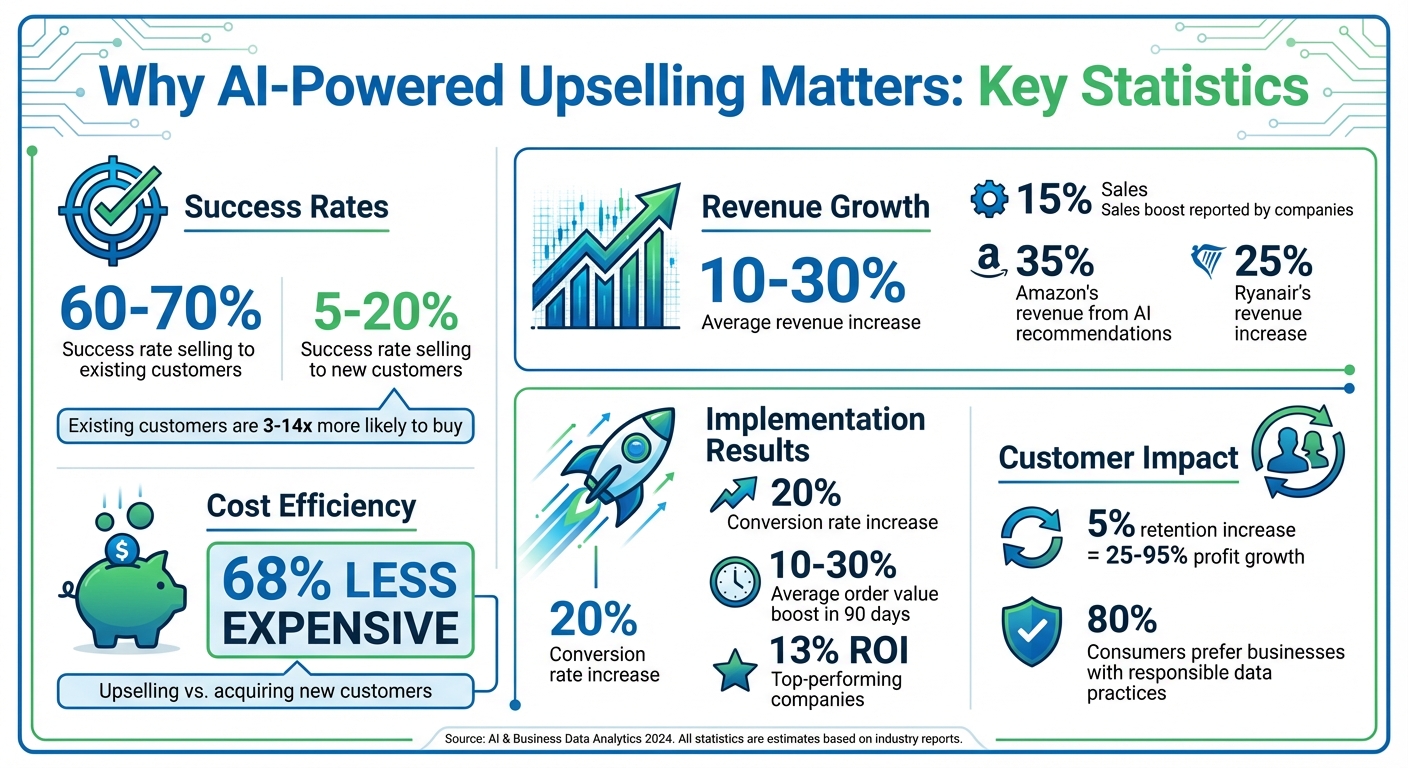
- Higher success rates: Selling to existing customers is 60–70% more likely to succeed compared to 5–20% for new customers.
- Cost efficiency: Upselling is 68% less expensive than acquiring new customers.
- Revenue growth: Companies using AI for upselling report a 10–30% increase in revenue, with some seeing a 15% sales boost.
AI tools like predictive analytics, machine learning, and natural language processing enable businesses to suggest upgrades, bundles, or complementary products at the right time. Examples include Amazon’s recommendation engine, which drives 35% of its revenue, and Ryanair, which achieved a 25% revenue increase using AI.
To implement AI for upselling:
- Set clear goals and metrics (e.g., average order value, customer retention).
- Use clean, organized data from multiple sources (purchase history, browsing habits, etc.).
- Start with small tests, measure results, and refine strategies.
AI-powered upselling improves customer satisfaction and loyalty while driving profit. Tools like Evalics help businesses integrate AI into their sales processes for measurable results.
Core Components of AI-Powered Upselling
Data and Signals for Upselling
AI-powered upselling relies heavily on gathering and analyzing a variety of data sources to create detailed customer profiles. Historical data, like past purchases, orders, or booking histories, helps identify trends and preferences [5]. For example, if a diner frequently orders burgers, the AI might suggest premium toppings or a signature drink pairing based on those habits [8].
Behavioral signals provide insight into what customers are currently interested in. These signals include browsing activity, page visits, content downloads, and even social media interactions [5]. Picture this: a customer adds a smartphone to their cart, and AI immediately suggests a high-quality case or a wireless charger. Real-time actions, such as cart activity or questions posed to a chatbot, further enable instant, targeted recommendations [5].
Metrics like email engagement and sentiment analysis also play a role. These measure actions such as email opens, clicks, and responses, while CRM data, product usage trends, and market insights enrich the AI's understanding [5][9]. Tools like Pipedrive Pulse analyze customer interactions and sentiment, identifying high-potential opportunities. For instance, if a lead frequently opens emails, downloads brochures, and revisits pricing pages, the system might suggest scheduling a personalized demo. Together, these diverse data points fuel AI systems to craft precise upselling strategies.
AI Technologies Behind Upselling
Once the data is in place, several AI technologies work together to turn insights into upsell opportunities. Machine learning identifies customer preferences by analyzing past behavior, while predictive analytics estimates future actions. Businesses that use these tools often see conversion rates increase by up to 20% [7].
Natural language processing (NLP) powers chatbots and voice assistants, enabling them to understand customer inquiries and suggest relevant upsells. For example, Netflix uses AI to recommend premium subscription options based on viewing habits [5]. Meanwhile, deep learning and reinforcement learning continuously fine-tune these recommendations, adjusting offers in real time [5][10].
These technologies consider factors like timing, context, and customer sentiment to deliver upsell offers when customers are most likely to respond positively. Take hotel chains, for instance - they use AI to suggest room upgrades or spa packages based on a guest's booking history and preferences, making the offer feel personalized and timely [5].
Delivering Upsell Offers Across Channels
AI-driven recommendations reach customers through multiple touchpoints, ensuring a seamless experience. On e-commerce platforms, AI powers "You may also like" sections with personalized suggestions. Mobile apps and self-service kiosks integrate AI into their digital ordering systems, presenting relevant upsell options while customers browse [8].
Email campaigns and retargeting ads also benefit from AI, automatically suggesting complementary items or upgrades based on browsing behavior. These recommendations can be included in newsletters, social media posts, or website pop-ups [6][7]. AI tools further integrate with platforms like Zendesk, Freshdesk, Intercom, and Slack, enabling businesses to deliver tailored offers during chatbot interactions or support conversations [1].
For sales teams, AI copilots provide real-time upsell suggestions during customer interactions. These insights are backed by data and can be adjusted by agents before being shared with the customer [1][11]. In some cases, AI agents handle frontline support tickets, offering upsell options as part of their responses. By integrating deeply with e-commerce platforms and internal databases, AI ensures that recommendations are not only timely but also highly relevant. Businesses that adopt these AI-driven strategies often see a 10–30% boost in average order value within just 90 days [12]. Altogether, these technologies and practices help businesses increase revenue while building stronger customer relationships.
AI Upselling Techniques and Use Cases
Personalized Recommendations and Bundles
AI takes customer data, like purchase history and browsing habits, and turns it into actionable upselling opportunities. For example, it might suggest pairing a laptop with a docking station to increase the order's value. By analyzing detailed customer behaviors, AI pinpoints complementary products or upgrades that customers are likely to find useful.
Bundling becomes even more effective when AI spots patterns in frequently purchased combinations. For instance, if customers often buy a phone case and screen protector together, AI can suggest these as a package deal. This not only increases the average order value but also saves customers the hassle of searching for related items. By considering timing, context, and individual preferences, AI ensures its recommendations feel relevant and helpful.
This approach creates a dynamic, real-time shopping experience that feels personalized and engaging.
Conversational AI for Upselling
Conversational AI, powered by natural language understanding, brings a human-like touch to upselling by engaging customers in real time. Unlike static or pre-scripted responses, these systems adapt their suggestions based on the customer's immediate needs.
Take this example: a customer asks about shipping times. Instead of just answering the question, a chatbot might suggest expedited shipping as an option. This makes the interaction not only informative but also actionable. With 78% of companies actively using AI in e-commerce [13], conversational AI is increasingly handling tasks that were once reserved for human agents. It often starts with simpler roles, like answering order-related questions or recommending products, and gradually expands its capabilities.
The influence of AI isn’t limited to one-on-one interactions - it extends across various sales channels, creating a seamless upselling experience.
Channel-Specific Upselling Strategies
By combining insights from personalized recommendations and conversational AI, businesses can fine-tune their upselling strategies for specific channels. On e-commerce platforms, AI-driven predictive analytics adjust product displays in real time based on a customer’s browsing and shopping behavior, ensuring the most relevant items are highlighted.
Email marketing also benefits from AI-powered segmentation. By analyzing individual behavior, businesses can send targeted upsell offers to the customers most likely to act on them. Timing these messages strategically boosts engagement and conversion rates.
In brick-and-mortar stores, AI enhances point-of-sale systems and digital kiosks. For instance, a digital kiosk at a restaurant might suggest premium toppings or drink upgrades based on the customer’s current order. These in-the-moment recommendations keep upselling consistent and relevant across physical and digital channels.
For businesses ready to embrace these advanced strategies, tools like Evalics (https://evalics.com) provide integrated AI solutions to optimize sales processes, improve operational efficiency, and increase revenue.
How to Implement AI for Upselling
Setting Goals and Metrics
Start by defining clear, measurable goals for your AI upselling efforts. These could include increasing average order value, boosting customer lifetime value, or driving additional revenue. Your metrics should strike a balance between financial outcomes and customer experience. For example, track upsell conversion rates to see how often customers accept your offers, monitor incremental revenue to measure financial impact, and analyze trends in average order value over time. While concerns about AI reliability persist[14], focusing on performance metrics can help you achieve better returns. In fact, top-performing companies report an average of 13% ROI on AI projects, compared to just 5.9% for those that don't track such metrics[14].
However, numbers alone don’t tell the full story. Pay attention to customer-centric indicators like satisfaction scores and feedback. If your upselling strategy boosts revenue but frustrates customers, you risk harming long-term relationships. By combining quantitative data with qualitative insights, you can get a well-rounded view of your AI upselling performance. Once your goals and metrics are in place, develop a structured plan to integrate AI smoothly into your systems.
Implementation Roadmap
Before diving into AI tools, assess whether your data is ready. AI recommendations rely on clean, well-organized information from sources like your website, mobile apps, email campaigns, and social media platforms[6]. Using a data management platform can help automate the cleaning and updating process, ensuring your AI has accurate data to work with[6].
Next, focus on integrating AI into your existing systems. For example, tools like Evalics are designed to connect seamlessly with CRMs, marketing automation platforms, and eCommerce systems. APIs and middleware can simplify this integration process[5][6]. If you operate physical locations, linking AI-powered ordering platforms with your point-of-sale systems ensures consistency across channels[8].
Instead of rolling out your AI solution all at once, start with targeted tests. Choose a specific customer segment or product category, implement your AI-driven upselling strategy, and measure the results against your key performance indicators. This phased approach allows you to fine-tune the system based on real-world data before scaling it further. Continuous monitoring and adjustments will help your AI improve as it learns from customer interactions[6]. These steps lay the groundwork for a successful AI upselling strategy.
Best Practices for AI Upselling
Once your goals are set and your system is in place, follow these best practices to maximize success. Always put the customer first - your AI should recommend products or upgrades that genuinely benefit them, rather than just pushing high-margin items[5][3]. When customers perceive recommendations as helpful rather than aggressive, they’re more likely to engage.
Transparency is another key factor. Clearly communicate how you collect and use customer data to build trust. While personalized offers can enhance loyalty[6], responsible data practices help address privacy concerns[6]. Be upfront about your data policies, give customers control over their information, and handle their data with care. Research shows that 80% of consumers are more likely to return to businesses that prioritize responsible data management[2].
Finally, strike a balance between AI automation and human involvement. While AI can handle routine tasks efficiently, your team should step in for more complex or sensitive interactions. Create feedback loops so your staff can flag issues or suggest improvements, enabling the AI to refine its recommendations over time. This combination of technology and human insight creates a well-rounded and effective upselling strategy.
Measuring and Improving AI Upselling Performance
Attribution and Revenue Impact
Figuring out which AI-driven interactions actually contribute to upsell revenue involves more than just last-click attribution. AI-based attribution digs deeper, analyzing customer behavior, context, and channel data to pinpoint the touchpoints that truly influence buying decisions[19]. Instead of giving all the credit to the final interaction, this method evaluates the entire customer journey.
Incrementality testing is an effective way to refine this measurement. By comparing groups exposed to AI upselling with control groups that aren’t, businesses can clearly see the added value. For instance, a consumer electronics company generated an extra $12.5 million in upsell revenue by evaluating AI performance using test and control groups[16].
The numbers speak for themselves: organizations that actively track campaign metrics are 2.3 times more likely to surpass their revenue goals[17]. Top-performing companies see a 13% return on investment (ROI) from AI projects, compared to an average of just 5.9% across other enterprises[14]. These advanced attribution techniques not only clarify performance but also set the stage for ongoing improvement through better analytics.
Analytics for Continuous Improvement
Analytics do more than measure success - they help fine-tune your AI upselling strategy. Real-time dashboards are essential for tracking key indicators like opportunity detection accuracy and conversion rate improvements[14][18].
An AI-powered sales analytics system transforms every customer interaction into actionable insights. Dashboards should uncover trends across customer segments, product types, and sales channels. For example, if you notice a drop in engagement with personalized recommendations, it might be time to refresh your suggestions to keep them relevant[15]. Similarly, a decline in revenue per AI-driven interaction could signal the need to tweak offer timing or structure[14].
McKinsey highlights the potential of AI in sales, noting that companies using AI can experience up to a 10% boost in sales revenue[15][18]. Additionally, businesses that adopt AI-focused measurement frameworks are 2.5 times more likely to see a noticeable revenue increase[15].
Key Metrics and Benchmarks
To ensure success, establish clear benchmarks that measure both financial outcomes and customer satisfaction. Focus on metrics like:
- Revenue-based upsell rate: The share of upsell revenue as a percentage of total revenue.
- Customer upsell rate: The percentage of customers who accept upsell offers.
- Average Revenue Per User (ARPU): Tracks the additional revenue generated per customer.
Don’t stop at revenue metrics - also monitor Customer Lifetime Value (CLV) to confirm that upselling contributes to long-term customer relationships. Keep an eye on retention rates and satisfaction scores like CSAT or NPS to ensure the AI-driven experience remains positive[14][18].
The impact of these metrics is clear. Bain & Company reports that even a modest 5% increase in customer retention can drive profits up by 25% to 95%[14][18]. Meanwhile, McKinsey notes that AI-powered recommendations can improve conversion rates by 20–30%[14][18].
Real-world examples underscore these results. Amazon’s recommendation engine, powered by AI, generates 35% of the company’s total sales[14]. According to Wharton’s 2025 Report, 75% of enterprises are seeing positive ROI from AI, and sales professionals who leverage AI are 3.7 times more likely to meet their quotas[14][18].
Unlock Hidden Revenue with AI-Powered Upsell Scoring
Conclusion
AI has reshaped upselling, turning it into a precise, customer-centric strategy backed by data insights [5][4]. Instead of relying on intrusive checkout pop-ups, businesses now use personalized, context-aware recommendations seamlessly woven into customer interactions, redefining how revenue growth is achieved [1][8].
The numbers speak volumes: companies report revenue increases of 10–30% on average, while spending 68% less compared to customer acquisition. Some businesses have experienced remarkable results, like a 20% boost in sales or a 30% jump in deal size. For instance, Bureau Inc. achieved a 9% rise in quarterly revenue thanks to AI-powered upselling [3][20].
What sets AI upselling apart is its ability to process massive amounts of customer data in real time, identifying patterns and predicting needs even before customers are aware of them. By replacing static, rule-based approaches with dynamic, personalized recommendations, AI not only enhances revenue but also fosters stronger customer relationships [1][5].
Solutions like Evalics are leveraging this potential by offering advanced AI automation tools. Evalics helps businesses refine their sales processes and analytics, enabling scalable and ever-evolving AI-driven strategies.
With well-defined goals, accurate metrics, and ongoing AI optimization, businesses can create a powerful upselling system that drives revenue growth while deepening customer loyalty over time.
FAQs
1. How can AI improve personalized upselling efforts?
AI takes personalized upselling to the next level by diving deep into customer data - like purchase history, preferences, and behaviors - to craft offers that feel tailor-made. These highly relevant recommendations strike a chord with individual customers, making them more likely to say "yes" to an upsell.
With the power of real-time insights and predictive analytics, AI doesn't just stop at understanding customers - it anticipates their needs. It pinpoints high-value opportunities and dynamically segments audiences, enabling businesses to deliver the perfect message at just the right moment. The result? Better engagement and a stronger shot at turning recommendations into conversions.
2. What metrics should you track to ensure successful AI-driven upselling?
To make AI-driven upselling work effectively, keeping an eye on the right performance metrics is key. Pay close attention to product usage patterns, customer health scores, and engagement levels - these can reveal where upsell opportunities might be hiding. On top of that, digging into sentiment trends and examining renewal or expansion history can offer valuable clues for crafting personalized offers and boosting customer retention.
3. What steps can businesses take to protect customer data when using AI for upselling?
To keep customer data safe when leveraging AI for upselling, businesses need to implement robust data governance policies and ensure that all sensitive data is securely encrypted. Anonymizing customer information wherever feasible is another key step. Additionally, obtaining clear and explicit consent from users is a must, along with adhering to privacy regulations such as GDPR and CCPA. Focusing on transparency and strong security measures not only protects customer privacy but also fosters trust.