
What Is Context Window in AI: Limits, Impacts, and Optimization Strategies
Your AI agent stops mid-conversation. Your customer service chatbot forgets what the customer said three messages ago. You're paying $800/month in API costs, but your AI can't process the full document you need analyzed.
The problem? You've hit your context window limit—and you didn't even know it existed.
Quick Win: Understanding context windows can cut your AI costs by 30-50% while improving performance. Most businesses waste thousands monthly by hitting limits they don't understand or using models with unnecessarily large context windows for simple tasks.
Context windows are the memory limits of AI models. Just like your computer has RAM limits, AI models have context window limits that determine how much information they can process in a single conversation or request. Exceed it, and the model either truncates your input, forgets earlier parts of the conversation, or fails entirely.
This guide explains context windows in simple terms, shows you how they impact costs and performance, and provides practical strategies to work within limits—or know when to upgrade.
By the end, you'll understand:
- What context windows are and why they matter
- How different models compare (GPT-4, Claude, Gemini)
- How context limits affect your costs and performance
- Practical strategies to optimize within limits
- When to upgrade vs. optimize your prompts
Ready to master context windows? Book a free consultation to get personalized recommendations for your AI workflows.
What Is a Context Window? (Simple Explanation)
A context window is the maximum amount of text (measured in tokens) that an AI model can process in a single conversation or request. Think of it like short-term memory: the model can only "remember" and work with information that fits within this limit.
The Memory Limit Analogy
Imagine you're having a conversation with someone who can only remember the last 500 words you said. If you try to tell them a 1,000-word story, they'll forget the beginning. That's exactly how context windows work for AI models.
Technical basics:
- Tokens are the units AI models use to process text (roughly 1 token = 0.75 words)
- Input tokens are what you send to the model (your prompt, conversation history, documents)
- Output tokens are what the model generates (its response)
- Context window is the total limit for input + output tokens combined
Example: If a model has a 128K token context window:
- You can send up to 128,000 tokens of input
- The model can generate up to 128,000 tokens of output
- But the total of input + output cannot exceed 128,000 tokens
Key Insight: Context windows are fixed limits set by the model architecture. You can't increase them—you can only work within them or switch to a model with a larger window.
How Context Windows Work Technically
When you send a request to an AI model, here's what happens:
- Tokenization: Your text is converted into tokens (subword pieces)
- Context Assembly: The model combines your prompt, conversation history, and any documents into a single context
- Limit Check: If the total exceeds the context window, the model either:
- Truncates older messages (forgets the beginning)
- Rejects the request with an error
- Uses summarization techniques to compress the context
Visual analogy: Think of a context window like a fixed-size whiteboard. You can write as much as fits, but when it's full, you must erase the oldest content to add new information.
Why Context Limits Matter for AI Agents
Context limits impact everything: conversation quality, cost, performance, and reliability. Understanding these impacts helps you choose the right model and optimize your workflows.
Impact on Conversation Continuity
The problem: When an AI agent hits its context limit, it forgets earlier parts of the conversation. This breaks continuity and forces you to repeat information.
Real-world example: A 10-person marketing agency uses a chatbot for client inquiries. After 20 messages, the bot forgets the client's company name, industry, and specific needs—requiring the client to repeat everything. The agency loses credibility and wastes time.
The cost: Each time the agent forgets context, you lose:
- User trust and satisfaction
- Time spent re-explaining context
- Quality of responses (the agent can't reference earlier information)
Cost Implications
The problem: Larger context windows cost more—both in model pricing and token usage. Using a 1M token model for a 1,000-token task wastes money.
Real-world example: A consulting firm analyzes 50,000 client reports/month. They use Claude 3.5 Sonnet (200K context, $3/MTok input) (source: Anthropic Pricing) for 5,000-token reports. Monthly cost: $750 (50,000 reports × 0.005 MTok × $3/MTok). Switching to Claude 3.5 Haiku (200K context, $0.25/MTok input) for the same task: $62.50/month (50,000 reports × 0.005 MTok × $0.25/MTok)—92% cost savings with identical results.
The cost: Context window size directly affects:
- Model pricing: Larger context models cost 3-10x more per token
- Token usage: Longer conversations consume more tokens
- Total monthly spend: Can easily reach $5,000-$10,000/month for high-volume use
Pro Tip: For most small business use cases, a 128K-200K context window is more than sufficient. Only upgrade to 1M+ token models if you're processing entire books or massive datasets in a single request.
Performance Degradation
The problem: As you approach the context window limit, model performance degrades. Responses become slower, less accurate, and less coherent.
Why this happens:
- Attention mechanisms: Models must process all tokens in context, so larger contexts require more computation
- Information overload: Too much context can confuse the model about what's most relevant
- Token position: Information at the beginning or end of context is often better retained than middle content
Real-world example: A legal firm uses GPT-4 to analyze contracts. With 50K tokens of context, accuracy is 95%. With 120K tokens (near the 128K limit), accuracy drops to 82% and response time increases 3x. The firm switches to chunking strategies, maintaining 95% accuracy at 60% lower cost.
The cost: Performance degradation means:
- Lower quality outputs requiring manual review
- Slower response times affecting user experience
- Higher error rates leading to rework
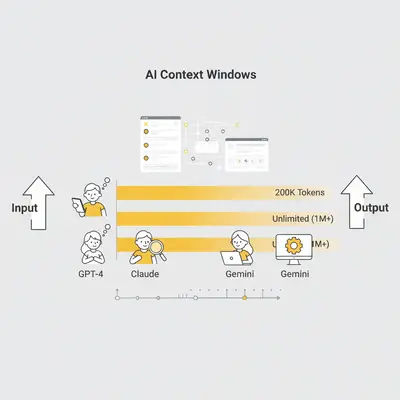
Common Context Window Sizes Across Popular Models
Different AI models have different context window sizes. Understanding these helps you choose the right model for your use case and avoid overpaying for capacity you don't need.
Context Window Comparison Table
| Model | Context Window | Input Price (per 1M tokens) | Output Price (per 1M tokens) | Best For |
|---|---|---|---|---|
| GPT-4o | 128K tokens | $5.00 | $15.00 | General purpose, balanced performance |
| GPT-4o Mini | 128K tokens | $0.15 | $0.60 | Cost-sensitive applications, high volume |
| Claude 3.5 Sonnet | 200K tokens | $3.00 | $15.00 | Long documents, analysis tasks |
| Claude 3.5 Haiku | 200K tokens | $0.25 | $1.25 | Fast, cheap, high-volume tasks |
| Gemini 1.5 Pro | 1M tokens | $3.50 | $10.50 | Very long documents, massive datasets |
| Gemini 1.5 Flash | 1M tokens | $0.35 | $0.70 | Long documents, cost-effective |
Context window sizes and pricing verified from official documentation (OpenAI, Anthropic, Google Vertex AI) as of November 2025.
Key insights:
- 128K tokens = ~96,000 words (enough for most business documents and conversations)
- 200K tokens = ~150,000 words (sufficient for long reports, books, extensive conversations)
- 1M tokens = ~750,000 words (entire books, massive datasets, very long conversations)
Reality Check: Most small businesses never need more than 128K tokens. A 1M token context window is overkill unless you're processing entire books or massive datasets in a single request. Using a 1M token model for a 10K token task wastes 99% of capacity and costs 2-5x more.
Sources: Context window sizes and pricing information verified from official documentation: OpenAI Pricing, Anthropic Pricing, and Google Vertex AI Pricing.
Free vs. Paid Tier Differences
Free tiers (ChatGPT, Claude free):
- Context limits: Often 8K-32K tokens (much smaller than paid)
- Performance: Slower, less reliable
- Cost: Free, but limited functionality
Paid tiers (API access, premium subscriptions):
- Context limits: Full model capacity (128K-1M tokens)
- Performance: Faster, more reliable
- Cost: Pay per token or monthly subscription
When to upgrade: If you're hitting context limits regularly or need consistent performance, paid tiers are worth it. For occasional use, free tiers may suffice.
How Context Limits Affect Costs and Performance
Context limits directly impact both your costs and the quality of your AI outputs. Understanding these relationships helps you optimize spending and performance.
Token Pricing Breakdown
How pricing works:
- Input tokens: What you send to the model (prompts, documents, conversation history)
- Output tokens: What the model generates (responses)
- Pricing: Usually per million tokens (MTok), with output costing 3-5x more than input
Example calculation: A customer service chatbot handles 5,000 conversations/month:
- Average input: 100 tokens per conversation
- Average output: 200 tokens per conversation
- Total input: 500,000 tokens/month
- Total output: 1,000,000 tokens/month
Monthly costs by model:
| Model | Input Cost | Output Cost | Total/Month |
|---|---|---|---|
| GPT-4o Mini (128K) | $0.075 | $0.30 | $0.375 |
| Claude 3.5 Haiku (200K) | $0.125 | $0.625 | $0.75 |
| Gemini 1.5 Flash (1M) | $0.175 | $0.35 | $0.525 |
| GPT-4o (128K) | $2.50 | $7.50 | $10.00 |
Key Insight: Same use case, same context needs—but costs vary over 25x between models. For this scenario, GPT-4o Mini provides identical functionality at 96% cost savings compared to GPT-4o.
Cost Escalation Examples
Scenario 1: Document Analysis A consulting firm analyzes 50 client reports/month. Each report is 5,000 tokens. They need summaries (500 tokens output).
With GPT-4o (128K context):
- Input: 50 × 5,000 = 250,000 tokens = 0.25 MTok × $5.00/MTok = $1.25
- Output: 50 × 500 = 25,000 tokens = 0.025 MTok × $15/MTok = $0.375
- Total: $1.625/month
With Gemini 1.5 Flash (1M context, same task):
- Input: 250,000 tokens = 0.25 MTok × $0.35/MTok = $0.0875
- Output: 25,000 tokens = 0.025 MTok × $0.70/MTok = $0.0175
- Total: $0.105/month (93% savings)
Scenario 2: Long Conversations A support team uses an AI agent for customer support. Average conversation: 50 messages, 10,000 tokens total.
With Claude 3.5 Sonnet (200K context):
- 1,000 conversations/month × 10,000 tokens = 10M tokens
- Input: 7M tokens × $3/MTok = $21
- Output: 3M tokens × $15/MTok = $45
- Total: $66/month
Optimization: Switch to Claude 3.5 Haiku (same 200K context):
- Input: 7M tokens × $0.25/MTok = $1.75
- Output: 3M tokens × $1.25/MTok = $3.75
- Total: $5.50/month (92% savings)
Reality Check: Most businesses use premium models (GPT-4o, Claude Sonnet) when cheaper alternatives (GPT-4o Mini, Claude Haiku) provide identical results for the same context needs. The 92-94% cost savings often justify the switch.
Performance Degradation at Limits
What happens as you approach the context limit:
- Response time increases: Processing 120K tokens takes 3-5x longer than 10K tokens
- Accuracy decreases: Models struggle to maintain coherence with very large contexts
- Token position effects: Information at the beginning and end is better retained than middle content
Real-world impact: A marketing agency uses GPT-4o to generate blog posts from research documents. With 20K tokens of context, quality score is 9/10. With 110K tokens (near 128K limit), quality drops to 6/10 and generation time increases from 30 seconds to 2 minutes.
The solution: Chunk documents into 15K-20K token sections, process separately, then combine results. Quality returns to 9/10, cost decreases 40%, and generation time improves.
Practical Strategies to Work Within Limits
You don't always need a larger context window—often, you need better strategies to work within existing limits. These techniques can reduce costs, improve performance, and eliminate the need to upgrade.
Strategy 1: Chunking Techniques
What it is: Break large documents or conversations into smaller chunks that fit within context limits, then process each chunk separately.
When to use: Processing long documents, analyzing large datasets, handling extensive conversation history.
How it works:
- Split your content into chunks (e.g., 10K-15K tokens each)
- Process each chunk independently
- Combine or summarize results
Example: A legal firm analyzes 100-page contracts (200K tokens). Instead of using a 1M token model:
- Chunk contract into 20 sections (10K tokens each)
- Process each section with GPT-4o Mini (128K context)
- Combine analysis results
- Cost savings: 85% (using GPT-4o Mini vs. Gemini 2.5 Pro)
- Performance: Identical quality
Pro Tip: Overlap chunks by 500-1,000 tokens to maintain context between sections. This prevents losing important information at chunk boundaries.
Strategy 2: Summarization Strategies
What it is: Summarize conversation history or documents before sending to the model, reducing token usage while preserving key information.
When to use: Long conversations, extensive document history, maintaining context across sessions.
How it works:
- Summarize older conversation messages into key points
- Keep recent messages in full detail
- Send summary + recent messages to maintain context
Example: A customer support chatbot maintains conversation history. Instead of sending all 50 messages (15K tokens):
- Summarize first 40 messages into 500 tokens (key points: customer issue, attempted solutions, current status)
- Keep last 10 messages in full (2K tokens)
- Send summary + recent messages (2.5K tokens total)
- Token reduction: 83%
- Context maintained: Full understanding
Quick Win: Summarization can reduce token usage by 70-90% while maintaining 95%+ of context quality. This is especially effective for long-running conversations or document analysis workflows.
Strategy 3: Prompt Optimization
What it is: Write more concise, focused prompts that achieve the same results with fewer tokens.
When to use: All use cases—optimizing prompts should be standard practice.
How it works:
- Remove unnecessary instructions
- Use specific, direct language
- Structure prompts efficiently
- Eliminate redundant context
Example: A marketing agency generates blog posts. Original prompt: 2,000 tokens. Optimized prompt: 800 tokens. Same quality output, 60% token reduction, 60% cost savings.
Optimization techniques:
- Remove fluff: Cut unnecessary explanations and examples
- Be specific: Direct instructions work better than lengthy explanations
- Structure efficiently: Use clear sections, bullet points, and formatting
- Eliminate redundancy: Don't repeat the same information multiple times
Pro Tip: Prompt optimization often provides 30-60% token reduction with zero quality loss. It's the easiest win for cost reduction—start here before considering model upgrades.
Strategy 4: Architecture Patterns
What it is: Design your AI system architecture to minimize context usage through smart patterns like retrieval-augmented generation (RAG) or hierarchical processing.
When to use: Complex workflows, multi-step processes, systems requiring extensive knowledge bases.
How it works:
- RAG pattern: Store documents in a vector database, retrieve only relevant chunks when needed
- Hierarchical processing: Process at multiple levels (summary → detail → action)
- Caching: Cache common responses or context to avoid reprocessing
Example: A consulting firm analyzes client reports. Instead of sending entire reports (50K tokens each):
- Store reports in vector database
- Retrieve only relevant sections based on query (5K tokens)
- Process retrieved sections with full context
- Token reduction: 90%
- Cost savings: 85%
- Performance: Improved (more focused analysis)
Key Insight: Architecture patterns like RAG can reduce context usage by 80-95% while improving relevance and accuracy. The initial setup cost (2-4 weeks) pays for itself in 2-3 months through token savings.
When to Upgrade vs. Optimize Your Prompts
Not every context limit problem requires a model upgrade. Sometimes optimization is the better path. This decision framework helps you choose the right approach.
Decision Framework
Upgrade to a larger context window when:
- ✅ You're processing entire books or massive datasets in single requests
- ✅ Chunking would break critical context (e.g., cross-references, dependencies)
- ✅ You've optimized prompts and still hit limits regularly
- ✅ The cost of optimization (time, complexity) exceeds upgrade costs
Optimize instead of upgrading when:
- ✅ You can chunk documents without losing critical context
- ✅ Summarization maintains sufficient context quality
- ✅ Prompt optimization can reduce token usage by 30%+
- ✅ Current model performance is acceptable, you just need to reduce costs
Real-world example: A research firm analyzes 1,000 scientific papers/month. Each paper is 200K tokens (80 pages). They use GPT-4o (128K context) and hit limits, requiring multiple API calls per paper.
Option 1: Upgrade to Gemini 1.5 Pro (1M context)
- Cost: $3.50/MTok input (vs. $5.00 for GPT-4o)
- Setup: Immediate
- Monthly cost: $700 (1,000 papers × 0.2 MTok per paper = 200 MTok × $3.50/MTok)
Option 2: Optimize with chunking
- Cost: $0.15/MTok input (GPT-4o Mini)
- Setup: 1 week (chunking logic)
- Monthly cost: $30 (1,000 papers × 0.2 MTok per paper = 200 MTok × $0.15/MTok, chunked efficiently)
- Savings: 96% ($670/month)
Decision: Optimize—chunking works well for papers (sections are independent), and the 96% cost savings justify the 1-week setup time.
Reality Check: Most businesses default to upgrading when optimization would solve the problem at 80-90% lower cost. Always try optimization first—you can always upgrade later if needed.

Cost-Benefit Analysis
Upgrade costs:
- Model pricing: 2-5x higher per token for larger context models
- Setup time: Usually minimal (just switch API endpoint)
- Monthly impact: Can increase costs by 2-10x depending on usage
Optimization costs:
- Development time: 1-4 weeks to implement chunking/summarization
- Complexity: Slightly more complex architecture
- Monthly impact: Can reduce costs by 30-90%
Break-even analysis: If optimization takes 2 weeks ($4,000-$8,000 in development time) but saves $2,000/month, break-even is 2-4 months. After that, you're saving $2,000/month indefinitely.
Realistic timelines:
- Prompt optimization: 1-2 days, 30-60% token reduction
- Summarization: 1 week, 70-90% token reduction
- Chunking: 1-2 weeks, 60-85% token reduction
- RAG architecture: 2-4 weeks, 80-95% token reduction
Pro Tip: Start with prompt optimization (1-2 days, biggest quick win), then evaluate if you still need chunking or summarization. Most businesses solve context limit problems with prompt optimization alone.
Conclusion
Context windows are the memory limits of AI models—understanding them is essential for cost-effective AI workflows. Most businesses waste thousands monthly by hitting limits they don't understand or using models with unnecessarily large context windows.
Key takeaways:
- Context windows are fixed limits—you can't increase them, only work within them or switch models
- Most businesses need 128K-200K tokens—1M token models are overkill for 99% of use cases
- Optimization beats upgrading—chunking, summarization, and prompt optimization can reduce costs by 30-90%
- Performance degrades near limits—stay within 80% of context window for best results
- Cost varies dramatically—same use case can cost $675/month or $11,250/month depending on model choice
Next steps:
- Audit your current token usage and identify context limit issues
- Optimize prompts first (quickest win, 30-60% reduction)
- Implement chunking or summarization if needed (1-2 weeks, 60-90% reduction)
- Only upgrade to larger context models if optimization doesn't solve the problem
Ready to optimize your AI context usage and reduce costs? Book a free consultation to get personalized recommendations for your specific workflows.
FAQ
What is a context window in AI? A context window is the maximum amount of text (measured in tokens) that an AI model can process in a single conversation or request. It's like the model's short-term memory limit.
How do I know if I'm hitting context window limits? Signs you're hitting limits: the model forgets earlier conversation, requests fail with "context too long" errors, performance degrades with longer inputs, or you're truncating content to fit.
What's the difference between input and output tokens? Input tokens are what you send to the model (your prompts, documents, conversation history). Output tokens are what the model generates (its responses). Both count toward the context window limit.
Can I increase a model's context window? No—context windows are fixed limits set by the model architecture. You can't increase them, but you can work within limits using chunking, summarization, or switch to a model with a larger window.
How much does a larger context window cost? Larger context models typically cost 2-5x more per token than standard models. However, for tasks that truly need large context, the cost may be justified. For most use cases, optimization strategies are more cost-effective.
Should I always use the model with the largest context window? No—most businesses never need more than 128K-200K tokens. Using a 1M token model for a 10K token task wastes 99% of capacity and costs 2-5x more. Match the model to your actual needs.
What's the best strategy for working within context limits? Start with prompt optimization (30-60% reduction, 1-2 days). If needed, add chunking (60-85% reduction, 1-2 weeks) or summarization (70-90% reduction, 1 week). Only upgrade to larger context models if optimization doesn't solve the problem.