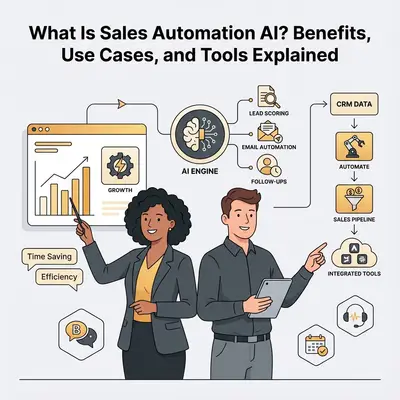
Sales Automation AI uses artificial intelligence to simplify repetitive sales tasks like managing leads, automating emails, and analyzing customer data. Unlike older systems, AI tools learn from outcomes and adjust strategies dynamically, helping sales teams focus on selling instead of admin work. Companies using AI report faster lead conversions, improved productivity, and up to 15% revenue growth.
Key Benefits:
- Saves Time: Automates data entry, follow-ups, and lead scoring, freeing up to 2 hours daily for sales reps.
- Boosts Revenue: Increases lead conversion rates and ensures smarter resource allocation.
- Scales Easily: Handles large volumes of leads and customers without manual effort or errors.
Use Cases:
- Lead Qualification: AI scores leads based on conversion likelihood.
- Email Automation: Sends personalized, data-driven messages at the right time.
- Customer Engagement: AI chatbots provide 24/7 support and guide prospects through the sales funnel.
- Sales Forecasting: Delivers accurate, real-time insights for better decision-making.
Evalics, a SaaS tool, offers tailored solutions to implement Sales Automation AI, with pricing options starting at $1,100 for basic automation to $44,000+ for company-wide strategies. It integrates with existing systems and focuses on simplifying workflows while driving growth.
Benefits of Sales Automation AI
Time Savings and Productivity
Sales reps often find themselves bogged down with administrative tasks, leaving less time for what they do best - selling. Sales Automation AI changes the game by taking over tasks like data entry, lead nurturing, follow-up scheduling, drafting emails, and preparing for meetings. This shift allows sales teams to concentrate on building relationships and closing deals instead [7]. The results speak for themselves: companies that adopt AI for sales report revenue increases of 13–15% and sales ROI improvements of 10–20% [8]. These gains come from AI’s ability to streamline workflows, speed up processes, and provide actionable insights throughout the sales cycle [7]. In short, the time saved translates directly into financial benefits.
Revenue Growth and ROI
AI-powered automation doesn't just save time - it has a noticeable impact on revenue. By boosting lead conversion rates, personalizing customer interactions, and refining sales processes, these tools deliver solid financial returns [8]. Companies leveraging sales automation have seen efficiency improve by 10–15%, thanks to fewer manual errors and smarter resource allocation. On top of that, AI enhances forecasting accuracy and supports better strategic decisions, helping teams identify high-priority opportunities and connect with prospects at the perfect time [8]. These combined factors contribute to stronger revenue growth and a healthier bottom line.
Scalability and Accuracy
Scaling traditional sales processes can be a challenge as demand grows. AI eliminates this bottleneck by managing a higher volume of leads and customers without the need to hire more staff [6]. In fact, current AI technology can automate roughly one-third of sales and operations tasks [9]. What’s more, AI systems continuously learn from data, improving their predictions and decision-making over time - far surpassing the capabilities of traditional rule-based approaches [2]. Automating repetitive tasks also cuts down on errors in areas like data entry, reporting, and order processing [3]. Plus, AI works 24/7, qualifying leads and engaging with customers across time zones [5], ensuring seamless support as sales demands grow.
8 AI Sales Automations That Feel Like Cheating (PROVEN Systems)
Sales Automation AI Use Cases
AI is reshaping sales processes by applying targeted strategies to key functions, making them more efficient and effective.
Lead Generation and Qualification
AI takes the guesswork out of finding and prioritizing potential customers. By automating lead collection and evaluation, it identifies prospects from multiple sources, scores them based on their likelihood to convert, and assigns them to the right sales reps using predictive lead scoring techniques [1][2]. This streamlined approach ensures that sales teams focus their energy on leads most likely to make a purchase.
Email and Outreach Automation
AI makes email campaigns smarter and more effective. It crafts personalized messages, determines the best time to send them, and automates follow-ups. By analyzing customer data - like browsing habits, purchase history, and social interactions - AI tailors content to resonate with individual recipients [10][11]. This means no more one-size-fits-all emails. Instead, you get custom subject lines, relevant content, and perfectly timed messages that keep customers engaged, freeing up sales teams to concentrate on meaningful conversations.
Customer Engagement and Nurturing
AI-powered chatbots and sentiment analysis tools provide 24/7 support, guiding leads through the sales funnel in real time. These tools anticipate customer needs by analyzing behavior and delivering proactive engagement [10][11]. Whether it’s answering product questions, qualifying leads after hours, or escalating complex issues to a human, chatbots ensure no opportunity slips through the cracks. Combined with data-driven forecasting, these tools create a seamless experience that helps sales teams make accurate predictions and stay ahead.
Sales Forecasting and Reporting
AI takes sales forecasting to a whole new level by continuously analyzing data from CRM systems, email interactions, call transcripts, market trends, and even economic indicators [12][13][14][15]. It filters out irrelevant information and highlights actionable insights [13]. Sales leaders get real-time revenue forecasts and can quickly spot trends, such as shifts in customer preferences or unexpected product demand. This allows teams to pivot strategies swiftly - no need for a data science degree to make sense of it all.
Evalics: Your Partner in Sales Automation AI
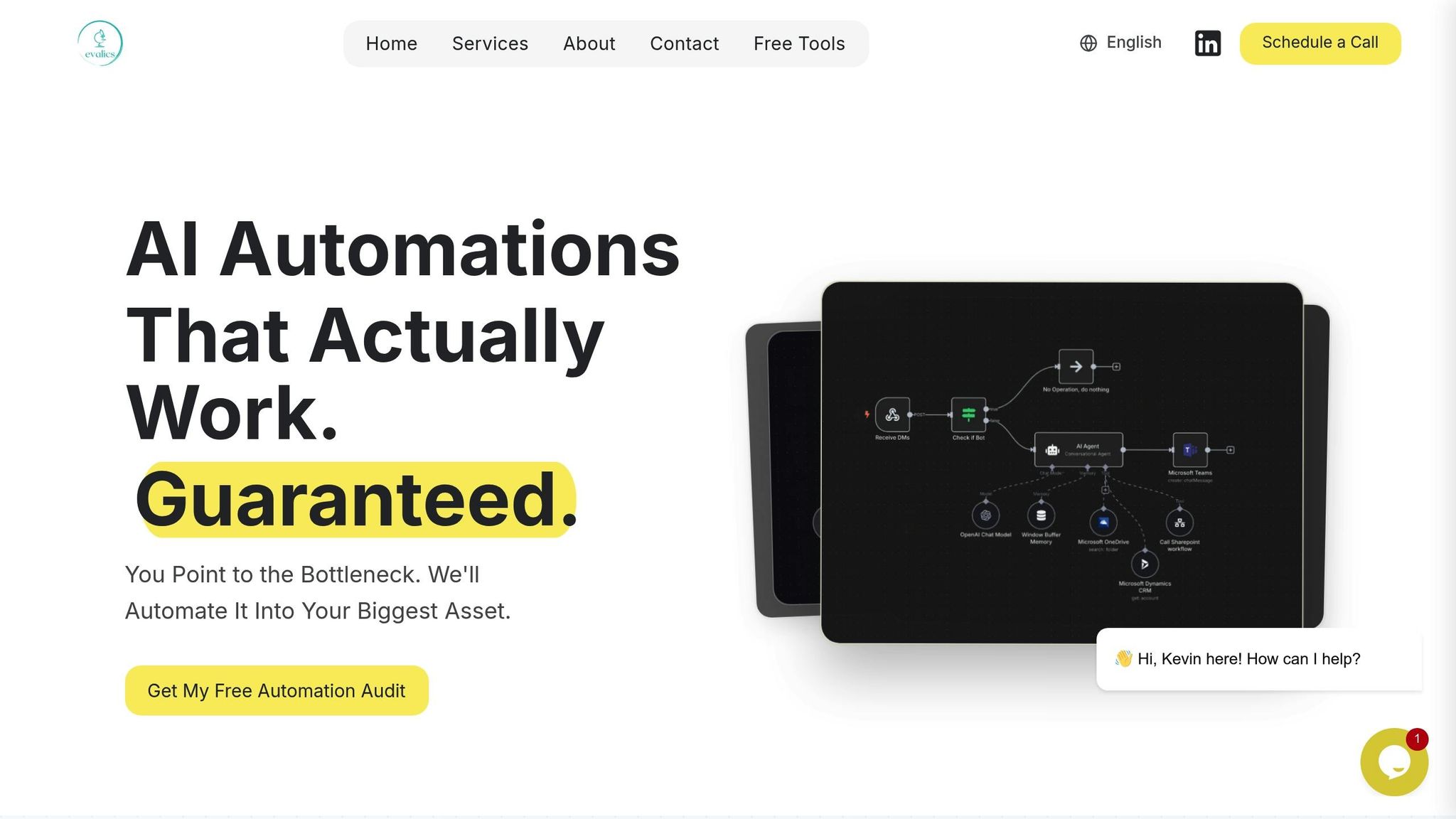
As Sales Automation AI reshapes how businesses approach revenue strategies, Evalics stands out as a platform built to simplify and enhance the process. Evalics is a SaaS solution designed to streamline sales workflows and drive growth. By cutting down on manual tasks and improving operational performance, Evalics scales effortlessly with your business needs. This sets the stage for diving into its features and pricing options.
Evalics Features and Benefits
Evalics offers a robust set of AI-driven tools aimed at simplifying sales automation and managing operational processes. Beyond automating repetitive tasks, it provides actionable insights to help refine sales strategies. With detailed documentation and training resources, Evalics ensures its tools align seamlessly with your business goals.
Evalics Pricing and Plans
Evalics offers three pricing tiers, each tailored to meet varying business requirements and project scopes:
| Plan Name | Pricing & Delivery | Included Benefits |
|---|---|---|
| AI Automations | $1,100 – $11,000 (1–4 weeks) | A fast-track solution designed to eliminate repetitive tasks and streamline critical sales functions. |
| Custom Solutions & Collaboration | $11,000 – $44,000 (3+ months) | A tailored package that includes a full business audit, cross-functional workflow automation, custom API integrations, and comprehensive team onboarding with documentation. |
| AI Accelerator Partnership | $44,000+ (6+ months) | A long-term partnership offering a company-wide automation roadmap, custom AI development, ongoing team training, and ROI tracking. |
How to Implement Sales Automation AI with Evalics
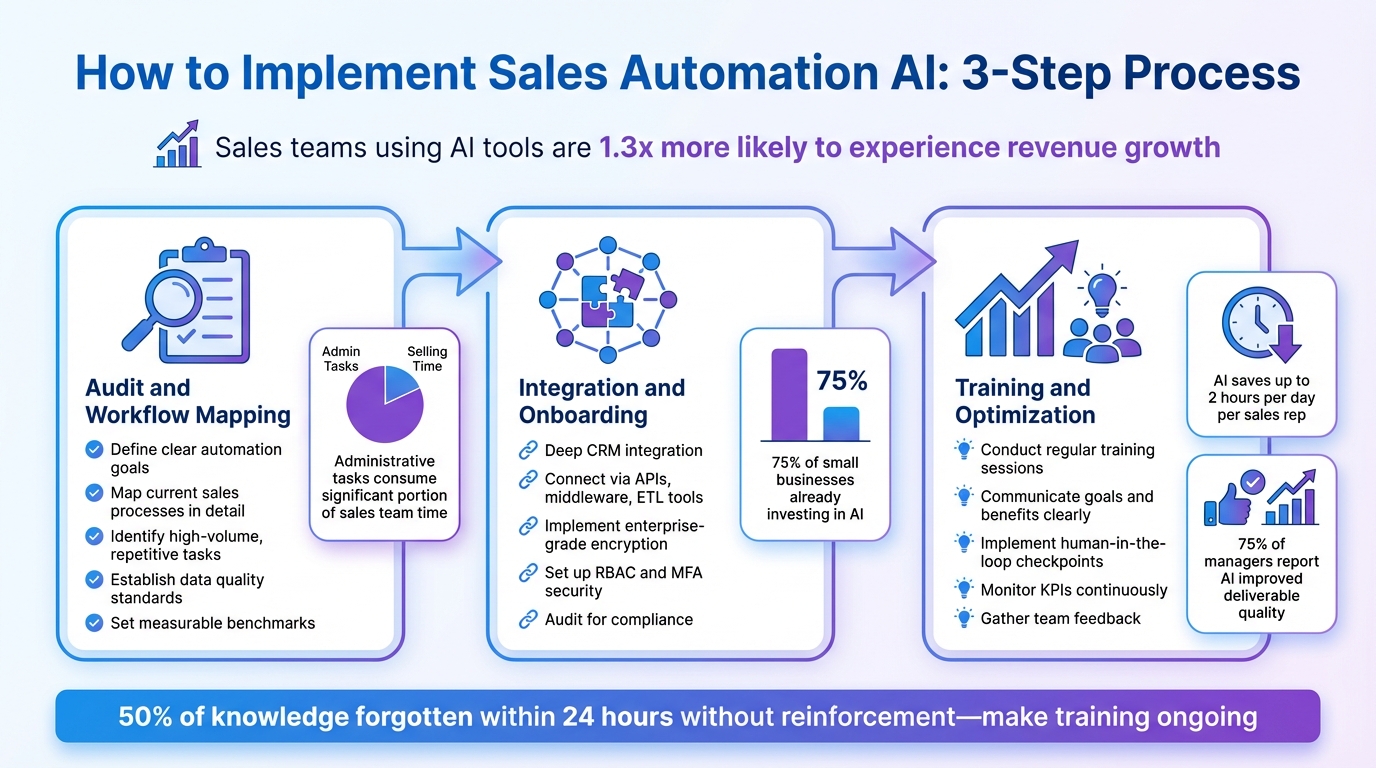
Rolling out Sales Automation AI effectively requires a structured approach. Research indicates that sales teams using AI tools are 1.3 times more likely to experience revenue growth [16]. Here’s a practical guide to leveraging Evalics for sales automation in three key steps.
Step 1: Audit and Workflow Mapping
Before diving into automation, take a step back to assess your current processes. Define clear goals for your AI implementation - whether you’re aiming to cut down on data entry, enhance lead qualification, or scale up personalized outreach efforts [2]. The best tasks to automate are high-volume, repetitive ones that follow predictable rules and are prone to delays or errors [3].
Start by mapping out your sales processes in detail. Identify every input, decision point, exception, and output. Highlight bottlenecks or frustrations in the current workflow. Many sales teams find that administrative tasks consume a significant portion of their time [4], making these areas prime candidates for automation. Look for opportunities in lead scoring, email automation, or CRM data enrichment [1][17].
Data quality is critical. Set up a centralized governance framework to standardize data formats and eliminate duplicates [3][2]. Link your automation goals to measurable outcomes like reduced turnaround times, fewer errors, and faster support resolutions [3]. Establishing these benchmarks upfront allows you to track the impact of your efforts. Studies show these steps significantly boost efficiency and revenue [16].
Once you’ve fully mapped your workflow, you’ll be ready to integrate Evalics seamlessly into your existing systems.
Step 2: Integration and Onboarding
For Evalics to deliver its full potential, it needs to integrate smoothly with your existing tools. Prioritize deep integrations with your CRM and other sales platforms to ensure data flows effortlessly without manual intervention [1]. Conduct a thorough audit of your workflows and identify any dependencies or potential weak points [3].
Use APIs, middleware, and ETL tools to connect data across your enterprise platforms, cloud services, and legacy systems [3]. If you’re dealing with older software that lacks modern APIs, consider using RPA bots to handle tasks like data entry or batch uploads [3].
Security should be a top priority. Implement enterprise-grade encryption, role-based access controls (RBAC), and multi-factor authentication (MFA) [3]. Regularly audit your systems to ensure compliance with regulations, focusing on data minimization and proper deletion policies. With 75% of small businesses already investing in AI [2], getting security right from the start is essential to maintaining your edge.
By setting up these integrations, you lay the foundation for a smooth onboarding process and long-term success.
Step 3: Training and Optimization
Once Evalics is integrated, the next step is empowering your team through training and continuous improvement. Adoption hinges on your employees understanding not just how to use Evalics, but also how it simplifies their work and boosts effectiveness [16][2]. Plan regular training sessions to combat knowledge decay - 50% of knowledge is forgotten within 24 hours, and up to 90% within a week without reinforcement [4].
Clearly communicate the goals and benefits of your AI tools. Highlight how they improve productivity and enhance the employee experience [3]. Involve your team early in pilot programs to reduce resistance to change [3], and actively gather feedback to ensure the tools address real-world needs [17].
Keep a human-in-the-loop approach by setting up checkpoints where human oversight is required for exceptions or edge cases [3]. Use KPIs to monitor the success of your implementation [16]. It’s worth noting that AI-powered sales automation can save up to two hours per day [4] - freeing up your team to focus on building relationships and closing deals.
As one expert puts it:
"AI can be a powerful ally, but it's your sales professionals who bring the vision, expertise, and strategic thinking that turns data into relationships and insights into action."
- Consensus [16]
The key is striking the right balance between automation and personalization. Let AI handle the repetitive tasks while your team focuses on what they do best. With 75% of managers reporting that AI tools improved the quality of their deliverables [3], implementing Evalics thoughtfully can give your business a real competitive edge.
Conclusion
Sales Automation AI is reshaping the way businesses operate by taking over repetitive tasks, freeing up teams to focus on more impactful activities. This guide has outlined how AI can streamline sales processes across various industries. From simplifying workflows and refining lead qualification to personalizing outreach at scale and offering actionable insights through predictive analytics, AI has proven its value.
The benefits are undeniable - higher productivity, improved accuracy, and increased revenue. AI integrates seamlessly into every stage of the sales cycle, from identifying prospects to accurate forecasting. The real challenge lies in striking the right balance: letting AI handle data-heavy, repetitive tasks while your team focuses on strategic thinking, creativity, and fostering strong customer relationships.
To make the most of sales automation, a step-by-step approach is essential. Begin by evaluating your current workflows, ensure tools integrate smoothly with your existing systems, and prioritize thorough training for your team to maximize adoption.
Evalics provides tailored solutions to support businesses at any point in their automation journey. Whether you’re just starting to explore the potential of AI in sales or scaling automation across your organization, having the right partner can be a game-changer. With a well-executed AI strategy, tools like Evalics can help boost efficiency, enhance customer engagement, and drive revenue growth. As this guide has shown, the right AI solution doesn’t just improve processes - it transforms them.
FAQs
1. How can Sales Automation AI help boost lead conversion rates?
Sales Automation AI transforms the way businesses handle leads by streamlining the process of identifying and prioritizing the most promising prospects. Through AI-powered scoring and routing, it pinpoints high-potential leads, ensuring sales teams can act quickly and effectively. This means faster follow-ups, smarter responses, and fewer missed opportunities, as the system detects buyer signals and automates timely communication.
On top of that, it takes outreach to the next level by personalizing messages at scale. Each prospect receives tailored communication, making engagement feel more genuine and impactful. By handling repetitive tasks and delivering actionable insights, Sales Automation AI frees up sales teams to focus on what they do best - nurturing relationships and closing deals. The result? Shorter sales cycles and improved conversion rates.
2. How can I effectively implement Sales Automation AI in my business?
To effectively put Sales Automation AI into action, begin by taking a close look at your current sales process. Identify any bottlenecks or repetitive tasks that could be streamlined with automation. Next, select AI tools that not only integrate smoothly with your CRM but also align with your specific business objectives. Start by automating tasks that have the most impact, such as lead scoring, email follow-ups, or scheduling, to achieve quick and noticeable results.
Make sure your team is well-trained on the new system and create an open channel for feedback during the initial implementation phase. Keep an eye on performance metrics to track progress and pinpoint areas that need adjustments. Use these insights to fine-tune the system and gradually expand your automation efforts, ensuring greater efficiency and boosting revenue over time.
3. How does Evalics work with my current sales tools?
Evalics works smoothly with your current sales tools through API connections and native integrations. This means you can automate tasks like lead scoring, personalized outreach, and sales analytics directly within platforms like CRMs or marketing software.
By syncing effortlessly with your existing systems, Evalics simplifies workflows, saves time, and boosts sales efficiency - all without causing any disruptions to your current processes.