
The recent release of the GitHub - mattmireles/gemma-tuner-multimodal: Fine-tune Gemma 4 and 3n with audio, images and text on Apple Silicon, using PyTorch and Metal Performance Shaders. toolkit marks a massive shift in how businesses approach AI customization. For years, the barrier to entry for fine-tuning was a wall of expensive NVIDIA H100 clusters and complex cloud infrastructure. This new tool changes the math entirely.
By enabling fine-tuning of Gemma models on text, images, and audio directly on Apple Silicon, this project democratizes enterprise-grade AI. You no longer need to rent massive GPU clusters or move terabytes of sensitive data to a third-party cloud provider. You can train on your own hardware, on your own terms, and keep your data private.
Why Is Local Multimodal Fine-Tuning Becoming the New Enterprise Standard?
Local multimodal fine-tuning is becoming the new standard because it solves the three biggest headaches for business owners: cost, privacy, and data gravity. When you train locally, you eliminate the recurring rental costs of high-end cloud GPUs. You also keep your proprietary data within your own perimeter, which is a non-negotiable requirement for many of my clients in regulated industries.
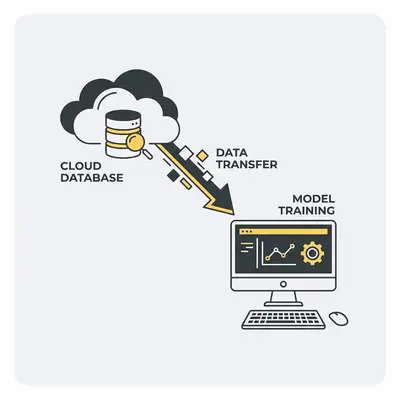
Key Insight: The ability to stream data from cloud warehouses like BigQuery directly to your local machine means you can train on massive datasets without needing a massive local SSD. You get the scale of the cloud with the control of a local workstation.
Furthermore, the "multimodal" aspect is a game-changer. Most businesses don't just have text; they have call-center audio, product images, and scanned documents. Being able to fine-tune a model to understand these specific inputs—rather than relying on generic, off-the-shelf models—is how you build a genuine competitive advantage.
How Do Current Fine-Tuning Tools Compare for SMBs?
Choosing the right tool is about matching your hardware to your data needs. While many frameworks exist, most are optimized for NVIDIA-based cloud environments. If you are already running a Mac-based office, you need tools that speak the language of Apple Silicon (MPS).
| Feature | Gemma-Tuner-Multimodal | MLX-LM | Unsloth | Axolotl |
|---|---|---|---|---|
| Text-only Fine-tuning | ✅ | ✅ | ✅ | ✅ |
| Image + Text (VQA) | ✅ | ⚠️ | ⚠️ | ⚠️ |
| Audio + Text | ✅ | ❌ | ❌ | ⚠️ |
| Apple Silicon (MPS) | ✅ | ✅ | ❌ | ❌ |
| Cloud Data Streaming | ✅ | ❌ | ❌ | ⚠️ |
What Is the Decision Framework for Adopting Local AI?
To decide if you should adopt local fine-tuning, you need to look at your specific business constraints. If your data is sensitive or resides in cloud warehouses, local training provides a secure, cost-effective bridge to custom AI without the complexity of managing remote GPU clusters.
1. Assess Data Modality Requirements
Determine if your business needs to process text, images, or audio. If your use case involves multimodal inputs—like analyzing customer support audio or product images—prioritize tools that support native multimodal LoRA. Generic models often hallucinate on domain-specific visual or audio data; fine-tuning is the only way to fix that.
2. Evaluate Hardware Constraints
Identify if your team is equipped with Apple Silicon. If your infrastructure is Mac-based, prioritize MPS-native tools to avoid the overhead of renting cloud GPUs. Using the right hardware for the job saves you thousands in monthly cloud bills.
3. Analyze Data Pipeline Integration
Consider where your data lives. If your data is stored in GCS or BigQuery, select tools that support streaming. This avoids the time and cost of downloading terabytes of data to local storage, which is often the biggest bottleneck in the training process.
Pro Tip: Start with a small, high-quality dataset to validate your model's performance before scaling to full-cloud streaming. A clean 500-row dataset is often more effective than a messy 50,000-row dataset.
How Can SMBs Implement Local Fine-Tuning?
Implementing local fine-tuning requires a structured approach to data preparation and model selection. Follow these steps to transition from raw data to a custom-tuned model:
- Define the Objective: Clearly state whether you are performing instruction tuning or completion tasks. Don't start training until you know exactly what "success" looks like for your model.
- Prepare Your Dataset: Format your CSV files to align with the required modality (text, image, or audio). Data hygiene is 90% of the work.
- Configure the Environment: Ensure your Apple Silicon machine has the necessary PyTorch and Metal Performance Shaders installed.
- Stream Data: Connect your local environment to your cloud data source (e.g., BigQuery) to avoid local storage bottlenecks.
- Execute LoRA Training: Run the fine-tuning process using the selected multimodal toolkit.
- Validate and Test: Evaluate the model against a hold-out set to ensure accuracy. Never deploy a model you haven't tested against real-world edge cases.
- Deploy: Integrate the fine-tuned weights into your production application.
Reality Check: Fine-tuning is not a magic wand. If your base data is poor, your fine-tuned model will simply be a faster, more confident version of your bad data. Focus on data quality first.
Evalics Tip: Need help automating your AI deployment? Contact Evalics to bridge the gap between local training and production. We help businesses move from "experimenting" to "deploying" without the technical headaches.
Source
Original reporting: GitHub - mattmireles/gemma-tuner-multimodal: Fine-tune Gemma 4 and 3n with audio, images and text on Apple Silicon, using PyTorch and Metal Performance Shaders.