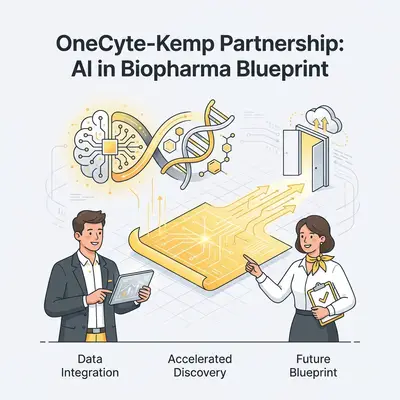
This post reacts to a recent report from Genetic Engineering & Biotechnology News (GEN) regarding the strategic partnership between OneCyte and Kemp Proteins. By combining single-cell technology with machine learning, these firms are accelerating biopharmaceutical development cycles.
The full report can be found here: Machine Learning and Single-Cell Technology Combined to Drive High-Performance Cell Line Development
This partnership serves as a masterclass in how AI-driven automation can solve systemic bottlenecks in high-stakes industries. For small business owners, the lesson is clear: integrating predictive design with rapid validation is the new standard for operational efficiency. When you stop treating AI as a "bolt-on" feature and start using it to bridge the gap between planning and execution, you stop guessing and start scaling.
What Does the OneCyte-Kemp Partnership Reveal About AI Integration?
The partnership demonstrates that AI is most effective when it bridges the gap between digital design and physical execution. By pairing Kemp’s PROTiQ™ machine learning platform with OneCyte’s high-throughput validation, the companies have created a closed-loop system that reduces failure rates and accelerates time-to-market for complex biological products.
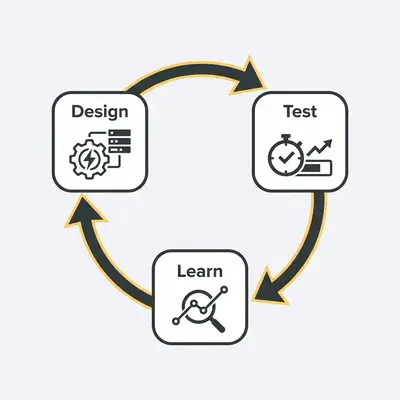
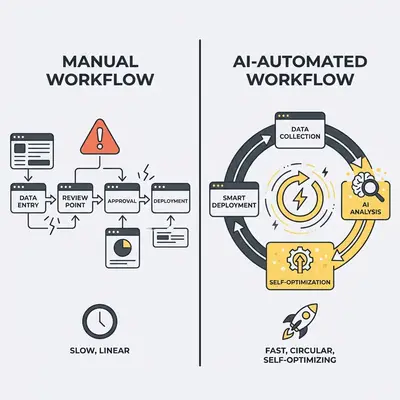
The core of this success is the "design-test-learn" cycle. In the past, biopharma companies relied on slow, linear processes. Now, they use ML to simulate outcomes before a single physical test is run. This isn't just about speed; it’s about risk mitigation. By identifying sequence liabilities early, they avoid wasting resources on dead-end candidates.
- The Power of Predictive Design: Using ML to simulate outcomes before physical testing allows you to filter out low-probability paths before you invest capital.
- Closing the Loop: High-throughput validation is the necessary partner to predictive AI. Without a way to quickly verify the AI’s predictions, you are just guessing with better software.
- Scalability Lessons: Small businesses can replicate this cycle by creating feedback loops where every output from a task informs the next iteration of the process.
Why Should Small Business Owners Care About Biopharma Trends?
While biopharma operates at a high level of complexity, the underlying operational challenges—long development cycles, high failure rates, and resource constraints—are universal. Small businesses that adopt the "predictive design" mindset can significantly reduce their own overhead by automating repetitive decision-making processes and validating workflows faster.
Key Insight: Automation isn't just for big pharma. It’s for any business that wants to stop guessing and start scaling.
If you are still manually reviewing every lead, every invoice, or every customer support ticket, you are operating with a "legacy" mindset. The goal is to identify where manual processes slow down growth and replace them with systems that learn from your historical data. When you automate the "test" phase of your business, you free up your team to focus on the "design" phase—the high-level strategy that actually moves the needle.
How Can SMBs Implement AI-Driven Automation?
Implementing AI-driven automation requires a shift from manual, reactive workflows to data-informed, proactive systems. By focusing on high-impact, repetitive tasks, small business owners can leverage AI to mimic the high-throughput efficiency seen in the OneCyte-Kemp partnership, ensuring that every resource is directed toward high-probability outcomes.
- Audit your current bottlenecks: Identify the most time-consuming, repetitive tasks. If a task takes more than 30 minutes a day and follows a predictable pattern, it is a candidate for automation.
- Digitize your data: Ensure your business processes are tracked in a format AI can analyze. If your data lives in paper files or scattered emails, you cannot build a predictive model.
- Select predictive tools: Choose software that offers forecasting or automated decision-making. Look for tools that integrate with your existing stack rather than forcing you to change your entire workflow.
- Run small-scale pilots: Test AI-driven workflows on a single process before scaling. Don't try to automate your entire business in a weekend.
- Validate and iterate: Use the results to refine your AI models for better accuracy. If the AI makes a mistake, treat it as a data point to improve the system, not a reason to abandon it.
- Integrate systems: Connect your design/planning tools with your execution/validation tools. The goal is a seamless flow of information from the moment a task is created to the moment it is completed.
What Are the Common Pitfalls of AI Adoption?
The most common pitfall is attempting to automate a broken process rather than optimizing the process first. Without clean data and a clear understanding of the desired outcome, AI can simply accelerate the production of errors. Successful adoption requires a focus on data integrity and a willingness to pivot based on AI-generated insights.
Reality Check: The "Garbage In, Garbage Out" trap is real. If your manual process is messy, your automated process will be a disaster.
Over-automation is another danger. You must know when to keep a human in the loop for critical decisions. AI is excellent at handling high-volume, low-risk tasks, but it should never replace the strategic judgment required for high-stakes client interactions or complex problem-solving.
Pro Tip: Start small, measure often, and scale only when the data proves the value.
Source
Original reporting: Machine Learning and Single-Cell Technology Combined to Drive High-Performance Cell Line Development