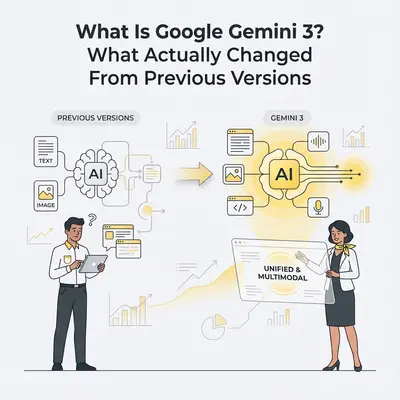
Google Gemini 3 is Google's latest flagship AI model family, released starting November 2025, with major advances in reasoning, multimodal processing, and agentic capabilities over the Gemini 2 series. For small business owners using Google tools, Gemini 3 delivers smarter responses in the Gemini app and Search—better document summaries, nuanced planning advice, and improved automation capabilities without requiring plan changes.
This post explains what actually changed from previous versions, what stayed the same, and what it means for your workflows. You'll get benchmarks, feature comparisons, and practical guidance to decide if upgrading makes sense for your automation needs.
Quick Win: Gemini 3 Pro is Google's most intelligent model to date, excelling in reasoning, multimodal tasks (text, images, audio, video), and agentic workflows. The improvements are real, but the core context window and multimodal foundations remain similar—so changes feel evolutionary rather than revolutionary for basic use.
The 30-second answer: What is Gemini 3?
What is Gemini 3? Gemini 3 is Google's newest AI model series, announced November 18, 2025. The first model, Gemini 3 Pro, is described as Google's "most intelligent model" that combines all of Gemini's capabilities together.
What's available today? Gemini 3 Pro is rolling out in:
- Google AI Studio (for developers)
- Vertex AI and Gemini Enterprise (for enterprises)
- Gemini CLI and Google Antigravity (new agentic development platform)
- The Gemini app (for general users)
- Google Search AI Mode (for Pro and Ultra subscribers)
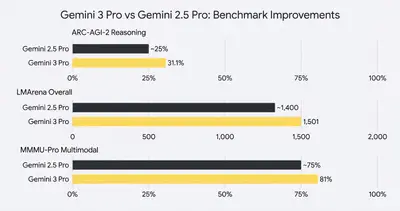
What actually improved? Google emphasizes three areas: state-of-the-art reasoning, advanced multimodal understanding, and exceptional coding/agentic capabilities. The model significantly outperforms Gemini 2.5 Pro on major AI benchmarks, including a 31.1% score on ARC-AGI-2 (abstract reasoning) and topping the LMArena leaderboard with 1,501 points.
Source: Google's Gemini 3 announcement, Gemini 3 Flash announcement
Release timeline and availability
Google unveiled Gemini 3 Pro on November 18, 2025, emphasizing immediate deployment across its ecosystem—a shift from prior gradual rollouts. This included day-one availability in the Gemini app (over 650 million monthly users), AI Mode in Search (reaching billions), and developer platforms like Vertex AI and Google AI Studio.
A faster variant, Gemini 3 Flash, launched on December 17, 2025, positioned as "frontier intelligence built for speed" and quickly became the default for many interactions. Gemini 3 Deep Think, focused on iterative hypothesis exploration for math, science, and logic, began rolling out to Ultra subscribers on December 5, 2025, after additional safety evaluations.
Access varies: free users get basic features in the Gemini app and Search, while paid subscribers (Google AI Plus, Pro, or Ultra) unlock higher limits and advanced modes like Deep Think.
This aggressive timeline reflects Google's push to integrate cutting-edge models directly into revenue-generating products like Search and Workspace, while competing with rapid advancements from OpenAI and others.
What actually changed in Gemini 3
A new model series, not just an update
Gemini 3 isn't a minor version bump. Google is positioning it as a new era, with Gemini 3 Pro as the first model in the series. This suggests more variants are coming (similar to how Gemini 2.5 Flash and Pro coexisted).
The announcement explicitly states: "We plan to release additional models to the Gemini 3 series soon so you can do more with AI."
Improved reasoning and multimodal understanding
Google claims Gemini 3 Pro delivers "state-of-the-art reasoning with unprecedented depth and nuance." The benchmarks they highlight:
- 31.1% on ARC-AGI-2 (abstract reasoning)—a significant improvement over its predecessor
- 1,501 Elo on LMArena Leaderboard (overall performance)—topping the leaderboard
- 81% on MMMU-Pro (multimodal reasoning)
- 87.6% on Video-MMMU (video understanding)
- 72.1% on SimpleQA Verified (factual accuracy)
These numbers suggest meaningful improvements, especially for tasks requiring deep analysis or multimodal inputs (text + images + video).
Better coding and agentic capabilities
Google calls Gemini 3 "the best vibe coding and agentic coding model we've ever built." It tops the WebDev Arena leaderboard and is designed to accelerate software development.
For small business automations, this could mean:
- Better code generation for custom workflows
- More reliable tool use in agentic automations
- Improved handling of complex, multi-step tasks
The model is integrated into Google Antigravity, a new agentic development platform that positions AI as an "active partner" rather than just a tool.
Deep Think mode (available now)
Gemini 3 Deep Think is an advanced reasoning mode that excels on challenging benchmarks. It began rolling out to Google AI Ultra subscribers on December 5, 2025, after additional safety evaluations.
This suggests Deep Think may be more powerful but also requires more careful deployment.
| Aspect | Gemini 2 Series Focus | Gemini 3 Improvements |
|---|---|---|
| Reasoning Depth | Introduced thinking and native tool use | State-of-the-art nuance, intent grasp, iterative exploration |
| Multimodal Processing | Strong long-context and basic vision/audio | Frontier-level spatial/video understanding, code execution on visuals |
| Agentic/Coding | Solid function calling and debugging | Enhanced autonomy, vibe coding, Antigravity platform integration |
| Speed/Efficiency | Flash variants for low-latency | Flash retains speed while matching Pro-grade reasoning |
| Context Window | Up to 1M tokens | Maintained 1M tokens with better utilization |
What didn't change (or still won't be solved by upgrading)
Context window and pricing details remain similar
The 1-million token context window and native multimodal support carry over from recent Gemini 2 models. Basic latency and efficiency for simple queries remain optimized in the Flash variant, avoiding drastic shifts for everyday users.
Tool reliability still depends on your setup
Better reasoning doesn't eliminate the need for:
- Output validation (models can still hallucinate)
- Error handling (API calls can still fail)
- Human oversight (for high-risk actions)
Gemini 3 improves capabilities, but it doesn't remove the need for guardrails in production automations.
Reality Check: Improved reasoning and coding capabilities are real, but they don't eliminate the need for validation, error handling, and human oversight in production workflows.
Who should care (and who can ignore it for now)
You should try Gemini 3 Pro if:
- You're building new automations and want the latest capabilities
- Your workflows rely heavily on reasoning or multimodal understanding
- You're prototyping agentic coding workflows
- You can tolerate preview model behavior changes
You can wait if:
- Your current Gemini 2.5 Pro workflows are working well
- You're running production automations that can't tolerate changes
- You need guaranteed pricing and availability
- You're not using advanced reasoning or coding features
For most small businesses, the improvements are meaningful but not urgent. If your automations are stable, there's no rush to upgrade.
How to try Gemini 3 safely in a small business
Start with non-critical workflows
Test Gemini 3 Pro on workflows where failures won't cost money or break customer-facing processes. Good candidates:
- Internal document summarization
- Draft content generation
- Exploratory data analysis
- Prototype agentic coding projects
Compare outputs side-by-side
Run the same prompts on both Gemini 2.5 Pro and Gemini 3 Pro, then compare:
- Response quality and accuracy
- Consistency across multiple runs
- Cost (if pricing differs)
- Speed/latency
This gives you concrete data on whether the upgrade is worth it for your use cases.
Keep production on stable versions
Until you've thoroughly tested Gemini 3 Pro, keep your production automations on stable model versions (like Gemini 2.5 Pro). New models can have unexpected behavior changes, and you don't want surprises in workflows that handle real business operations.
Monitor for updates
Google plans to release additional Gemini 3 models soon. Watch for:
- Gemini 3 Flash (already released December 17, 2025)
- General availability announcements (moving out of preview)
- Pricing and context window details
- Deep Think mode availability (rolling out to Ultra subscribers)
Pro Tip: Use Gemini 3 Pro for new projects and testing, but keep production automations on stable versions until you've verified behavior matches your requirements. This gives you the benefits of improved capabilities without the risk of unexpected changes.
Conclusion
Gemini 3 represents a meaningful step forward in reasoning, multimodal understanding, and coding capabilities. The improvements are real and measurable on benchmarks—31.1% on ARC-AGI-2, 1,501 Elo on LMArena, and top scores in multimodal tasks.
For small business automations, the key takeaway is timing: Gemini 3 Pro is available now, which means it's great for testing and new projects, but production workflows should stay on stable versions until you've verified behavior matches your requirements.
If you want to explore how Gemini 3 could improve your specific automation workflows, we can help you test it safely and compare it against your current setup. For pricing details, see our Gemini 3 pricing breakdown. For comparisons with other models, see Gemini 3 vs OpenAI: Cost, Limits, and Tradeoffs.
Book a free automation audit to discuss how Gemini 3 could fit into your workflows.
About the Author
Kevin Michael Schindler is an AI Automation Expert at Evalics, helping small businesses and teams implement practical automation systems that save time and reduce operational drag.
Key Citations