You spend two hours every morning researching prospects. You open dozens of LinkedIn tabs. You read company news. You try to craft the perfect cold email. After all that effort, you send out ten messages and get zero replies.
Lead generation often feels like a grueling numbers game. Most businesses try to fix this by increasing their volume. They buy massive email lists and blast thousands of generic messages.
That approach damages your brand and ruins your domain reputation.
AI changes this dynamic entirely. It does not just send emails faster. It automates the heavy lifting of research, qualification, and timing. When you get leads with AI, you combine the personalization of manual outreach with the scale of automation.
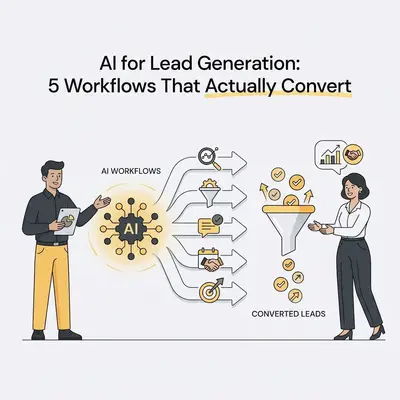
Here are five proven AI lead generation workflows that actually convert prospects into buyers.
1. The Instant Lead Qualifier
When a new lead fills out a form on your website, the clock starts ticking. They are thinking about the problem right now, and they are almost certainly filling in someone else's form too. Yet most sales teams take hours or days to respond.
Worse, your sales team might rush to call a lead only to find out they have zero budget.
This workflow fixes both problems. It uses AI to score and route leads instantly.
How it works:
- A prospect submits a Typeform or HubSpot form.
- The automation sends the prospect's answers and company domain to an AI model (like Claude or GPT-4).
- The AI reviews their website, evaluates their company size, and scores the lead against your ideal customer profile.
- If the score is high, the AI posts a summary in a specific Slack channel and alerts your sales team to call immediately.
- If the score is low, the AI adds the lead to an automated email nurture sequence.
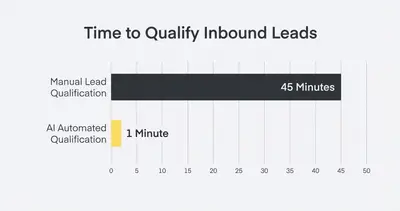
Quick Win: By automating your AI lead qualification, you stop wasting expensive sales talent on unqualified prospects. Your team only talks to people who are ready to buy.
2. Deep Profile Enrichment
Personalized emails get higher response rates. But writing a truly personalized email takes 15 to 20 minutes of research per prospect. You have to read their recent LinkedIn posts, check their company blog, and understand their industry.
The Deep Profile Enrichment workflow acts like an invisible research assistant. It gathers everything you need to know before you ever type a word.
How it works:
- You add a new name and company URL to an Airtable or Google Sheet.
- An automation triggers a tool to scrape the company's recent news, career page, and the prospect's LinkedIn bio.
- An AI model digests all this unstructured data.
- The AI outputs three highly specific, relevant talking points (e.g., "They just hired a new VP of Sales," or "They recently expanded into Europe").
- The automation updates your CRM with these talking points.
When your sales rep opens the CRM, the research is already done. They can draft a hyper-personalized email in two minutes instead of twenty.
3. The Signal-Based Outreach Engine
Timing is everything in sales. Reaching out when a company is actively experiencing a problem is the easiest way to book a meeting.
Traditional lead generation relies on guessing. Signal-based outreach relies on hard data. You set up automations to monitor specific trigger events across the web, allowing you to reach out at the exact right moment.
How it works:
- You set up a web scraper to monitor job boards for specific roles (e.g., companies hiring a "Director of Revenue Operations").
- When the automation detects a matching job post, it triggers a workflow.
- The system identifies the likely hiring manager at that company using a data provider like Apollo.
- AI drafts a personalized email referencing the specific job post and how your service solves the exact problem they are trying to hire for.
- The draft goes into a queue for human review.
Reality Check: Never let AI send cold emails completely unsupervised. Always include a "human-in-the-loop" step. Review the AI's drafts, tweak the tone, and click send yourself. This ensures quality and prevents embarrassing mistakes.
4. The Intelligent Lead Magnet Follow-Up
Most businesses offer a free guide or checklist in exchange for an email address. The problem happens afterward. Every person who downloads the guide receives the exact same follow-up email sequence, regardless of who they are.
A CEO receives the same generic email as an intern. This destroys your conversion rate.
Instead, you can use AI to build dynamic, hyper-personalized follow-up sequences based on the prospect's identity.
How it works:
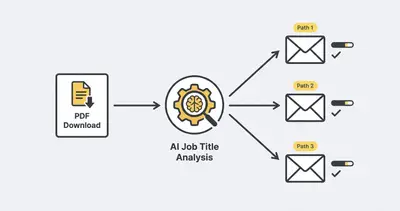
- A user downloads your PDF.
- An automation tool like n8n grabs their email address and enriches it to find their job title and industry.
- The AI analyzes their role. If they are a CEO, the AI drafts an email focusing on ROI and high-level strategy. If they are an IT Manager, the AI drafts an email focusing on implementation and security.
- The automation sends this customized email 15 minutes after the download.
This approach makes your marketing feel like a one-on-one conversation. It is one of the best sales automations for small businesses looking to maximize their existing website traffic.
5. Dead Pipeline Reactivation
Every business has a graveyard of lost deals in their CRM. These are prospects who took a meeting but said "not right now," or leads who went completely dark.
Most sales reps forget about these leads. They chase the new opportunities instead. But there is massive revenue hidden in your old pipeline data. You just need AI to find it.
How it works:
- An automation scans your CRM for deals marked "Closed Lost" or "Unresponsive" over six months ago.
- The workflow checks LinkedIn to see if the prospect's company recently raised funding, launched a new product, or changed leadership.
- If a trigger event is found, the AI drafts a re-engagement email.
- The email references the previous conversation and ties it to the new trigger event (e.g., "I know the timing wasn't right last year, but I saw you just secured Series A funding. Are you looking to scale your team now?").
This workflow runs quietly in the background, constantly mining your old data for new opportunities. It turns dead leads into warm conversations without any manual effort.
How to Start Building These Workflows
Do not try to build all five of these workflows this week. If you try to overhaul your entire sales process at once, you will get overwhelmed and abandon the project.
Start small.
Pick the most painful part of your current lead generation process. If your team spends too much time researching, build the Profile Enrichment workflow first. If you struggle with lead quality, start with the Instant Lead Qualifier.
Use platforms like Make.com or n8n to connect your tools. Many of the top marketing agency integrations involve linking your CRM directly to an AI model to handle this exact type of data processing.
Pro Tip: Before building complex scrapers, test your logic manually. Take a prospect's data, paste it into ChatGPT, and see if the prompt generates a good email. If the manual prompt fails, the automation will fail too.
The Bottom Line
Lead generation does not have to be a manual grind. By implementing AI workflows, you can research deeper, respond faster, and personalize at scale.
AI will not close the deal for you. People still buy from people. But these workflows ensure that your human sales team spends 100% of their time actually selling, rather than doing data entry.
Ready to stop wasting time on manual outreach? Building custom lead generation systems is exactly what we do. Book a demo with Evalics today, and let's turn your manual pipeline into an automated growth engine.
By Kevin Michael Schindler, AI Automation Expert at Evalics
Related Resources
- How to Get Leads With AI
- What Is AI Lead Qualification Guide
- AI Sales Automation For Small Businesses
- How Real Time Data Improves Sales Processes
Official Sources
- HubSpot: State of AI in Sales and Marketing
- Salesforce: How AI is Transforming the Sales Process
- Clearbit: The Complete Guide to B2B Lead Enrichment