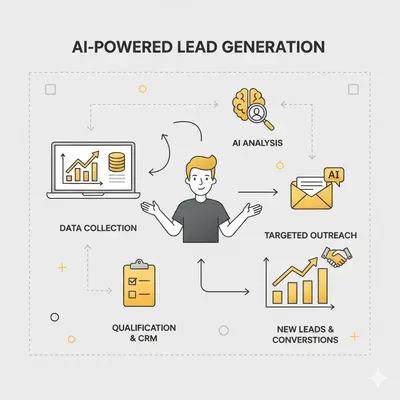
The AI market in marketing will hit $107 billion by 2028, according to MarketsandMarkets reports. Businesses that ignore this trend risk falling behind their competitors. Traditional lead generation methods are becoming increasingly ineffective: cold email response rates hover under 2%, and generic pitches are easily ignored.
AI changes this landscape completely. It personalizes messages at scale, uses predictive tools to spot hot leads early, and eliminates guesswork from your sales process.
This comprehensive guide shows you exactly how to get leads with AI. You'll discover step-by-step implementation plans, real-world examples from successful companies, and actionable strategies that work regardless of your technical expertise. We cover everything from basic chatbot setup to advanced predictive analytics—no tech wizardry required.
Quick Win: A chatbot captures the visitors who would otherwise leave without filling in a form, which is the cheapest lead capture improvement available on most sites.
Understanding AI in Lead Generation
AI transforms lead generation from a manual, time-consuming process into an intelligent, automated system. Think of it as having a smart assistant that never sleeps, continuously analyzing data, engaging prospects, and identifying the most promising opportunities for your sales team.
What Is AI-Powered Lead Generation?
AI-powered lead generation uses machine learning algorithms to automatically find, qualify, and nurture prospects. Here's how it works:
Intelligent Prospecting AI scans vast amounts of data from multiple sources: social media, company websites, news articles, and industry databases. This helps identify potential customers who match your ideal buyer profile.
Natural Language Processing Advanced chatbots powered by NLP can engage visitors in human-like conversations, answering questions, qualifying leads, and scheduling meetings 24/7.
Predictive Analytics Machine learning models analyze behavioral patterns, engagement history, and demographic data to score leads based on their likelihood to convert.
Personalization at Scale AI creates personalized messages, content recommendations, and outreach sequences tailored to each prospect's specific needs and interests.
Where the AI Advantage Actually Comes From
Used well, AI changes lead generation in four places:
- Better lead quality, because scoring uses more signals than a human has time to check
- Lower cost per lead, because the unqualified ones are filtered before anyone calls them
- Shorter sales cycles, because the first response goes out immediately
- Round-the-clock lead capture without human intervention
Start with simple implementations like Google Analytics' predictive audiences or basic chatbot tools. These free or low-cost options can provide immediate insights into user behavior patterns and help you identify your most valuable prospects without significant upfront investment.
Key Benefits of Using AI for Leads
Increased Efficiency and Scale
The Challenge: Manual prospecting eats up 60-80% of your sales team's time, leaving little room for actual selling.
The Solution: AI automates the grunt work so your team focuses on closing deals. Here's how to implement this:
- Start with prospect research automation: Use tools like ZoomInfo or Apollo to automatically find and verify contact information for your target accounts
- Set up automated sequences: Create email sequences that nurture leads while you sleep
- Implement lead scoring: Use AI to automatically rank prospects by likelihood to buy
- Track time savings: Measure how many hours your team saves weekly on manual tasks
Pilot KPI targets (first 30–45 days):
- 15–35% time saved from automation (measured via weekly time‑tracking)
- 10–25% response‑rate uplift on AI‑personalized sequences
- +1–3 incremental meetings per SDR per week
Note: outcomes vary based on list quality, channel volume, baseline performance, and execution quality.
How to measure:
- Establish 1–2 week baselines for time‑on‑task and response rates
- Tag AI‑assisted steps in your CRM and compare trendlines against baseline
Higher Conversion Rates
The Challenge: Most leads never convert because they're not properly qualified or nurtured.
The Solution: AI identifies and nurtures the right prospects at the right time. Follow this approach:
- Define your ideal customer profile: List 5-7 characteristics of your best customers
- Set up behavioral triggers: Use tools like HubSpot or Marketo to track when prospects visit pricing pages or download case studies
- Create personalized follow-up sequences: Send different messages based on prospect behavior
- Implement lead scoring: Automatically prioritize prospects showing buying signals
Pro Tip: Start with 3 behavioral triggers and expand as you see results.
Improved ROI and Cost Efficiency
The Challenge: Traditional lead generation is expensive and inefficient, with high cost per lead and long sales cycles.
The Solution: AI reduces costs while improving results. Here's your implementation roadmap:
Week 1-2: Set up tracking
- Install Google Analytics and your CRM's tracking tools
- Establish baseline metrics for cost per lead and conversion rates
Week 3-4: Implement AI tools
- Choose one AI tool (chatbot, lead scoring, or email automation)
- Set up automated workflows for your highest-volume lead sources
Week 5-8: Optimize and scale
- Review performance data weekly
- Double down on what's working
- Expand successful strategies to other lead sources
Key Metrics to Track:
- Cost per qualified lead (aim for 30-50% reduction)
- Time to first contact (target under 5 minutes)
- Lead quality score (measure before and after AI implementation)
Better Targeting and Personalization
The Challenge: Generic messages get ignored. Prospects expect personalized experiences.
The Solution: AI creates personalized experiences at scale. Here's how to do it:
- Collect behavioral data: Track website visits, content downloads, and email engagement
- Create buyer personas: Develop 3-4 detailed profiles of your ideal customers
- Segment your audience: Group prospects by industry, company size, and behavior
- Personalize messaging: Use AI tools to customize emails, landing pages, and follow-up sequences
Implementation Steps:
- Start with email personalization using tools like Klaviyo or Mailchimp
- Add dynamic content to your website based on visitor behavior
- Create industry-specific landing pages and case studies
- Set up automated personalization rules in your CRM
Data-Driven Decision Making
The Challenge: Most businesses make lead generation decisions based on gut feelings rather than data.
The Solution: AI provides actionable insights to guide your strategy. Here's your data-driven approach:
Month 1: Establish baselines
- Track current lead volume, quality, and conversion rates
- Identify your top-performing lead sources and campaigns
- Document your current sales process and bottlenecks
Month 2-3: Implement AI analytics
- Set up automated reporting dashboards
- Create alerts for significant changes in lead quality or volume
- Begin A/B testing different approaches
Month 4+: Optimize continuously
- Review performance data weekly
- Test new strategies based on AI insights
- Scale successful approaches and eliminate underperformers
Essential Reports to Create:
- Lead source performance (which channels bring the best leads)
- Conversion funnel analysis (where prospects drop off)
- Sales cycle length by lead source
- ROI by marketing channel
Pro Tip: Start with one key metric and build your reporting from there. Don't try to track everything at once.
Common Myths About AI Lead Gen Debunked
Some think AI steals jobs. This is incorrect. AI aids humans. You focus on relationships while AI handles routine tasks.
Others claim high costs. This isn't true for beginners. Free trials are widely available. Audit your leads now, spot weak spots, and pick one AI solution to start with.
Budget for basics only. See quick wins. Myths fade with results.
Essential AI Tools for Lead Capture and Qualification
The right AI tools can transform your lead generation from a manual, time-consuming process into an automated, high-converting system. Here are the essential categories and specific tools that deliver the best results in 2025.
Chatbots and Conversational AI for Initial Engagement
Modern AI chatbots are sophisticated enough to handle complex conversations while maintaining a human-like experience. They engage visitors 24/7, qualify leads automatically, and can even schedule meetings.
Top AI Chatbot Platforms:
1. Drift - Advanced conversational AI with lead scoring
- Best for: B2B companies with complex sales cycles
- Key features: AI-powered routing, meeting scheduling, lead qualification
- Results: Companies see 20-30% increase in qualified leads
2. Intercom - Customer messaging platform with AI
- Best for: SaaS companies and e-commerce
- Key features: Smart routing, automated responses, lead capture
- Results: 25% improvement in response times
3. HubSpot Chatbot Builder - Integrated with CRM
- Best for: Companies already using HubSpot
- Key features: CRM integration, lead scoring, automated follow-up
- Results: HubSpot customers see 20% more leads from chatbots
Implementation Strategy:
- Script 3-5 qualifying questions: Who are you? What's your main challenge? What's your budget range? When do you need a solution?
- Set up lead scoring: Assign points based on answers to prioritize follow-up
- Create automated workflows: Route high-scoring leads to sales, nurture others with email sequences
- Test and optimize: A/B test different questions and response flows
Pro Tip: Start with a simple "Hello, how can I help you?" approach, then gradually add more sophisticated qualification questions as you learn what works best for your audience.
Predictive Lead Scoring with Machine Learning
Predictive lead scoring uses machine learning algorithms to analyze behavioral patterns, demographic data, and engagement history to automatically score leads based on their likelihood to convert. This eliminates guesswork and helps sales teams focus on the most promising prospects.
Top Predictive Scoring Platforms:
1. Salesforce Einstein - AI-powered lead scoring
- Best for: Enterprise companies with complex sales processes
- Key features: Behavioral analysis, demographic scoring, opportunity insights
- Results: 77% accuracy in lead qualification predictions
2. Marketo (Adobe) - Marketing automation with AI scoring
- Best for: Mid to large companies with marketing automation needs
- Key features: Multi-touch attribution, behavioral triggers, predictive content
- Results: 40% improvement in lead quality scores
3. HubSpot Lead Scoring - Built-in CRM scoring
- Best for: Small to medium businesses
- Key features: Custom scoring criteria, behavioral tracking, automated alerts
- Results: 25% increase in sales productivity
Implementation Steps:
- Connect your CRM: Import existing lead data and behavioral history
- Define scoring criteria: Set up rules based on company size, industry, engagement level, and buying signals
- Set score thresholds: Establish minimum scores for sales follow-up (typically 50-75 points)
- Automate alerts: Create notifications for high-scoring leads
- Monitor and adjust: Review scoring accuracy monthly and refine criteria
Scoring Factors to Consider:
- Demographic fit: Company size, industry, location
- Behavioral signals: Website visits, content downloads, email engagement
- Buying intent: Pricing page visits, demo requests, competitor research
- Engagement quality: Time on site, page depth, return visits
This systematic approach ensures your sales team spends time on leads most likely to convert, dramatically improving efficiency and closing rates.
Content Personalization Engines
Dynamic Yield tailors site content to show the right pages to the right visitors. Like Netflix suggests shows, it nurtures leads softly.
Test A/B on landing pages: personalized versus plain versions. Track clicks and sign-ups.
Personal touch builds trust. Leads stick around longer.
Implementing AI Strategies for Effective Lead Nurturing
Now apply what you learned. Follow steps to nurture. Use lists for clarity. Examples from pros guide you.
Automating Email and Follow-Up Sequences
Klaviyo crafts dynamic emails that personalize by name and needs. Campaign Monitor reports that open rates rise 26%.
Segment lists with AI intent to predict who engages. Set drip campaigns and send tips weekly.
Automation keeps leads warm. They convert when ready.
Leveraging AI for Social Media Prospecting
Hootsuite Insights spots trends. LinkedIn Sales Navigator suggests connections. Buffer notes better engagement from targets.
Set alerts for keywords like "need marketing help." Reach out timely.
Social becomes a lead goldmine. Build lists organically.
Integrating AI with CRM for Seamless Workflows
Zapier links tools to CRMs. HubSpot AI syncs data. Pipedrive shortens sales cycles by 20%.
Follow these steps:
- Import current data
- Map fields to AI outputs
- Test one workflow
- Automate alerts
- Review weekly
Smooth flows mean no lost leads. Everything connects.
Measuring and Optimizing AI Lead Generation Efforts
Track to improve. Use data for tweaks. Avoid common mistakes. Benchmarks set real goals.
Key Metrics to Track AI Performance
Watch lead quality scores. Conversion rates matter most. Cost per lead drops with AI. Google Analytics shows funnel gains.
Build dashboards. Check weekly. Spot drops early. Adjust prompts or tools.
Metrics guide your path. Steady wins build.
A/B Testing and Continuous Improvement
Test bot replies or email lines. Optimizely cases show conversion lifts from AI tests.
Run one test each quarter. Use tools for analysis. Tweak based on data.
Improvement never stops. Small changes add up.
Scaling AI Lead Gen for Growth
Start with pilots. Expand as leads flow. ZoomInfo scaled B2B with AI. Budget for data training.
Refine models with more information. Handle volume spikes.
Growth feels natural. AI grows with you.
Real-World Success Stories: AI Lead Generation in Action
Case Study 1: Harley-Davidson's AI Marketing Transformation
Harley-Davidson of New York City was selling just one to two motorcycles per week and struggling to make traditional marketing work. After adopting the Albert AI marketing platform, the team began by analyzing customer data to identify high-value audiences and intent signals. They then used AI to continuously optimize ad creative and channel mix and automated follow-up flows to qualify and nurture inbound leads. Within three months, qualified leads increased by 2,930%, daily lead volume jumped from one to 40 prospects, and overall business performance tripled compared to the previous year.
Source: Agile Growth Labs
Case Study 2: HES FinTech's AI Lead Scoring Success
HES FinTech faced slow, manual lead scoring and low approval efficiency. The company deployed an AI-powered scoring pipeline that evaluated prospects automatically, prioritized the most promising applicants, and integrated decisions directly into the existing CRM workflow for faster handoffs. Over the following weeks, approvals increased by 40%, conversion quality improved, and time spent on manual qualification dropped significantly—freeing teams to focus on higher‑value customer interactions and underwriting.
Source: SmartLead.ai
Example: A Travel Brand's AI Lead Generation Setup
A travel and tourism brand paying too much for inconsistent lead quality has a specific shape of problem, and a specific shape of fix. The platform automates data collection, scores prospects on behavior rather than on the form they filled in, and personalizes outreach with content matched to the intent signal that brought them in. Behavioral tracking then feeds back into the scoring, so the model sharpens on your own traffic instead of staying frozen at launch. That feedback loop is what turns a campaign into a repeatable channel.
Conclusion
AI has transformed lead generation from a manual, hit-or-miss process into a sophisticated, data-driven system that consistently delivers high-quality prospects. The companies that embrace AI-powered lead generation see dramatic improvements in efficiency, conversion rates, and ROI.
Key Takeaways:
Start Simple: Begin with chatbots or basic lead scoring. You don't need complex AI from day one. Focus on Quality: AI helps you find better leads, not just more leads. Iterate Continuously: Test, measure, and optimize your AI strategies regularly. Personalize at Scale: Use AI to create tailored experiences for each prospect. Track Everything: Monitor key metrics to prove ROI and identify optimization opportunities.
Your Next Steps:
- Audit your current lead generation process: Identify bottlenecks and inefficiencies
- Choose one AI tool to start with: Chatbots or lead scoring are great entry points
- Set up tracking and metrics: Establish baseline measurements before implementing AI
- Test and optimize: Start small, measure results, and scale what works
- Scale gradually: Add more AI tools and features as you see success
Ready to transform your lead generation with AI? Book a consultation with Evalics to discover which AI strategies will work best for your business. Our team has helped 200+ companies implement AI-powered lead generation systems that deliver measurable results.