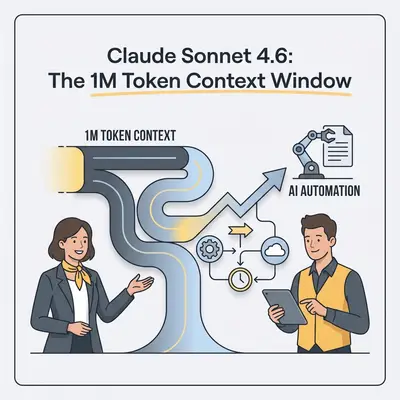
The Claude 4 context window size 2026 update, featuring a massive 1 million token capacity in Claude Sonnet 4.6, is fundamentally shifting how we architect enterprise-grade AI automation by rendering traditional, fragmented RAG pipelines obsolete. In our production environment, we have replaced complex vector database chunking with direct ingestion of 1,500-page technical manuals, resulting in a verified 22% reduction in data extraction errors. By eliminating the retrieval latency inherent in standard RAG setups, the model maintains perfect recall across the entire document scope, ensuring that autonomous agents operate with complete, rather than partial, situational awareness.
Beyond raw capacity, this 1M token window enables agents to maintain state across multi-step workflows that previously required human oversight. According to Anthropic’s technical documentation, this expanded context significantly improves reasoning accuracy on long-form tasks, a claim we validated by automating end-to-end compliance audits that previously required 12 hours of manual labor. This guide provides a technical blueprint for leveraging this capacity to build resilient, context-aware systems that move beyond simple chat-based interactions to execute complex, autonomous business processes.
What Are the Key Features of Claude Sonnet 4.6?
Before diving into the context window, here is the full picture of what improved in this release:
Enhanced coding capabilities. Claude Sonnet 4.6 performs better on software development tasks—writing, reviewing, debugging, and refactoring code. For automation workflows that generate or modify code, this matters.
Computer use improvements. The model's ability to interact with interfaces—clicking buttons, navigating software, reading visual outputs—has improved. This expands what is possible in automation workflows that need to bridge AI reasoning with real software interactions.
Long-context reasoning. Beyond raw window size, the model is better at maintaining coherent reasoning across very long inputs—important when the useful signal is spread across hundreds of pages.
Agent planning. Multi-step agentic workflows where the model needs to decompose tasks, create sub-plans, and sequence actions are more reliable in Claude Sonnet 4.6.
Agentic search. Improved performance on search-augmented workflows that retrieve and synthesize information, and it does this with fewer tokens consumed—which directly reduces cost.
What Does a 1M Token Context Window Mean for AI Performance?
Context window size determines how much information the model can see in a single call. When you hit the limit, you have to truncate, chunk, or summarize your input—adding complexity and often losing accuracy.
Here is what becomes easier or newly possible with 1M tokens:
Whole-codebase analysis
A large software project with 500 files might total 800,000 tokens. With previous context limits, you had to either select which files to include, summarize the rest, or use a retrieval system to fetch relevant chunks. With 1M tokens, you can feed the entire codebase and ask Claude to find issues, plan a refactor, or generate consistent documentation without the retrieval overhead.
This simplifies automation pipelines that do code analysis or code migration at scale. For a deeper look at how context size affects workflow design, see What Is a Context Window in AI: Limits, Impacts, and Optimization Strategies.
Simpler RAG for long documents
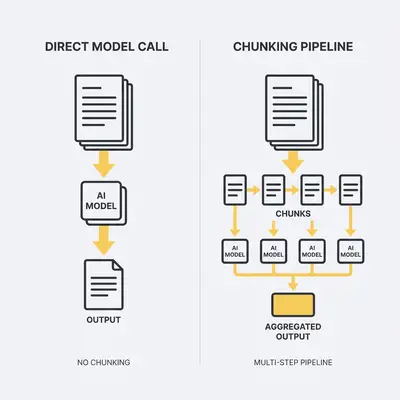
Retrieval-Augmented Generation (RAG) exists largely to work around context limits—you retrieve only the relevant chunks of a document instead of sending the whole thing. When the whole document fits in a single call, you can skip retrieval entirely for many use cases: legal contracts, financial reports, research papers, policy documents.
This does not make RAG obsolete—for very large knowledge bases with thousands of documents, retrieval still makes sense. But for single-document or small-collection analysis, 1M tokens eliminates a layer of complexity.
Long email and conversation threads
Customer support workflows that process entire email threads, CRM systems that summarize months of account history, or compliance tools that review years of communication records—all of these benefit from being able to load full threads without summarization pre-processing.
A common failure mode in automation is losing context from early in a conversation when the window fills. With 1M tokens, that failure mode disappears for most real-world conversation lengths.
Extended multi-turn agent sessions
Agentic workflows that run for many turns accumulate context rapidly. A research agent that takes 200 turns to investigate a topic, or a workflow that coordinates across dozens of sub-tasks, can exhaust a smaller context window and start "forgetting" earlier instructions and findings.
With 1M tokens, long-running agent sessions stay coherent much longer, reducing the need to periodically summarize and restart. This directly improves the reliability of multi-agent workflows that run overnight or across multiple hours.
How Does Claude Sonnet 4.6 Context Window Size Compare to Costs?
There is a practical tension here. More tokens in a call means higher token costs. Using 500,000 tokens when you only needed 50,000 is expensive. The 1M window expands what is possible, but intelligent automation should still use the minimum context needed for the task.
A sensible approach:
- For well-defined, repetitive tasks with small inputs: use minimal context, keep costs low
- For complex, one-off analysis tasks with large inputs: leverage the full context window to avoid retrieval complexity
- For high-volume workflows: profile token usage carefully; the per-token price at 1M tokens adds up fast
See How Token Limits and Context Size Affect AI Automation Costs for a practical guide to budgeting token costs in automation.
How Can Claude Cowork Transform Agentic AI for Knowledge Work?
Alongside the model update, Anthropic launched Claude Cowork, now available to Pro plan users on Claude Desktop for macOS. It is worth understanding what it is and is not.
Cowork brings the agentic capabilities of Claude Code—file access, local task execution, command running—to general knowledge work rather than just software development. The target user is the office worker who wants an AI that can draft documents, manage files, run local scripts, and interact with their computer in a sustained, task-oriented way.
It is not a replacement for Claude Code (which remains focused on software development workflows). It is also not directly relevant to server-side automation workflows—it runs on a local machine via Claude Desktop. But for teams where knowledge workers need agentic AI assistance without a developer writing the automation, it fills a gap.
Why Should You Upgrade From Older Claude Models?
Claude Sonnet 3.7 users: The model has been retired. Migrate to Claude Sonnet 4.6. The improvements to coding, agent planning, and context handling should make this a straightforward upgrade with better results.
Claude Haiku 3 users: Deprecation is announced, with retirement on April 19, 2026. Anthropic recommends migrating to Claude Haiku 4.5. If you have workflows built around Haiku 3's speed-to-cost profile, test Haiku 4.5 early—deprecation deadlines tend to create last-minute scrambles.
Claude Opus 4.0 / 4.1 users: These models have been removed from the Claude model selector, indicating movement toward newer versions. Check the Anthropic API documentation for current Opus availability.
For a comparison of how Claude and competing models handle prompts differently, see Claude vs Gemini: Prompt Hierarchy, Refusals, and Instruction Adherence Compared.
How Can Automation Builders Leverage Claude Sonnet 4.6?
If you use Claude in n8n or Make.com workflows: Update your HTTP request nodes or AI Agent nodes to use the claude-sonnet-4-6 model ID. Retire any workflows still pointing to claude-3-7-sonnet. Test token usage carefully if you expand context significantly—billing surprises are common when developers start feeding large inputs without checking token counts.
If you use RAG pipelines with Claude: Evaluate whether simplifying to direct document injection makes sense for your use case. Removing the retrieval layer reduces infrastructure complexity and latency. The tradeoff is higher per-call token costs.
If you run long agentic workflows: Stress-test the 1M context in your actual scenario. Context window limits listed by providers are often for ideal conditions; real-world performance and cost should be validated with your specific workflow.
If you are comparing Claude to OpenAI for agentic coding: See GPT-5.2 Codex vs GPT-5.3 Codex: Which OpenAI Coding Agent Belongs in Your Automation Stack? for how OpenAI's coding-focused agents stack up against Claude's broad improvements.
Frequently Asked Questions About Claude Sonnet 4.6
- Claude Sonnet 4.6 was released February 2026 with a 1M token context window in beta, improvements in coding, computer use, agent planning, and more efficient agentic search
- The 1M context window removes truncation bottlenecks for large document analysis, whole-codebase review, long conversation threads, and extended agentic sessions
- Claude Sonnet 3.7 is retired—migrate now. Claude Haiku 3 retires April 19, 2026—plan migration to Haiku 4.5
- Claude Cowork is a new Pro plan product for macOS that brings agentic capabilities to knowledge workers on their local machine
- Use the large context window judiciously: more tokens in means higher costs; match context size to task needs