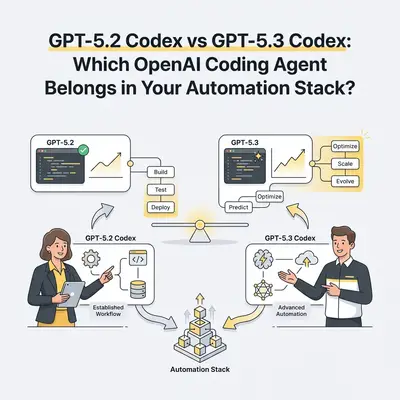
OpenAI released two new agentic coding models in early 2026 that change what automated developer workflows can actually do. GPT-5.2-Codex and GPT-5.3-Codex are not just better at writing code—they are designed to act like developers themselves, handling multi-step tasks, reasoning across large codebases, and in GPT-5.3's case, using computers directly.
If you are building automation workflows that involve code generation, system interactions, or agentic developer tasks, understanding where each model fits is worth the 10 minutes.
Quick Take: GPT-5.2-Codex is a strong choice for high-volume, well-defined coding automation. GPT-5.3-Codex is the right pick when your workflow needs broader reasoning, multi-step execution, or computer use. GPT-5.3-Codex-Spark is a faster option currently in research preview.
What Are the GPT-5.x Codex Models?
OpenAI's Codex line is their agentic coding series—models trained and optimized specifically for developer tasks, not general conversation. These are not the same as the older Codex models from 2021. The GPT-5.x Codex family is built on top of GPT-5's reasoning architecture and inherits the August 2025 knowledge cutoff across all variants.
GPT-5.2-Codex: The advanced agentic coding model released in early 2026. It improves on context compaction (handling long sessions efficiently), long-horizon work (multi-step tasks that unfold over time), and large-scale code changes (refactors, migrations, multi-file edits). It also significantly enhances cybersecurity capabilities, making it a fit for security automation workflows.
GPT-5.3-Codex: The most capable agentic coding model OpenAI has released. It extends beyond code review and writing into handling nearly any developer task, including computer use—clicking, navigating interfaces, and executing system-level actions autonomously. This is a meaningful shift from code assistant to autonomous agent.
GPT-5.3-Codex-Spark: A smaller, faster variant of GPT-5.3-Codex in research preview. It delivers over 1000 tokens per second, making it the first real-time coding model in the GPT family. High capability for real-world tasks despite being the smaller sibling.
Capability Comparison: What Each Model Can Do
Before picking a model, match its strengths against your actual workflow requirements.
GPT-5.2-Codex: Strengths
Long-horizon tasks. Multi-step projects where the model needs to plan several steps ahead, remember context across a long session, and execute without losing track. Good for automated refactoring jobs or code migration scripts that span dozens of files.
Large code changes. Stronger performance when edits span many files or involve complex dependencies. If your automation writes or modifies production code, GPT-5.2-Codex handles scope better than general-purpose models.
Cybersecurity workflows. Enhanced security reasoning makes it suitable for automated vulnerability scanning, code review for security issues, and compliance-oriented automation pipelines.
Context compaction. For workflows with very long conversations or large input contexts, GPT-5.2-Codex compresses information more efficiently, reducing token costs on long-running agentic sessions.
GPT-5.3-Codex: Strengths
Computer use. This is the headline capability. GPT-5.3-Codex can interact with operating systems, browsers, and desktop applications directly. For automation that involves navigating UIs, filling forms, or extracting data from visual interfaces, this changes what is possible without custom browser automation code.
Breadth of developer tasks. If a developer could do it, GPT-5.3-Codex can probably attempt it. This includes debugging across live environments, running and interpreting test suites, reading logs, and adjusting system configurations.
Multi-step reasoning. Better at decomposing complex requests into coherent action plans with fewer human interruptions. Workflows that previously required hand-holding every few steps can now run more autonomously.
GPT-5.3-Codex-Spark: Strengths
Speed. 1000+ tokens per second means responses that feel instantaneous for users. This matters for real-time applications—live code completion, immediate automation feedback loops, or streaming outputs into a UI.
Cost efficiency at scale. Smaller model means lower cost per token. For high-volume workflows where raw capability is less critical than throughput, Spark can handle large batches at a fraction of the cost of GPT-5.3-Codex.
Caveat: Still in research preview, so production reliability should be tested carefully before committing to it in critical workflows.
Where Each Model Fits in an Automation Stack
Use GPT-5.2-Codex When:
- You have high-volume coding tasks that are well-defined (test generation, documentation, lint fixes)
- Your automation involves large-scale code changes across many files
- You need security-oriented code analysis baked into a pipeline
- Cost efficiency matters and GPT-5.3 capability is more than you need
- Your workflow runs long sessions and benefits from context compaction
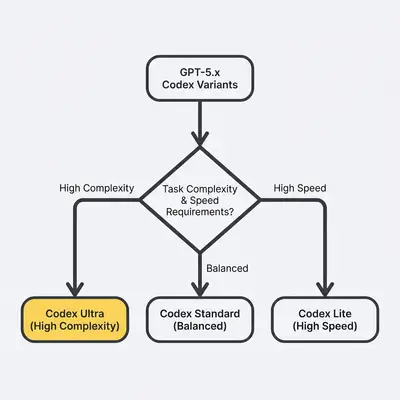
Use GPT-5.3-Codex When:
- Your workflow requires computer use—navigating browsers, interacting with desktop apps, or reading visual interfaces
- You are building an autonomous developer agent that handles open-ended tasks with minimal human oversight
- The task requires broad planning across many tools and steps, not just code generation
- You are willing to pay more for reliability and capability on complex workflows
Use GPT-5.3-Codex-Spark When:
- You need real-time responses—live coding assistants, immediate automation feedback
- You are running high-throughput, lower-complexity coding tasks where speed matters more than depth
- You are experimenting and want fast iteration cycles at lower cost
- Always validate in non-critical environments first while it is in research preview
Practical Fit for Business Automation
For businesses running workflows on platforms like n8n or Make.com, the Codex models are most useful in specific scenarios:
Automated code review in pull request pipelines. GPT-5.2-Codex can review code changes for quality, security, and style adherence as part of a CI/CD workflow, flagging issues before human review.
Documentation generation. Feeding code files into GPT-5.2-Codex to produce or update technical documentation at scale. Works well in a nightly automation job.
Agentic data pipelines. GPT-5.3-Codex's computer use capability can fill gaps in automation where APIs do not exist—navigating a legacy interface, extracting data from a visual dashboard, or interacting with a system that only has a GUI.
Real-time code assistance. GPT-5.3-Codex-Spark is the right fit if you are embedding live code suggestions into a product or internal tool and need responses that feel instant.
Most non-technical teams will access these capabilities through tools that wrap the OpenAI API, rather than calling it directly. The important thing is knowing when to route a workflow to Codex rather than a standard GPT-5 variant—the capability difference justifies the cost for the right tasks.
Cost Considerations
OpenAI has not published a flat cost comparison across the Codex models yet, but the general pattern holds across the GPT-5.x family: more capable models cost more per token. For automation use cases, this means:
- GPT-5.2-Codex is the value tier for agentic coding—strong enough for most defined workflows, cheaper than GPT-5.3.
- GPT-5.3-Codex is the premium tier—justified when computer use or broader task handling is genuinely needed.
- GPT-5.3-Codex-Spark may be the cheapest option for high-volume simple coding tasks once it exits research preview.
For a deeper look at managing AI costs at scale, see The Real Cost of AI Models at Scale: What Pricing Pages Don't Show and When Cheaper AI Models Become More Expensive in Production.
How the Codex Models Compare to Claude Sonnet 4.6
If you are evaluating OpenAI's Codex models alongside Anthropic's latest offering, the key differentiator is context size and task type. Claude Sonnet 4.6's 1M token context window is a major advantage for workflows involving very long documents, large codebases read as input, or sustained multi-turn reasoning over enormous contexts.
GPT-5.3-Codex, by contrast, wins when the task requires taking actions in the world—clicking, navigating, executing—rather than just reasoning over a large input. Both are excellent; the choice depends on whether your bottleneck is context size or autonomous action.
For a head-to-head on how ChatGPT and Claude handle automation prompts differently, see ChatGPT vs Claude for Automation: When Prompts Break.
Choosing a Model: A Simple Decision Framework
Pick the right model by answering three questions:
1. Does your workflow require computer use or autonomous system interaction?
- Yes → GPT-5.3-Codex
- No → Continue to question 2
2. Are your tasks well-defined, high-volume, or primarily large code changes?
- Yes → GPT-5.2-Codex
- No, tasks are complex and open-ended → GPT-5.3-Codex
3. Is real-time speed or throughput the primary requirement?
- Yes (and tasks are simple) → GPT-5.3-Codex-Spark (research preview)
- No → GPT-5.2-Codex or GPT-5.3-Codex based on complexity
This framework will cover most business automation scenarios. For an even broader model selection guide, see How to Choose the Best AI Model for Your Use Case.
Key Takeaways
- GPT-5.2-Codex is OpenAI's capable, cost-efficient agentic coding model—best for defined, high-volume developer automation
- GPT-5.3-Codex is the most powerful option, adding computer use and broad autonomous task handling
- GPT-5.3-Codex-Spark offers 1000+ tokens per second for real-time coding, currently in research preview
- All three models carry the August 2025 knowledge cutoff and are available through ChatGPT paid tiers and the OpenAI API
- Most businesses will access these through automation platforms that wrap the API—knowing when to route tasks to Codex is the key skill to develop