
A 10-person marketing agency processes 200 emails per day, summarizes weekly reports, and extracts client data from documents. They're evaluating Gemini Flash vs Pro, wondering if the premium model's "better reasoning" justifies paying 8x more per request.
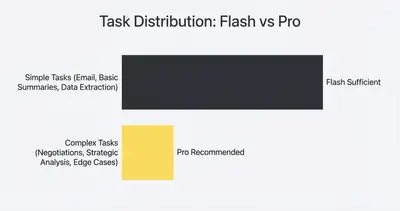
Here's what most teams miss: For 80% of daily business tasks, Gemini Flash delivers results that are indistinguishable from Pro—at a fraction of the cost. The remaining 20% of tasks benefit from Pro's deeper reasoning, but only when complexity actually matters to business outcomes.
The decision isn't about which model is "better." It's about matching the model to the task complexity and business impact.
Quick Win: Start with Gemini Flash for all daily tasks. Upgrade to Pro only when Flash gives you generic answers or when task complexity directly impacts revenue, client relationships, or strategic decisions.
This guide breaks down when Flash is good enough versus when Pro provides noticeable, business-relevant improvements. You'll get a decision framework, cost analysis, and real-world examples to choose the right model for each task. For detailed pricing breakdowns, see our complete Gemini 3 pricing guide.
Understanding Gemini Flash vs Pro
Before diving into task-specific decisions, it helps to understand what each model is designed for.
Gemini Flash: Speed and Efficiency
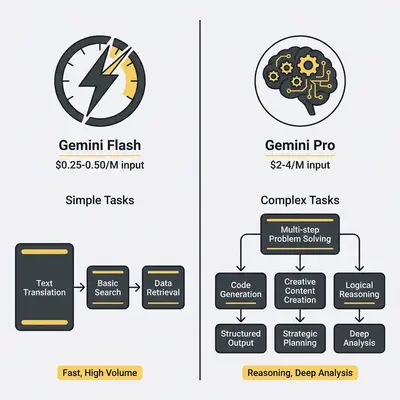
Gemini Flash is Google's lightweight, high-speed model optimized for simple tasks. Think of it as the "workhorse" model—fast, reliable, and cost-effective for high-volume operations.
Key characteristics:
- Speed: Responds in 1-2 seconds for most queries
- Cost: Approximately $0.25-0.50 per million input tokens, $1.50-3.00 per million output tokens
- Best for: High-volume simple tasks, basic text processing, straightforward automation
- Limitations: Less nuanced reasoning, may miss subtle context in complex scenarios
Flash is designed to handle the bulk of your daily AI interactions without breaking the bank. It's the default choice for most productivity tasks.
Gemini Pro: Advanced Reasoning
Gemini Pro is Google's premium model with deeper reasoning capabilities and superior performance on complex tasks. It's the "consultant" model—slower, more expensive, but better at nuanced analysis.
Key characteristics:
- Reasoning: Deeper analysis, better context understanding, superior nuance
- Cost: Approximately $2-4 per million input tokens, $12-18 per million output tokens
- Best for: Complex reasoning, strategic planning, nuanced analysis, critical business decisions
- Trade-offs: 8x higher input costs, 4-6x higher output costs, slightly slower response times
Pro excels when task complexity directly impacts business outcomes. It's worth the premium when accuracy and nuance matter more than speed or cost.
Everyday Tasks: When Flash Suffices vs When Pro Matters
The real question isn't which model is better—it's which model is right for each specific task. Here's how Flash and Pro compare on common daily business tasks.
Email Writing
Simple email drafting: Flash is usually sufficient.
A marketing manager needs to draft a follow-up email to a client. The task is straightforward: acknowledge receipt, confirm next steps, and maintain a professional tone.
Flash output: Clear, professional, grammatically correct. Gets the job done for standard business communications.
Pro output: Slightly more nuanced tone, better flow, but the difference is often marginal for simple emails.
When to use Pro: Complex negotiation emails, multi-stakeholder communications, sensitive client situations where tone and nuance directly impact outcomes. If an email could make or break a deal, Pro's deeper reasoning helps craft more strategic messaging.
Pro Tip: Use Flash for 90% of your email drafting. Reserve Pro for high-stakes communications where every word matters to business outcomes.
Summarization
Basic document summaries: Flash handles most cases well.
A team lead needs to summarize a 20-page project report into key takeaways for leadership.
Flash output: Captures main points, identifies key metrics, provides a clear overview. For straightforward documents, this is often sufficient.
Pro output: Better at identifying underlying themes, connecting ideas across sections, and highlighting nuanced implications. The difference becomes noticeable with complex technical documents or when subtle context matters.
When to use Pro: Long, complex documents with multiple themes. Legal or technical materials where nuance matters. Strategic planning documents where understanding implications is critical. If the summary informs major business decisions, Pro's deeper analysis is worth the cost.
Real-world example: A consulting firm uses Flash to summarize weekly status reports (sufficient). They switch to Pro for analyzing 50-page RFP responses where understanding subtle requirements could impact proposal quality and win rates.
Information Extraction
Structured data extraction: Flash excels at simple extraction tasks.
A sales team needs to extract names, email addresses, and company names from a list of business cards or contact forms.
Flash output: Accurately extracts structured data from clear, well-formatted sources. Handles standard formats reliably.
Pro output: Better at handling edge cases, ambiguous formats, and extracting information from unstructured or messy sources. The difference shows when data quality varies significantly.
When to use Pro: Unstructured or messy data sources. Complex extraction requirements with multiple edge cases. When extraction accuracy directly impacts revenue (e.g., lead qualification, invoice processing). If bad data costs money, Pro's superior edge case handling justifies the premium.
Real-world example: An e-commerce business uses Flash to extract product information from well-structured supplier catalogs (works perfectly). They use Pro to extract order details from handwritten customer notes or poorly formatted PDFs where Flash misses critical information.
Rewriting for Tone and Style
Simple tone adjustments: Flash handles basic rewriting well.
A content creator needs to rewrite a technical blog post for a general audience, adjusting tone from formal to conversational.
Flash output: Adjusts tone appropriately, simplifies language, maintains core meaning. Effective for straightforward tone shifts.
Pro output: Better at maintaining nuance while changing tone, preserving subtle meanings, and adapting style more naturally. The difference is noticeable when preserving specific implications matters.
When to use Pro: Complex documents where maintaining nuance during rewriting is critical. Brand voice adaptation where subtle messaging differences matter. Legal or compliance materials where precision is essential. If tone changes could alter meaning, Pro's superior nuance preservation is worth it.
Quick Analysis vs Deeper Reasoning
Basic analysis: Flash provides solid quick insights.
A business owner needs a quick analysis of monthly sales trends to identify top-performing products.
Flash output: Identifies trends, highlights key metrics, provides actionable insights. Sufficient for straightforward analysis.
Pro output: Deeper pattern recognition, identifies non-obvious correlations, provides more strategic insights. The difference shows when analysis informs major business decisions.
When to use Pro: Strategic planning where deeper insights impact long-term decisions. Complex data interpretation with multiple variables. When analysis informs high-stakes choices (pricing, product strategy, market positioning). If insights drive significant business changes, Pro's deeper reasoning is justified.
Decision Framework: Choosing Flash vs Pro
Use this decision framework to route tasks to the right model based on complexity and business impact.
Decision Tree
Start here: Is this a simple, high-volume task?
- Yes → Use Flash. Examples: Basic email replies, simple data extraction, straightforward summarization, routine text processing.
If no, ask: Does task complexity directly impact business outcomes?
-
No → Use Flash. Even if the task is moderately complex, if the outcome doesn't significantly impact revenue, client relationships, or strategic decisions, Flash is usually sufficient.
-
Yes → Use Pro. Examples: High-stakes negotiations, strategic planning, complex analysis informing major decisions, tasks where accuracy and nuance directly affect business results.
Task Complexity Matrix
| Task Type | Complexity | Business Impact | Recommended Model |
|---|---|---|---|
| Basic email drafting | Low | Low | Flash |
| Client follow-up emails | Low-Medium | Medium | Flash |
| Negotiation emails | High | High | Pro |
| Simple document summaries | Low | Low-Medium | Flash |
| Complex technical summaries | High | Medium-High | Pro |
| Structured data extraction | Low | Low-Medium | Flash |
| Unstructured data extraction | High | Medium-High | Pro |
| Basic tone rewriting | Low-Medium | Low | Flash |
| Nuanced brand voice adaptation | High | Medium-High | Pro |
| Quick trend analysis | Low-Medium | Low-Medium | Flash |
| Strategic business analysis | High | High | Pro |
Volume Considerations
High-volume tasks: Even if complexity is moderate, Flash often makes more sense at scale.
A customer service team processes 1,000 support tickets per day. Each ticket needs a quick summary and categorization. Flash handles this reliably at $0.50 per million tokens. Pro would cost $4 per million tokens—8x more expensive. At 1,000 tickets per day, that's $1,200+ per month in additional costs for marginal quality improvements.
Low-volume, high-impact tasks: Pro is justified even for occasional use.
A business owner needs to analyze quarterly financial data to make strategic decisions about product lines. This happens four times per year, but the insights directly impact $500,000+ in revenue decisions. Pro's deeper analysis is worth the premium for these critical, low-volume tasks.
Key Insight: Volume and impact work together. High-volume simple tasks favor Flash. Low-volume high-impact tasks favor Pro. High-volume high-impact tasks may require a hybrid approach—Flash for routine processing, Pro for critical analysis.
Cost Analysis: Understanding the Real Impact
The pricing difference between Flash and Pro isn't just academic—it directly impacts your monthly costs, especially at scale.
Pricing Comparison
Gemini Flash:
- Input tokens: $0.25-0.50 per million (batch processing: $0.25)
- Output tokens: $1.50-3.00 per million (batch processing: $1.50)
Gemini Pro:
- Input tokens: $2-4 per million (varies by context length)
- Output tokens: $12-18 per million
Cost multiplier: Pro costs approximately 8x more for input tokens and 4-6x more for output tokens compared to Flash.
Real-World Cost Scenarios
Scenario 1: Email automation (high volume, simple tasks)
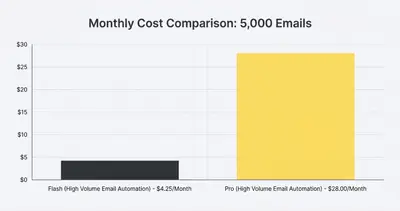
A 10-person agency automates email responses, processing 5,000 emails per month. Each email averages 500 input tokens and 200 output tokens.
Flash costs:
- Input: 5,000 × 500 = 2.5M tokens × $0.50 = $1.25/month
- Output: 5,000 × 200 = 1M tokens × $3.00 = $3.00/month
- Total: $4.25/month
Pro costs:
- Input: 2.5M tokens × $4.00 = $10.00/month
- Output: 1M tokens × $18.00 = $18.00/month
- Total: $28.00/month
Difference: $23.75/month ($285/year) for tasks where Flash provides sufficient quality.
Scenario 2: Strategic analysis (low volume, high impact)
A business owner analyzes quarterly reports four times per year. Each analysis uses 50,000 input tokens and 10,000 output tokens.
Flash costs:
- Input: 4 × 50,000 = 200K tokens × $0.50 = $0.10/year
- Output: 4 × 10,000 = 40K tokens × $3.00 = $0.12/year
- Total: $0.22/year
Pro costs:
- Input: 200K tokens × $4.00 = $0.80/year
- Output: 40K tokens × $18.00 = $0.72/year
- Total: $1.52/year
Difference: $1.30/year for tasks where Pro's deeper insights could impact $500,000+ in strategic decisions. Pro is clearly justified here.
ROI Considerations
When Flash ROI is higher:
- High-volume simple tasks where quality differences are marginal
- Cost-sensitive workflows where savings compound
- Tasks where speed matters more than nuance
- Routine processing where "good enough" is sufficient
When Pro ROI is higher:
- Low-volume tasks where quality directly impacts revenue
- Strategic decisions where deeper insights matter
- Complex tasks where Pro's accuracy prevents costly errors
- High-stakes communications where nuance affects outcomes
Reality Check: Most teams overestimate Pro's value for simple tasks and underestimate Flash's capabilities. Start with Flash for everything, then upgrade specific tasks to Pro only when Flash gives you insufficient results or when business impact justifies the premium.
Common Pitfalls: What to Avoid
Understanding when to use Flash vs Pro helps avoid three common mistakes that waste money and time.
Pitfall 1: Over-Estimating Pro Value for Simple Tasks
The mistake: Assuming Pro is always better, so using it for everything "just to be safe."
The reality: For simple tasks like basic email drafting or straightforward summarization, Flash and Pro often produce indistinguishable results. The quality difference doesn't justify the 8x cost premium.
Example: A team uses Pro for all email drafting, spending $200/month. Switching 90% of emails to Flash reduces costs to $40/month with no noticeable quality difference.
Solution: Start with Flash for all tasks. Only upgrade to Pro when Flash gives you generic answers or when task complexity actually matters to business outcomes.
Pitfall 2: Under-Estimating Costs at Scale
The mistake: Thinking "$2 vs $0.50 per million tokens" is negligible, then scaling to thousands of requests per day.
The reality: At scale, small per-request cost differences compound into significant monthly expenses. A 5x cost difference on 10,000 daily requests adds up quickly.
Example: A customer service automation processes 10,000 tickets per day. Using Pro instead of Flash costs an additional $600/month ($7,200/year) for tasks where Flash provides sufficient quality.
Solution: Calculate monthly costs at your actual volume before choosing a model. Use Flash for high-volume tasks unless Pro's quality improvements directly impact revenue or customer satisfaction.
Pitfall 3: Misinterpreting Benchmarks vs Real Outputs
The mistake: Assuming benchmark performance differences translate directly to noticeable quality improvements in real-world tasks.
The reality: Benchmarks measure performance on standardized tests. Real business tasks often don't require the same level of complexity. A 15% benchmark improvement might be unnoticeable for simple email drafting.
Example: Pro scores 20% higher on reasoning benchmarks, but for basic email replies, both Flash and Pro produce professional, grammatically correct responses. The benchmark difference doesn't matter for this use case.
Solution: Test both models on your actual tasks. If you can't tell the difference in blind comparisons, Flash is sufficient. Save Pro for tasks where quality differences are actually noticeable and impactful.
Example: A marketing agency tested Flash vs Pro on 50 client email drafts. In blind reviews, the team couldn't consistently identify which model wrote which email. They switched to Flash for all email drafting, saving $180/month with no quality complaints from clients.
Rules of Thumb: Quick Decision Guidelines
Use these quick rules to make Flash vs Pro decisions without overthinking every task.
Default to Flash
Use Flash unless:
- Task complexity directly impacts revenue or strategic decisions
- Flash gives you generic or insufficient answers
- Task requires deep reasoning that Flash can't handle
- Quality differences are noticeable and business-critical
Flash is your default for:
- 80% of daily productivity tasks
- High-volume simple operations
- Cost-sensitive workflows
- Routine text processing
Upgrade to Pro When
Use Pro when:
- Task complexity justifies the cost premium
- Quality differences are noticeable and impactful
- Business outcomes depend on accuracy and nuance
- Flash produces insufficient results
Pro is worth it for:
- Strategic planning and analysis
- High-stakes communications
- Complex reasoning tasks
- Tasks where errors are costly
Hybrid Approach
Best practice: Use both models strategically.
- Flash for: High-volume simple tasks, routine processing, cost-sensitive workflows
- Pro for: Complex reasoning, strategic analysis, high-impact decisions
- Result: Optimize both cost and quality by routing tasks to the right model
Most successful teams use Flash for 80-90% of tasks and Pro for the remaining 10-20% where complexity and business impact justify the premium.
Practical Examples: Three Ways the Choice Plays Out
Three worked scenarios showing how to choose between Flash and Pro based on task complexity and business impact.
Example 1: Email Automation for Customer Service
The setup: An e-commerce business handles a high monthly volume of customer service email and wants automated responses for common questions plus follow-up summaries.
Initial approach: Pro for all email processing.
Problem: Most of that volume is simple inquiries, such as shipping status, return policies, and product questions, where Pro's deeper reasoning changes nothing about the answer.
Solution: Flash for the routine bulk, and Pro reserved for the small share that needs nuance: complaint escalations and complex product questions.
Takeaway: High-volume simple tasks do not need Pro. On this shape of workload the cheaper model handles routine processing at a fraction of the cost, and Flash's lower latency is a bonus on a channel where response time is visible to the customer.
Example 2: Strategic Document Analysis
The setup: A consulting firm analyzes long RFP responses. Catching subtle requirements directly affects proposal quality.
Initial approach: Flash for all document analysis, to save cost.
Problem: Flash misses nuanced requirements and implications that Pro catches, which produces incomplete proposals.
Solution: Pro for RFP analysis. The deeper reasoning is what surfaces non-obvious requirements and strategic implications.
Takeaway: This is the inverse of the email case. Volume is low, so the cost difference is small in absolute terms, and the value of each individual answer is high. That combination is what justifies the premium model.
Example 3: Hybrid Approach for a Content Team
The setup: A content agency needs AI for several different tasks: blog post drafting, client email, data extraction from research, and strategic content planning.
Initial approach: Pro for everything.
Problem: Most of those tasks do not benefit from Pro's reasoning. Only the strategic planning work is noticeably better.
Solution: A hybrid split:
- Flash for: the bulk of blog post drafting, basic client emails, research data extraction
- Pro for: strategic content planning, complex client communications, nuanced brand voice adaptation
Takeaway: Most teams end up here. Route each task to the model that matches its complexity, since paying premium rates for routine drafting is where the budget quietly goes.
Conclusion: Making the Right Choice
Choosing between Gemini Flash and Pro isn't about finding the "better" model. It's about matching the model to your specific tasks, volumes, and business needs.
Key takeaways:
-
Start with Flash for everything. It handles 80% of daily business tasks reliably at a fraction of Pro's cost. Most teams overestimate Pro's value for simple tasks.
-
Upgrade to Pro only when it matters. Use Pro when task complexity directly impacts business outcomes, when Flash gives insufficient results, or when quality differences are noticeable and business-critical.
-
Use a hybrid approach at scale. Most successful teams use Flash for high-volume simple tasks and Pro for low-volume high-impact tasks. This optimizes both cost and quality.
The goal isn't to minimize costs or maximize quality in isolation. It's to optimize the balance based on your specific use cases, volumes, and business priorities.
For most small businesses, Flash is the right default choice. Pro becomes worth it when deeper reasoning directly impacts revenue, client relationships, or strategic decisions. Test both models on your actual tasks, measure the real quality differences, and make data-driven decisions based on business impact—not abstract benchmarks.
Ready to optimize your AI model selection for your specific workflows? Book a demo with Evalics to discuss how Flash and Pro can work together in your automation strategy.
Related Resources
- Gemini 3 Pricing Explained: What You Pay and What Actually Scales - Detailed pricing breakdown and cost optimization strategies
- How to Choose the Best AI Model for Your Use Case - Broader framework for selecting AI models across different providers
- Gemini 3 Thinking vs Pro: Key Workspace Differences - Understanding different Gemini modes in Google Workspace
Official Sources
- Google AI Studio Pricing - Official Gemini API pricing and documentation
- Gemini API Documentation - Technical specifications and capabilities
- Google AI Blog: Gemini 3 Flash - Official announcement and feature details
By Kevin Michael Schindler, AI Automation Expert at Evalics