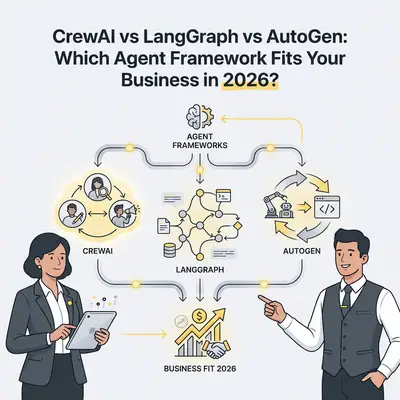
Choosing between LangGraph vs CrewAI vs AutoGen in 2026 is no longer just a preference; it is a strategic architectural decision that dictates your system's long-term stability and maintenance overhead. The 'best' framework depends entirely on your specific requirements for state persistence and error recovery. LangGraph’s graph-based state management makes control flow and failure points explicit, which is what matters in complex, cyclic workflows where you need to find exactly where a run broke. While CrewAI remains the fastest path to deploying role-based, multi-agent prototypes, AutoGen continues to lead in autonomous code-execution loops where high-frequency tool calling is required. The industry has shifted toward modularity; choosing the wrong framework now risks significant technical debt due to the breaking API changes introduced in recent updates. This guide breaks down these frameworks to help you align your infrastructure with your specific scalability requirements, ensuring your agents remain stable as your business grows.
What Is the Current State of AI Agent Frameworks in 2026?
The agent framework market matured considerably between 2024 and 2026. The "just pick one and build" advice from 2024 has given way to clearer tradeoffs as production deployments revealed where each framework struggles.
CrewAI raised $18M in funding and reports that 70% of new AI-native business workflows by January 2026 use its framework. These numbers reflect genuine adoption, but also a particular kind of task: well-defined, role-based pipelines where agents collaborate like a team.
LangGraph is in production at LinkedIn, Uber, and over 400 companies. LangChain itself is pivoting to focus primarily on RAG (retrieval-augmented generation), with agent developers increasingly migrating to LangGraph for its graph-based control flow model.
AutoGen is part of Microsoft's unified agent framework (merged with Semantic Kernel), targeting general availability in Q1 2026. It comes with production SLAs, multi-language support, and deep Azure integration. Best for teams already in the Microsoft ecosystem.
For background on what AI agents actually are and what realistic expectations look like, see What Are AI Agents? A Practical Explanation for Businesses and AI Agents in 2025: What's Real, What's Hype.
How Does CrewAI Facilitate Rapid Role-Based Agent Prototyping?
Design Philosophy
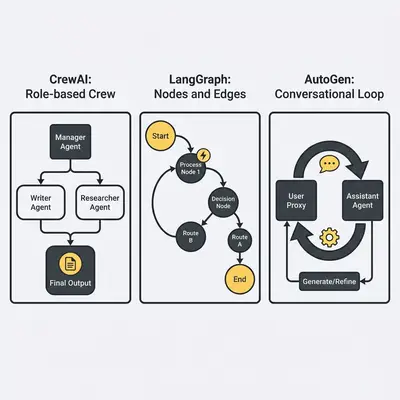
CrewAI models multi-agent systems as a "crew"—a team of agents, each with a defined role, goal, and set of tools. You assign a Research Agent, a Writing Agent, a Review Agent, and they collaborate to produce an output. The mental model is intuitive for anyone who has worked with human teams.
Strengths
Rapid prototyping. CrewAI's abstraction makes it possible to go from idea to working multi-agent pipeline quickly. The role-based model is easy to explain to non-technical stakeholders and maps naturally to existing business processes.
Structured, pipeline-style workflows. The framework handles pipeline-style tasks well: research → analyze → write → review. If your workflow has a defined sequence with clear handoffs, CrewAI excels.
Large community. With the most visible marketing and adoption numbers in the space, CrewAI has extensive tutorials, community resources, and third-party integrations.
Weaknesses
Limited observability. When a CrewAI workflow fails, debugging can be opaque. The framework is less transparent about what each agent is doing at each step compared to LangGraph's explicit control flow.
Less flexibility for non-linear workflows. Tasks that require dynamic branching, loops, or complex conditional logic are harder to express cleanly in CrewAI's role-based model.
Production surprises. Fast prototyping sometimes reveals gaps when moving to production—error handling, retry logic, and state management require more attention than the framework provides by default.
Best Fit
Use CrewAI when:
- You want a working multi-agent prototype quickly
- Your workflow maps naturally to a team of specialized agents with clear handoffs
- You are building an enterprise use case where a role-based agent structure maps cleanly onto the process
- Prototyping speed matters more than production observability at this stage
Why Is LangGraph the Preferred Choice for Observable Production-Grade Workflows?
Design Philosophy
LangGraph represents workflows as a directed graph—nodes are agent actions or processing steps, edges are the control flow between them. This is a lower-level abstraction than CrewAI, but one that gives you explicit control over every decision and state transition.
Strengths
Observability and debuggability. Because workflows are explicit graphs, you can trace exactly what path a workflow took, inspect state at any node, and identify where failures occur. This is the primary reason production teams choose LangGraph.
Cycles and conditional logic. Graphs support loops, branches, and dynamic routing—patterns that are difficult or impossible in sequential frameworks. Workflows that need to retry, re-evaluate, or take different paths based on intermediate results fit naturally.
Human-in-the-loop. LangGraph was designed with human review checkpoints in mind. You can pause a workflow at any node, surface information to a human, accept their input, and continue. This is valuable for automation workflows where certain decisions require human approval.
Production track record. Deployments at LinkedIn, Uber, and 400+ companies across a wide variety of use cases provide evidence that the framework handles production scale and complexity.
Weaknesses
Steeper learning curve. Graph-based thinking requires more upfront design work. You need to model your workflow explicitly rather than just defining roles and letting the framework figure out coordination.
More boilerplate. Building a LangGraph workflow involves defining nodes, edges, state schemas, and conditional routing functions. The payoff is control; the cost is more code.
LangChain dependency. LangGraph builds on LangChain concepts and conventions. If your team has mixed feelings about LangChain's abstraction choices, that baggage carries over.
Best Fit
Use LangGraph when:
- You need reliable, observable workflows in production
- Your workflow has complex control flow—branches, loops, retries, or conditional routing
- Human-in-the-loop checkpoints are part of your design
- Your team values debuggability over development speed
- You are joining companies like LinkedIn and Uber in betting on graph-based agent orchestration
For integrating LangGraph-style observability into your automation platform, see n8n Workflow Design Patterns: Error Handling and Production Setup.
How Do AutoGen and Semantic Kernel Power Complex Conversational Agent Loops?
Design Philosophy
AutoGen is built around multi-agent conversation—agents communicate with each other in a structured dialogue to solve tasks. Unlike the graph model or crew model, the primary coordination mechanism is messages between agents, often including code-execution loops where agents write and run code to complete tasks.
The 2026 Update: Unified with Semantic Kernel
Microsoft merged AutoGen with Semantic Kernel into a unified agent framework, targeting general availability in Q1 2026. This merger brings:
- Multi-language support: Python, C#, and Java—important for enterprise teams not working in Python
- Production SLAs: Commercial support and availability guarantees from Microsoft
- Azure integration: Deep connections to Azure OpenAI, Azure AI Studio, and the broader Azure ecosystem
- Semantic Kernel's plugin model: A structured way to give agents access to external tools and APIs
Strengths
Conversational coordination. For tasks where agents need to reason together, share partial results, and iteratively improve, AutoGen's conversation model is natural and effective.
Code-execution loops. AutoGen's original strength was agents that write code, execute it, observe the result, and iterate. For workflows that involve automated coding and testing cycles, this model is particularly powerful.
Microsoft ecosystem integration. If your organization is on Azure, uses Microsoft 365, or has .NET/C# development capacity, the unified framework's Azure and multi-language support is a significant advantage.
Weaknesses
Less suited for deterministic pipelines. Conversational coordination is powerful for open-ended reasoning but can be unpredictable for workflows that need deterministic, reproducible results.
Framework transition risk. The merger with Semantic Kernel is recent. APIs changed significantly; code from AutoGen tutorials before 2025 may not work with the unified framework. Validate production code against current documentation.
Python-first community knowledge. Despite the new multi-language support, most community resources and examples are Python-based. C# and Java support, while available, has less community depth.
Best Fit
Use AutoGen / Microsoft's unified framework when:
- Your workflows involve conversational multi-agent reasoning or code-execution loops
- You are in the Microsoft Azure ecosystem and want native integration
- Your development team includes C#, Java, or .NET developers who cannot or will not work in Python exclusively
- You need commercial support and production SLAs from a major vendor
Which AI Agent Framework Is Best for Your Business: A Comparative Analysis?
| Dimension | CrewAI | LangGraph | AutoGen + SK |
|---|---|---|---|
| Mental model | Role-based crew | Directed graph | Conversational loop |
| Speed to prototype | Fast | Moderate | Moderate |
| Production observability | Limited | Strong | Moderate |
| Complex control flow | Difficult | Native | Moderate |
| Human-in-the-loop | Limited | Native | Moderate |
| Code-execution loops | Possible | Possible | Native |
| Language support | Python | Python | Python, C#, Java |
| Vendor backing | CrewAI (startup) | LangChain (startup) | Microsoft |
| Best for | Role-based pipelines | Production systems | Microsoft ecosystem |
How Can Small Businesses Leverage AI Agent Frameworks for Automation?
For most small businesses, none of these frameworks are the right starting point. They all require developers, Python knowledge, and infrastructure to run. The multi-agent patterns they enable are increasingly being delivered through no-code tools:
- n8n has AI Agent nodes and supports multi-agent workflows with a visual canvas. For agentic automation without framework-level coding, Agentic AI in n8n: How to Build Multi-Agent Workflows for Complex Tasks is the right starting point.
- Google Workspace Studio offers natural-language agent creation inside Workspace apps, now with deeper Gemini integration.
- Make.com offers AI modules that can chain agent-style actions across apps.
If you do have a developer on your team and are evaluating frameworks for a custom build, the decision framework is:
- If you need a prototype fast and tasks are role-based: CrewAI
- If production reliability and observability are non-negotiable: LangGraph
- If you are in the Microsoft stack or need multi-language support: AutoGen + Semantic Kernel
For a broader look at what automation tools are available before investing in framework development, see Building vs Buying: When to Build Custom vs Buy an Automation Solution.
What Are the Key Takeaways for Choosing an AI Agent Framework?
- CrewAI is the fastest framework to prototype with, best for role-based, pipeline-style multi-agent systems; widely adopted at enterprise scale
- LangGraph is the production-reliability choice, offering graph-based control flow, observability, human-in-the-loop, and proven deployments at companies like LinkedIn and Uber
- AutoGen merged with Semantic Kernel in early 2026 into Microsoft's unified agent framework; best for conversational loops, code-execution, and Azure-native environments
- All three require developer skills; small businesses without technical resources are better served by n8n, Google Workspace Studio, or Make.com
- Framework APIs changed significantly between 2024 and 2026—validate all third-party tutorials against current documentation before building on them